
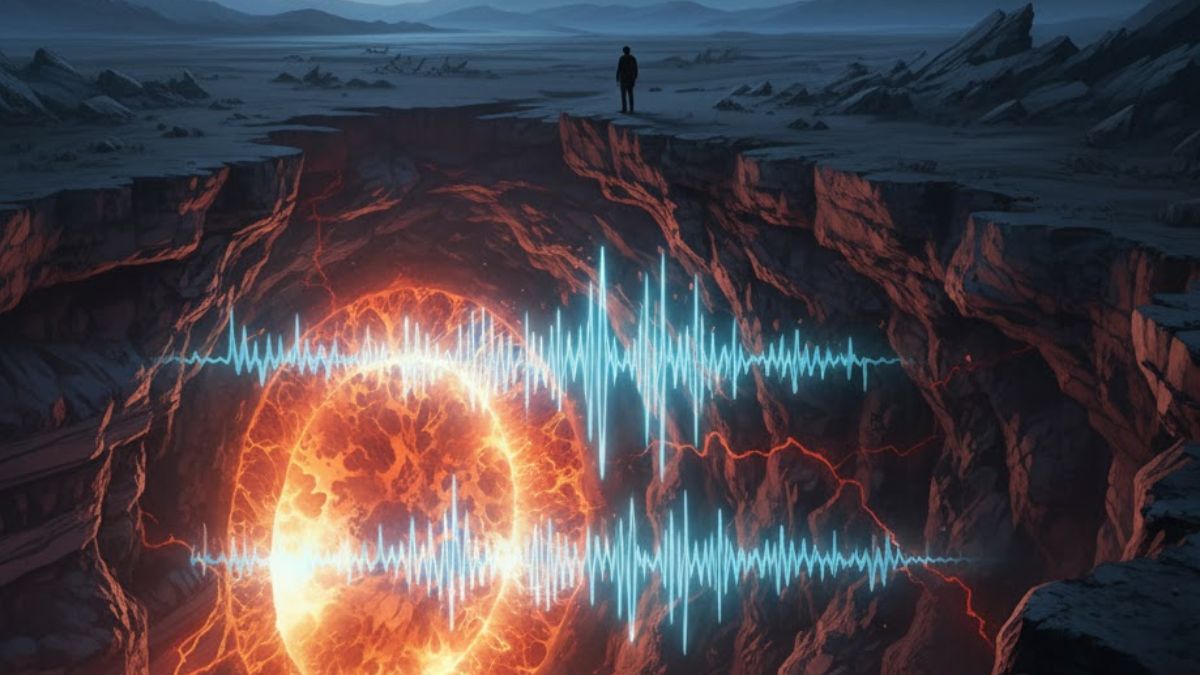
It’s a quiet evening. You’re sitting outside, and the world is settling into its nightly hush. Then, you hear it. Not a car, not a plane, not a voice. It’s a low, deep sound, a rumble or a hum that seems to come from nowhere and everywhere at once. It vibrates through the ground and the air, and just as you strain your ears to locate it, it fades away, leaving only questions. You’ve just experienced one of Earth’s strangest mysteries—a sound from the deep with no clear source.
These unexplained noises aren’t rare. From the remote wilderness to the suburbs, people all over the world have reported hearing deep, rumbling booms, eerie hums, and long, drawn-out creaks that defy logic. Scientists have set up sensitive microphones and seismographs, trying to catch the culprit, but often, the sounds leave no trace. They are acoustic ghosts, echoing from the depths of our planet without a calling card.
What could possibly be making these noises deep within the Earth? Are they the planet’s natural sounds, the groans of a living, shifting world? Or could they be something even more puzzling? If you’ve ever been stopped in your tracks by a sound you couldn’t identify, you’re about to dive into a mystery that has baffled experts for decades.
What are these mysterious “Earth Sounds” people keep hearing?
When people talk about mysterious sounds from the Earth, they aren’t describing the everyday noise of a thunderstorm or a passing truck. These are distinct, often unsettling sounds that feel profoundly different. They are frequently described as a deep, diesel engine-like hum, a distant cannon boom, or a low-frequency groan that makes windows rattle. The key is that they are persistent, unexplained, and heard by multiple people in an area.
One of the most famous examples is the “Bristol Hum.” For decades, residents of Bristol, England, have reported a constant, low-pitched droning sound that is inaudible to some but drives others to distraction, especially at night. Similar “hums” have been reported in places like Taos, New Mexico, and Windsor, Ontario. Then there are the “Skyquakes” or “Misty Guns”—loud, explosion-like booms that shake houses, often heard along coastal areas like the Ganges Delta in India or the shores of Lake Seneca in New York. They sound like distant thunder, but the sky is perfectly clear.
These sounds share a common thread: they are elusive. They appear without warning, are heard by a select few (or many), and then vanish before any official investigation can pinpoint their origin. This elusiveness is what fuels the mystery and pushes us to ask what grand, natural processes could be responsible for such phenomena.
Is the Earth itself groaning and creaking like an old house?
Think of an old wooden house on a cold night. It creaks and groans as the temperature changes and the wood contracts. Our planet does something very similar, but on a scale that is almost impossible to imagine. The Earth is not a silent, solid ball; it’s a dynamic, ever-changing system. Its constant movements might just be the source of some of these eerie sounds.
The Earth’s crust is made up of gigantic plates that are always slowly moving. They grind against each other, they pull apart, and they collide. This movement creates immense pressure and friction. Sometimes, this pressure is released in small tremors or as deep, grinding noises that travel through the rock. These aren’t full-blown earthquakes that show up on news alerts, but smaller, deeper shifts. It’s the sound of geological stress finding a release. Furthermore, vast caves and tunnels can collapse under the surface, creating booming echoes that travel upward. The planet is constantly settling, and these deep groans could be the sound of that monumental process.
Could ocean waves or storms really cause deep booms?
It might seem strange that something happening on the surface of the ocean could create a sound that seems to come from deep within the ground, but the ocean is a powerful force. Giant waves, especially during storms, generate enormous energy. When a massive wave crashes against a cliff or the continental shelf, the impact sends powerful vibrations through the earth itself. These vibrations can travel for hundreds of miles as a low-frequency rumble.
Similarly, scientists have discovered that large ocean waves can create a constant, subtle pressure on the seafloor. This pressure can cause the ground to vibrate at a very low frequency, creating a perpetual hum. This is a natural, global phenomenon, but in certain coastal areas, the conditions might be just right for this hum to become audible to the human ear, manifesting as the mysterious drone so many people report. So, the next time you hear a deep rumble near the coast, it might not be a truck or construction—it could be the awesome power of the entire ocean echoing beneath your feet.
What is the secret world of Tectonic Plates and deep rumbles?
To understand the deepest sounds, we need to journey down to the birthplace of the Earth’s greatest noises: the tectonic plates. These massive slabs of rock, some as large as continents, float on the molten layer of the Earth’s mantle. Their movement is the engine behind most of our planet’s geology. The boundaries where these plates meet are hotspots for mysterious sounds.
When two plates slide past one another, like the Pacific Plate and the North American Plate along California’s San Andreas Fault, they don’t always move smoothly. They get stuck. As the pressure builds over days or years, the rocks strain until they finally slip. This sudden release of energy is an earthquake. But before the main shock, and during the countless tiny aftershocks, the grinding rock produces deep, low-frequency rumbles and creaks. Our ears might not hear the smallest of these shifts, but sensitive instruments can. Some of the louder, more noticeable booms could be the sound of a particularly large section of rock fracturing deep underground, too far down to cause a damaging quake at the surface but close enough for its acoustic shockwave to be heard.
Are we hearing the sound of melting ice or shifting glaciers?
Far from the tropics, in the icy realms of the poles and high mountains, another source of deep-earth sounds is at work. Glaciers are colossal rivers of ice, and they are anything but silent. As a glacier moves, it grinds over the bedrock beneath it, creating a continuous, deep rumble. But the most dramatic sounds come when ice breaks.
The process of “icequakes” is a leading candidate for many unexplained booms in cold climates. When a massive sheet of ice cracks or a large chunk of a glacier calves off into the ocean, it releases a tremendous amount of energy. This event, known as a cryoseism, generates a sonic boom that can travel through the air and the ground. People living near icy regions often report loud, explosion-like sounds on cold, quiet days—the sound of the frozen world fracturing and reshaping itself. As the planet’s climate changes and ice becomes more unstable, these events may be becoming more frequent.
Is human activity causing these strange underground noises?
While nature is a prolific noisemaker, we cannot ignore the sounds created by our own species. Our industrial world is a constant source of vibration. Some of the mysterious hums people report have been traced back to very ordinary, human-made sources.
A factory running machinery overnight, a mining operation using explosives, or even a distant highway with heavy truck traffic can generate a low-frequency hum that travels surprisingly far. Sound behaves differently at low frequencies; it can travel long distances with little loss of energy and bend around obstacles. A hum heard in a quiet suburb could be originating from an industrial park miles away. Furthermore, activities like fracking for natural gas or drilling for oil involve pumping fluid at high pressure into deep rock layers, which can cause small tremors and deep rumbling sounds. So, sometimes, the mystery isn’t a natural wonder but the far-reaching echo of our own industrial heartbeat.
Why can’t scientists find the source of every strange sound?
With all our advanced technology, it seems like we should be able to solve this mystery. We have satellites, global networks of seismographs, and highly sensitive microphones. So why do so many sounds remain unexplained? The challenge lies in the nature of sound itself and the vastness of our planet.
Sound waves can be reflected, refracted, and absorbed by different layers of rock, water, and air. A sound heard in one town might have originated dozens of miles away, making it incredibly difficult to triangulate its source. Many of these sounds are also transient—they last for only a few seconds and don’t happen again in the same spot. By the time scientists can deploy their equipment, the sound is gone. The Earth’s background noise, from wind and waves to human activity, also creates a constant cacophony that can mask these mysterious sounds. Finding a single, unexplained rumble in all that noise is like trying to find a specific pebble on an entire beach.
Could there be a simple explanation we haven’t thought of yet?
For every mystery, there is a desire for a simple answer. Some researchers propose that what we are hearing is not one single thing, but a “cocktail” of different sounds, all blending together. A distant storm over the ocean, combined with a minor tectonic shift, amplified by a specific atmospheric condition, could create a unique and startling boom that would be impossible to trace back to its individual components.
The atmosphere itself can act as a giant amplifier. Under certain temperature conditions, a layer of warm air can trap sound waves and bounce them back down to the ground, allowing them to travel much farther than normal. A sound that would typically fade away after a few miles could, on the right day, be heard hundreds of miles from its source. This means a sonic boom from a military jet far out over the ocean could be heard inland as a mysterious, ground-shaking blast with no visible cause. The explanation may be simple, but the path the sound took to get to our ears is wonderfully complex.
Conclusion
The deep, unexplained sounds of our planet remind us that Earth is still a place of wonder and mystery. From the slow, grinding groan of tectonic plates to the explosive crack of a calving glacier, our world is far from silent. While science has explained many of these noises, a few stubborn cases remain, tickling our curiosity and reminding us that there is still much to learn about the ground beneath our feet.
These mysterious rumbles and hums connect us to the dynamic life of our planet. They are a reminder that the Earth is alive, constantly moving, shifting, and settling. So the next time you hear a deep boom with no source or a low hum in the dead of night, instead of feeling unsettled, you might smile. You are hearing the heartbeat of our active, talking, and wonderfully mysterious world.
What do you think that sound was the last time you heard something you couldn’t explain?
FAQs – People Also Ask
1. What is the most famous unexplained earth sound?
The most famous is likely the “Bristol Hum,” a persistent low-frequency droning noise reported by residents in various parts of the world. Despite numerous investigations, a single definitive source for the widespread phenomenon has never been found.
2. Can animals hear these deep earth sounds before humans?
Yes, many animals can hear a wider range of frequencies than humans. It’s possible that some deep earth rumbles are inaudible to us but are detected by animals, which might explain unusual animal behavior before events like earthquakes.
3. Are these mysterious booms a sign of a coming earthquake?
While small rumbles can be related to minor tectonic activity, most unexplained booms are not reliable predictors of major earthquakes. Scientists use much more precise instruments to monitor for genuine seismic hazards.
4. Why do only some people hear the “The Hum”?
The ability to hear low-frequency hums varies from person to person. Factors like age (as hearing changes), the specific sensitivity of an individual’s hearing, and background noise levels can all affect who hears it and who doesn’t.
5. Has a mysterious earth sound ever been recorded?
Yes, scientists have recorded many. One famous example is the “Bloop,” an ultra-low-frequency sound detected in the Pacific Ocean in 1997, which was eventually attributed to a giant icequake. Many other sounds remain unidentified.
6. Could it be aliens or secret military technology?
While it’s a popular idea in fiction, there is no evidence linking unexplained earth sounds to extraterrestrials. Some sounds have been traced to secret military exercises or aircraft, but these are usually confirmed by authorities eventually.
7. Do these sounds happen more in certain parts of the world?
Yes, they are often reported more frequently in specific locations like coastal areas, near fault lines, or in regions with specific atmospheric conditions, which act as natural amplifiers for sound.
8. What should I do if I hear a loud, unexplained boom?
First, don’t panic. Check local news and social media to see if others heard it too. It was likely a natural event or something like a sonic boom. You can report it to local authorities, but it is rarely a cause for concern.
9. How deep within the Earth do these sounds originate?
The origins can vary greatly. Some may come from just a few miles down, like a collapsing cavern, while others, related to tectonic activity, can originate dozens or even hundreds of miles below the surface.
10. Are these sounds a new phenomenon, or have they always happened?
People have reported mysterious sounds for centuries. What’s new is our ability to record and discuss them globally. In the past, they might have been explained as thunder gods or folklore; today, we use science to try and understand them.
