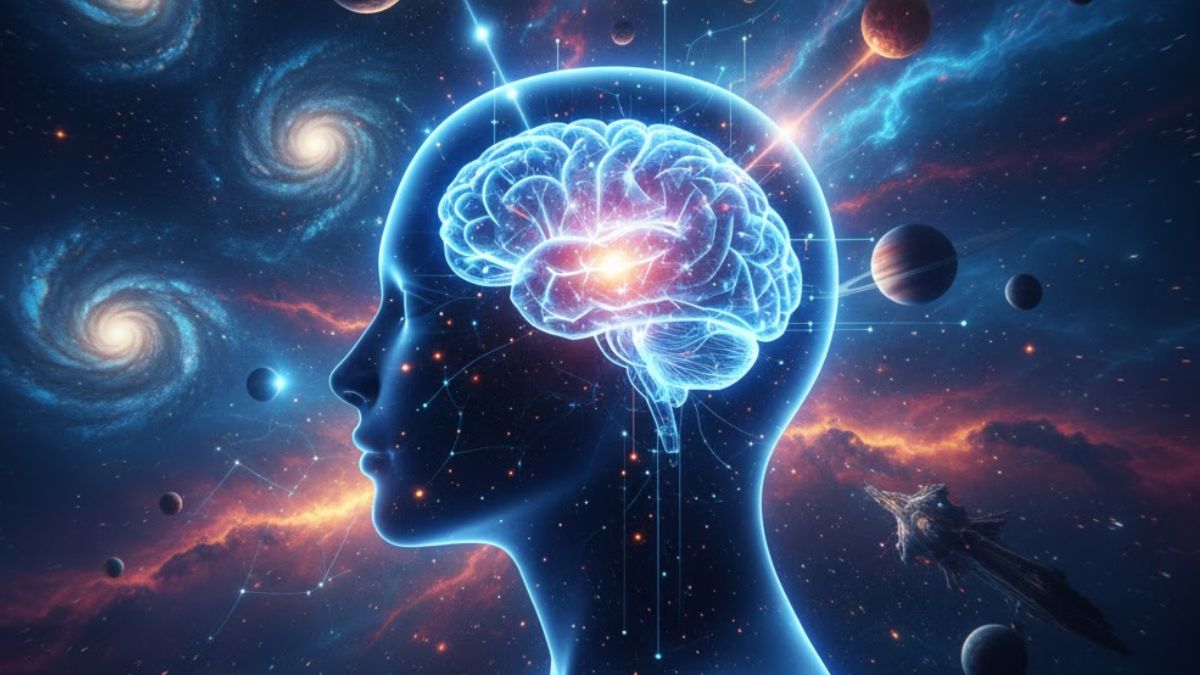
There’s a conversation happening inside your head right now. No, not the one you’re using to read these words. This is a different kind of conversation, one made of whispers. It’s the quiet feeling that tells you not to take a certain street home, the sudden idea for a solution to a problem while you’re in the shower, or the effortless way you remember the lyrics to a song you haven’t heard in years. This silent, background hum is the sound of your subconscious brain at work.
Think of your mind as a vast ocean. The part you’re aware of—your conscious mind—is just the surface, the sunlight dancing on the waves. It’s where you make decisions, have thoughts, and focus your attention. But beneath that surface lies something immense, dark, and powerful: the subconscious. This is the deep sea of your mind, holding everything from your childhood memories to the skills you’ve mastered so well you don’t even have to think about them. It’s the hidden engine running your life, and most of the time, you don’t even know it’s there.
So, what is really going on down in the depths? How does this hidden part of you shape your everyday life, your habits, and even your dreams? What if you could learn to listen to its whispers and unlock a more powerful, creative, and intuitive version of yourself?
What is the subconscious brain, really?
If you’ve ever driven a familiar route and arrived at your destination without a clear memory of the turns you took or the stops you made, you’ve experienced your subconscious in the driver’s seat. It’s the part of your brain that handles all the automatic tasks, freeing up your conscious mind to think about your weekend plans or what to make for dinner. But it does so much more than just autopilot your commute.
The subconscious brain is like a massive, super-efficient computer server running in the background of your life. It stores every single experience you’ve ever had, every face you’ve seen, and every feeling you’ve felt. It manages your bodily functions, like your heartbeat and digestion, without you ever having to give it a thought. More importantly, it’s the source of your gut feelings, your intuition, and your deepest beliefs about the world. While your conscious mind is logical and slow, your subconscious is intuitive, emotional, and incredibly fast. It’s the silent partner in everything you do, working 24/7 to keep you safe and help you navigate the world.
How does your subconscious control your habits?
Look at your daily routine. The way you brush your teeth, the first thing you do when you get your phone, even the path you walk through your own home—these are all habits. And almost all of them are managed by your subconscious brain. It loves patterns because they save energy. When you repeat an action over and over, your subconscious brain says, “I’ve got this,” and files it away as an automatic program.
This is why breaking a bad habit can feel so difficult. You might consciously decide to stop eating junk food, but when you’re tired or stressed, your subconscious automatically reaches for that bag of chips because that’s the well-worn program it has on file. It’s not trying to sabotage you; it’s just efficiently running a routine it knows. The good news is you can rewrite these programs. By consciously repeating a new, positive behavior, you can send a new instruction to your subconscious. At first, it takes effort, but soon, the new habit becomes just as automatic as the old one. Your subconscious is a creature of routine, and you are its programmer.
Can your subconscious mind make you more creative?
Have you ever struggled for hours to solve a tricky problem, only to have the perfect answer pop into your head the moment you stopped thinking about it? This famous “aha!” moment is a gift from your subconscious. While your conscious mind was taking a break, your subconscious was still hard at work, connecting dots you didn’t even know were there.
Your subconscious mind is a master of connection. It takes all the information, memories, and ideas you’ve ever encountered and constantly sifts through them, looking for patterns and new combinations. This is the heart of creativity. When you’re relaxed—in the shower, walking in nature, or just about to fall asleep—you quiet your conscious mind. This allows the subconscious to send its brilliant connections up to the surface as sudden insights or inspirations. So, the next time you’re stuck, instead of forcing it, try stepping away. Trust that the powerful artist within your subconscious is still on the job, painting a solution in the quiet of your mind.
Why do we dream, and what do our dreams mean?
Dreams are like a secret nightly broadcast from your subconscious. While you sleep, your conscious mind is offline, and your subconscious takes the stage. It processes the emotions and events of the day, files away memories, and works through unresolved thoughts and feelings. Sometimes, it does this by creating wild, confusing, or even frightening stories.
While scientists are still unraveling all the mysteries of dreams, many believe they are a form of overnight therapy. Your subconscious is helping you make sense of your life, practicing for potential threats, or working through hidden fears and desires. That’s why a dream might feature a strange mix of people and places from different parts of your life. Your subconscious is using these symbols to tell a story about how you feel. So, while a dream about showing up to school unprepared might not be about school at all, it could be your mind’s way of processing a feeling of being not ready for a challenge in your waking life.
How can you talk to your own subconscious?
You might think the communication is one-way, but you can absolutely send messages to your subconscious. The key is understanding that it doesn’t communicate with words and logic the way your conscious mind does. It speaks the language of emotion, imagination, and repetition.
One of the most powerful ways to talk to your subconscious is through visualization. When you close your eyes and vividly imagine achieving a goal—feeling the emotions, seeing the sights, hearing the sounds—your subconscious brain often can’t tell the difference between the vivid imagination and a real event. This is why athletes mentally rehearse their races. They are programming their subconscious for success. Another way is through affirmations. By repeating a positive statement with strong emotion and belief, you can slowly convince your subconscious to adopt a new, empowering belief about yourself. It’s like gently training the most powerful part of your mind to be on your team.
What is the link between your subconscious and your fears?
Many of our deepest fears don’t live in our conscious thoughts; they are buried in the subconscious. This is your brain’s ancient survival mechanism. Its main job is to keep you safe, so it’s always on the lookout for danger. Sometimes, based on a past negative experience, it learns a fear that isn’t rational. For example, if you had a scary experience with a dog as a child, your subconscious might tag all dogs as “dangerous,” making you feel afraid even around a friendly puppy.
Your conscious mind knows the puppy is safe, but your subconscious, trying to protect you, screams “Danger!” This is the root of many phobias and anxieties. The fear feels very real because it’s coming from a deep, automatic part of you. To overcome these fears, you need to gently reassure your subconscious that you are safe. This can be done through slow, positive exposure and by using the techniques we discussed, like visualization, to show your subconscious a new, safe story.
Can we unlock hidden talents in our subconscious?
You have a vast library of untapped knowledge and ability stored in your subconscious. Think about a skill you used to be good at, like playing an instrument or speaking a language. Even if you haven’t done it in years, your subconscious has kept the files. This is why you can often pick it up again much faster than someone starting from scratch.
But it goes further than old skills. Your subconscious is also a reservoir of potential. That little voice that says, “I wish I could paint,” or “I think I’d be good at that,” is often your subconscious pointing you toward a latent talent. By taking a small step—buying a sketchbook, taking a beginner’s class—you are telling your subconscious you’re listening. As you practice, you are not just learning with your conscious mind; you are downloading a new skill set into your subconscious, where it can become a seamless and natural part of you. The hidden artist, musician, or writer might already be inside you, waiting for the invitation to come out and play.
The subconscious brain isn’t a mysterious ghost in the machine; it’s the foundation of who we are. It’s the storage of our past, the engine of our present, and the map for our future. By understanding that this powerful force is not something to be feared but to be understood, we open the door to a more intuitive, creative, and balanced life.
The real journey isn’t to the stars or the depths of the ocean, but inward, into the vast universe within our own minds. What do you think your subconscious is trying to tell you today?
FAQs – People Also Ask
1. How powerful is the subconscious mind?
The subconscious mind is incredibly powerful. It controls most of our bodily functions, stores all our memories, and influences our habits, beliefs, and emotions. It’s estimated to be responsible for about 95% of our brain activity, making it the primary driver behind our behavior.
2. Can your subconscious mind change your body?
Yes, it can. The mind-body connection is very real. Through the placebo effect, if your subconscious believes a treatment will work, your body can often produce real physical changes. Similarly, chronic stress (a subconscious fear response) can lead to physical health issues, while positive visualization can help improve physical performance.
3. How can I heal my subconscious mind?
Healing the subconscious often involves practices that access it without the critical filter of the conscious mind. This can include techniques like meditation, hypnotherapy, journaling, and repetitive positive affirmations. These methods help to identify and rewrite negative beliefs stored deep within.
4. Does the subconscious mind remember everything?
In a way, yes. Your subconscious is like a perfect recording device, storing every experience and impression you’ve ever had. However, we can’t always consciously access these memories. They are filed away and influence us in subtle ways, through intuition, dreams, and automatic reactions.
5. What is the difference between the unconscious and the subconscious?
The terms are often used interchangeably. Generally, the subconscious refers to information just below consciousness that you can access, like a forgotten memory that someone jogs loose. The unconscious is often seen as a deeper repository for things that are much harder to bring to the surface, like primal instincts and deeply repressed memories.
6. How does the subconscious mind affect decision making?
Your subconscious mind affects nearly every decision you make through gut feelings, intuition, and ingrained biases. It quickly processes past experiences and emotions to guide you, often before your conscious mind has even logically weighed the options.
7. Can you learn while you sleep by listening to recordings?
The idea of “sleep learning” is appealing, but most science suggests that complex learning doesn’t work this way. While your subconscious is active during sleep, your conscious mind, which is needed for encoding new, complex information, is mostly offline. However, soothing sounds or affirmations might influence your mindset or relaxation.
8. Why do we forget our dreams so quickly?
We forget dreams because the chemistry of the sleeping brain is not optimal for storing long-term memories. As we wake up and our conscious mind boots up, the dream content, which is stored in short-term memory, often fades away unless we make a conscious effort to recall it immediately.
9. How can I stop negative thoughts from my subconscious?
To quiet negative subconscious thoughts, you need to replace them with positive ones. This takes consistent effort. Practices like mindfulness can help you notice the negative thought, and then using affirmations or visualization can help you plant a new, positive belief in its place.
10. Is intuition the same as the subconscious mind?
Yes, intuition is essentially your subconscious mind communicating with you. It’s the result of your subconscious rapidly processing information from your past experiences and your current environment, giving you a “feeling” or a “hunch” about what to do, without any conscious reasoning.
