
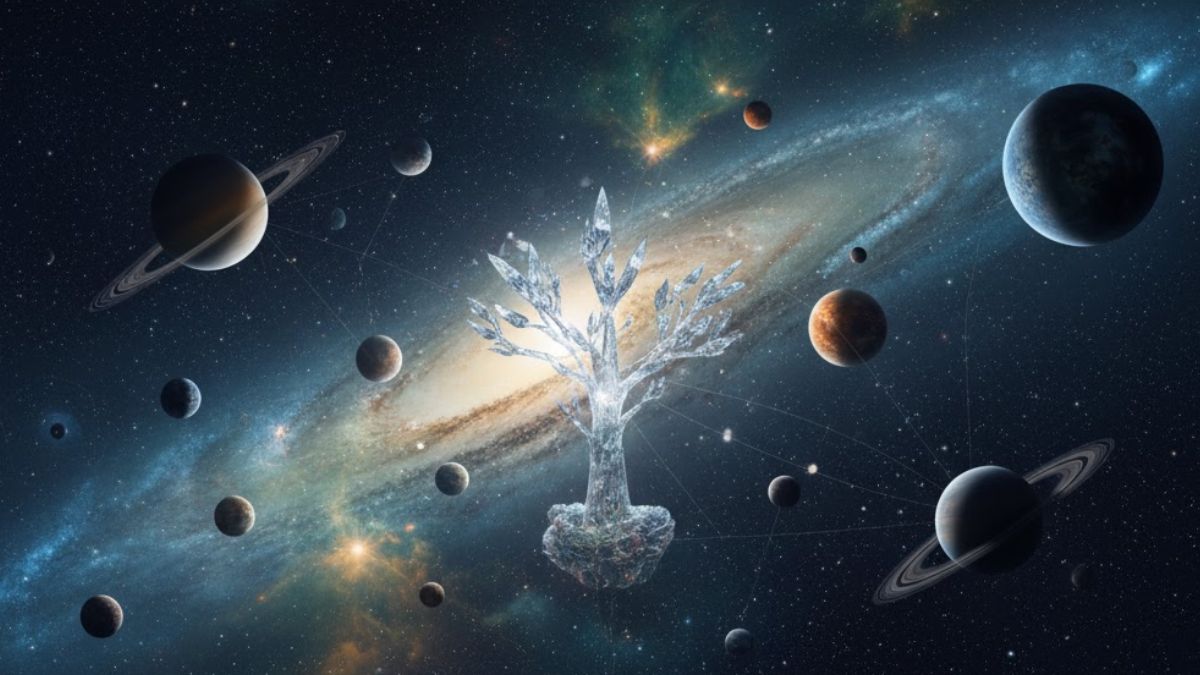
There’s a quiet moment on a clear night, when you’re far from the city lights, that the true depth of the sky reveals itself. It’s not just a dark blanket; it’s a vast, sparkling ocean. Every single point of light is a sun, and many of those suns have their own families of planets spinning around them. In that moment, it’s hard not to feel a profound sense of wonder, and a single, thrilling question often bubbles up: Are we truly alone in all of this?
For a long time, the idea of life elsewhere felt like science fiction. We pictured little green men in flying saucers. But today, the question is at the very heart of serious science. Astronomers, biologists, and chemists are all piecing together a new, incredible story of the cosmos. They are discovering that the ingredients for life are not some rare, magical recipe. Instead, they seem to be scattered almost everywhere we look, like cosmic seeds waiting for the right conditions to sprout.
This article is a journey into that exciting possibility. We’ll explore why scientists are starting to believe that life, in some form, could be a common feature of our universe. We’ll look at the building blocks found in distant clouds of gas, the incredible planets being discovered, and the tough little creatures on Earth that show us life is far more stubborn than we ever imagined. So, if the sight of the night sky ever makes you curious, let’s explore together. What if the universe is not a silent, empty void, but a quiet, bustling neighborhood?
What are the basic ingredients for life, and are they really everywhere?
To understand if life could be common, we first need to know what we’re looking for. What does life need to get started? If you think about all life on Earth, from the smallest bacteria to the largest whale, it’s built from a surprisingly simple set of raw materials. The most important ones are carbon, hydrogen, oxygen, nitrogen, phosphorus, and sulfur. Scientists sometimes joke that we are all just made of “star stuff,” and they aren’t wrong.
These essential elements are forged in the hearts of stars and scattered across the galaxy when those stars explode. This means the very atoms that make up your body were once part of a distant, giant star. It’s a beautiful and humbling thought. Now, here’s the amazing part: astronomers, using powerful telescopes, can detect these same elements floating in vast clouds of gas and dust between the stars. They find them on asteroids, comets, and in the atmospheres of other planets. They are the most common building blocks in the universe. It’s like walking into a kitchen and finding that all the flour, sugar, and eggs you could ever need are already sitting on the counter, in nearly endless supply.
But ingredients alone aren’t enough. You also need water. Water is the perfect mixer. It allows all those different chemicals to move around, meet, and interact to form more complex molecules. For a long time, we weren’t sure how common water was beyond Earth. Now, we know it’s everywhere. We see evidence of water on Mars, in the subsurface oceans of moons like Europa and Enceladus, and even in the mineral structures of asteroids. The universe, it seems, is not just stocked with the ingredients for life, but it’s also surprisingly wet. If the ingredients are so common, and the water is so plentiful, is it really so hard to believe that life could have started in more than one place?
How many planets could possibly support life?
Just two decades ago, we didn’t know for sure if there were any other planets orbiting distant stars. These planets are called exoplanets. Today, thanks to missions like NASA’s Kepler Space Telescope, we know of thousands. And that’s just a tiny, tiny fraction of what’s out there. Our Milky Way galaxy alone is estimated to have billions of planets. Let that number sink in for a moment. Billions.
The real excitement comes from a special kind of planet known as the “Goldilocks Zone” planet, or more formally, the habitable zone. This is the region around a star where it’s not too hot and not too cold, but just right for liquid water to exist on a planet’s surface. Earth is perfectly placed in our Sun’s Goldilocks Zone. Venus is too close and is a scorching hellscape. Mars is a bit too far and is a frozen desert. But around other stars, we are finding a huge number of worlds sitting comfortably in their own Goldilocks Zones. Some are rocky, like Earth. Others might be very different, but could still have the right conditions.
And it’s not just about the distance from the star. We now know that life on Earth can survive in the most extreme conditions we can imagine—in boiling hot acid, in crushing deep-sea pressures, and locked in ice for millions of years. This toughness of life, called extremophilia, opens up even more possibilities. A planet doesn’t need to be a perfect twin of Earth to host life. A moon with a frozen crust and a warm, liquid ocean underneath, like Jupiter’s moon Europa, could be a perfect home for microbial life, or maybe even something more. With billions of potential homes in our galaxy alone, the sheer numbers start to work in favor of life being a common occurrence.
What have we learned from rovers and space telescopes?
Our search isn’t just about looking at dots of light in the sky. We are sending robotic explorers to other worlds to search for clues. On Mars, rovers like Curiosity and Perseverance are acting as robotic geologists. They are driving across the Martian surface, drilling into rocks, and analyzing the soil. What they have found is fascinating. We now know that Mars was once a much warmer and wetter planet, with rivers, lakes, and maybe even a vast ocean.
These rovers have detected complex organic molecules—the carbon-containing building blocks of life—in ancient Martian rocks. They haven’t found life itself, but they have found the evidence that all the ingredients were present and that Mars was once a habitable world. The Perseverance rover is now collecting samples to be brought back to Earth in the future, where scientists can study them in much greater detail. The question has shifted from “Was Mars ever habitable?” to “Did life ever actually start there?”
Meanwhile, space telescopes like the James Webb Space Telescope (JWST) are opening a new window into the universe. JWST is powerful enough to analyze the light passing through the atmospheres of distant exoplanets. By splitting this light into a rainbow, called a spectrum, scientists can figure out what gases are in that planet’s air. They are looking for “biosignatures,” which are gases that are strongly linked to life. On Earth, the large amount of oxygen in our atmosphere is a clear biosignature because it’s constantly replenished by plants and microbes. Finding a similar combination of gases, like oxygen and methane together, on a distant world would be one of the most compelling hints that we are not alone.
Could life be completely different from what we know?
When we imagine alien life, we often picture something with eyes and legs. But this might be our Earth-centric imagination limiting us. Life elsewhere could be so bizarre we might not even recognize it at first. All life on Earth is based on the same blueprint: we use DNA, we are carbon-based, and we rely on water. But does life have to be this way?
Scientists are exploring the possibility of “weird life.” What if life could be based on a different element? Silicon, for example, is right below carbon on the periodic table and can form similar, though less stable, bonds. Could there be slow, crystalline lifeforms on a scorching hot world? What if life could use a completely different liquid instead of water? On a cold moon like Titan, which has rivers and lakes of liquid methane, could there be lifeforms with a completely different chemistry, living in what we would consider a deep freeze?
Even the definition of life is tricky. Is a virus alive? It can’t reproduce on its own, but it carries genetic information and evolves. The line between living and non-living can be blurry. This means we might discover something on another world that is clearly a complex, self-sustaining system, but doesn’t fit our textbook definition of “life.” It would force us to completely rewrite our understanding of biology. The universe is a vast laboratory that has been running experiments for over 13 billion years. It seems almost arrogant to think that it only came up with one way to build something that can grow, reproduce, and evolve.
Conclusion
Gazing up at the stars will never feel the same once you consider the possibilities. The discovery that the ingredients for life are universal, that planets are incredibly common, and that life on Earth is tenacious, paints a new picture of our cosmos. It’s a picture that is shifting from a silent, empty expanse to a potentially vibrant and living tapestry. We are at the very beginning of this great exploration. The next few decades promise answers from the returned samples from Mars, the continued discoveries of the James Webb Telescope, and perhaps even a mission to the watery moons of Jupiter or Saturn.
The evidence is building towards a universe that is not hostile to life, but one that is perhaps fertile and waiting. We may soon find that life is not a rare, fragile flame on a single world, but a cosmic phenomenon—a natural process that emerges whenever the conditions are right. The greatest discovery in human history might be just around the corner. When we finally do find that first, undeniable sign of another living world, how do you think it will change our understanding of our own place in the universe?
FAQs – People Also Ask
1. What is an exoplanet?
An exoplanet is any planet that exists outside of our own solar system. These planets orbit around other stars, and we have discovered thousands of them, with many more likely waiting to be found.
2. Why is water so important for life?
Water acts as a universal solvent, meaning it can dissolve many different substances. This allows the chemical ingredients of life to mix, move, and react with each other in a way that is essential for the complex processes of life to begin and survive.
3. What is the Goldilocks Zone?
The Goldilocks Zone, or habitable zone, is the area around a star where the temperature is just right—not too hot and not too cold—for liquid water to potentially exist on the surface of a planet. This is considered a key factor for life as we know it.
4. Have we ever found life on Mars?
Not yet. Our rovers have found evidence that Mars once had the right conditions to support life, including water and organic molecules, but we have not discovered any direct signs of past or present living organisms.
5. What is a biosignature?
A biosignature is any substance or signal that provides scientific evidence of past or present life. This could be a specific gas in a planet’s atmosphere (like oxygen), a particular molecule, or even a fossilized structure.
6. Could there be intelligent life out there?
It’s possible, but we have no evidence for it yet. While simple microbial life might be common, the step to complex, intelligent, and technologically advanced life may be much more rare and difficult.
7. What is an extremophile?
An extremophile is an organism that thrives in conditions that are extreme from a human perspective, such as intense heat, cold, pressure, or acidity. Their existence on Earth shows us that life can survive in a much wider range of environments than we once thought.
8. How does the James Webb Telescope search for life?
The James Webb Telescope analyzes the starlight that filters through the atmospheres of distant exoplanets. By studying this light, scientists can determine the chemical composition of those atmospheres and look for gases that might be produced by living things.
9. What is astrobiology?
Astrobiology is the scientific field that studies the origin, evolution, distribution, and future of life in the universe. It combines astronomy, biology, geology, and planetary science to answer the question of whether we are alone.
10. What would be the impact of discovering alien life?
The discovery of even simple microbial life on another world would be one of the most profound events in human history. It would revolutionize our understanding of biology and our place in the cosmos, confirming that life is a fundamental part of the universe.
