
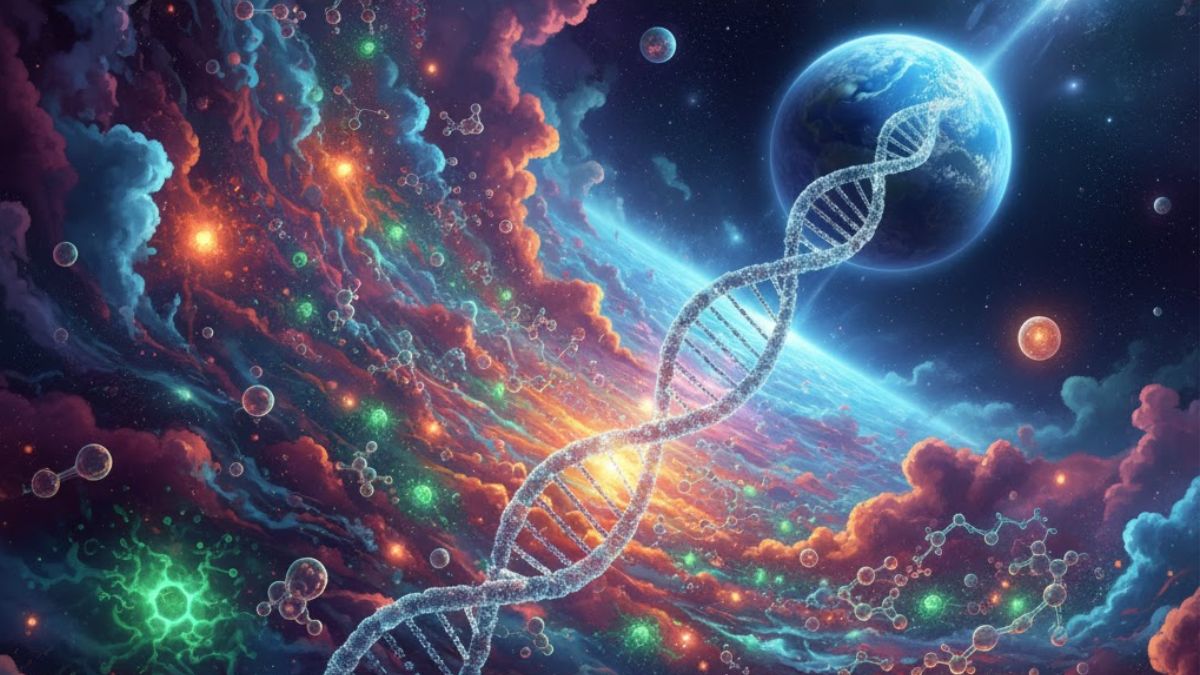
There’s a quiet mystery that sits at the very foundation of our existence, one so profound we often forget to even question it. Every single living thing on our planet—the towering trees, the birds in the sky, the bacteria in the soil, and you, reading this—shares a common origin. At some point in the deep, distant past, on a rocky world that was just learning how to be a world, non-living matter crossed a threshold and became alive. It was the most important event in Earth’s history, and yet, we have no crime scene tape, no video recording, and no eyewitnesses. The evidence has been erased by four billion years of geological activity and time.
Scientists have pieced together incredible parts of the story. We know the age of the Earth, about 4.5 billion years. We know that life appeared surprisingly quickly, with the first simple organisms showing up just a few hundred million years after the planet cooled down enough to have liquid water. This tells us that life might not be a freak accident, but a natural process that can emerge when the conditions are just right. But the “how” is the puzzle. How did a soup of simple chemicals transform into something that could eat, grow, and make copies of itself?
This question takes us on a journey back to our planet’s violent infancy, to a time of fiery volcanoes and a strange, alien atmosphere. It forces us to ask what “life” even means and whether we are alone in the universe. If we can understand how life began here, it might tell us how common it could be out there among the stars. So, how did we go from a lifeless rock to a world teeming with creatures, all starting from a few simple ingredients?
What Was the Early Earth Actually Like?
To understand how life began, we first need to picture the stage on which this incredible drama unfolded. Forget the blue and green marble we know today. The early Earth, around 4 billion years ago, was an extreme and hostile place. The young Sun was fainter, but the planet itself was a furnace of its own making. The surface was mostly molten rock, constantly churning from the heat of its formation and the radioactive decay inside. Massive volcanoes erupted continuously, spewing gases like carbon dioxide, nitrogen, and water vapor into the air, creating a thick, toxic atmosphere with no breathable oxygen.
For a very long time, scientists pictured this early world as a vast, steamy ocean under a hazy sky. There were no continents as we know them, just small, volcanic islands poking out of a global sea. This water was the key ingredient. It came from within the planet, trapped in minerals that melted and released their water as steam, which then condensed and fell as rain for millions of years, filling the basins to create the first oceans. The sky was likely an orange-ish hue, and the air would have been poisonous to us, filled with methane and ammonia.
This chaotic environment, however, was a perfect chemical laboratory. It had all the raw materials—water, gases, and minerals—and an enormous amount of energy to power reactions. Energy came from everywhere: the intense ultraviolet radiation from the Sun, which was not blocked by an ozone layer; violent lightning strikes flashing through the ash-filled skies; and the immense heat from volcanoes and hydrothermal vents on the ocean floor. It was in this cauldron of creation that the first building blocks of life were forged.
How Could Life Start from Non-Living Chemicals?
The leap from non-life to life seems like a magic trick, but scientists believe it was a slow, gradual process of chemistry becoming biology. Think of it like building a very complicated Lego model. You don’t start with the finished castle; you start by sorting the bricks. The first step was to create those bricks—the fundamental molecules that all life is built from.
In the 1950s, two scientists named Stanley Miller and Harold Urey conducted a famous experiment that tried to recreate these early conditions. They took a flask of water to represent the ocean, and filled another with gases they thought were in the early atmosphere—methane, ammonia, and hydrogen. Then they passed electrical sparks through the gas to simulate lightning. In just a week, the simple, clear water turned a murky brown. When they analyzed it, they found it was rich with amino acids, the essential building blocks of proteins, which are the workhorse molecules of all living cells.
This was a groundbreaking discovery. It showed that the basic ingredients for life could form naturally from simple chemicals and energy. Of course, amino acids are not life. They are just the bricks. The next, and much more difficult, step was to figure out how these bricks organized themselves into a structure that could do something. They needed to form things like RNA, a molecule that can both store information like a blueprint and act like a machine to carry out tasks. How these first complex molecules assembled, and how they began to interact, is the very heart of the mystery.
Where Did the First Life Come Together?
If the Miller-Urey experiment showed us how to make the bricks, where did the actual construction site exist? Scientists have a few favorite candidates for the location of life’s first kitchen.
One leading idea points to the deep ocean, to places called hydrothermal vents. These are not volcanoes on land, but cracks in the ocean floor where superheated water, rich in minerals from the Earth’s crust, gushes out into the cold, deep sea. Some of these vents, called “white smokers,” create porous, chimney-like structures full of tiny compartments. These natural nooks and crannies could have acted as the first cells, concentrating the chemical building blocks together and providing a safe place for them to interact and become more complex, protected from the violent world above.
Another possibility is much closer to the surface. It might have happened in shallow, sun-drenched pools on the early continents. As water evaporated in these pools, it would have concentrated the chemicals, like letting a soup simmer down to a richer flavor. This would make it easier for molecules to bump into each other and form new, more complex links. The clay at the edges of these pools is also a fascinating candidate. Clay has a layered structure that can act as a scaffold, holding molecules in place and even helping to jump-start the formation of the first genetic material, like a natural 3D printer for early life.
There is no single answer yet. Each of these environments has its own strengths, and it’s possible that different steps of the process happened in different places. The bricks may have formed in the atmosphere, the walls started in a clay bed, and the final assembly happened in a deep-sea vent. The journey from chemistry to biology was likely a long and winding road, not a single event.
What Was the Very First Life Form Like?
Whatever the location, the result was the first living organism. We often call it LUCA, which stands for the Last Universal Common Ancestor. It’s important to understand that LUCA was not the very first living thing ever. It was the one ancestor that every living thing on Earth today—from a blade of grass to a blue whale—can trace its lineage back to. Think of it as the great-great-great-grandparent of the entire tree of life.
LUCA was incredibly simple. It wouldn’t have looked like a bacterium under a microscope. It was probably more like a tiny, wobbly bag of chemicals, a simple cell without a nucleus. It lived in the hot, dark, and oxygen-free depths of the ocean, most likely near those hydrothermal vents. It didn’t need the Sun to survive. Instead, it fed on the chemicals around it, like hydrogen and sulfur, in a process called chemosynthesis. This is a way of life that still exists today in these extreme environments.
This first life form had the two most critical abilities that define life: it could metabolize, meaning it could take in energy from its environment to power itself, and it could replicate, meaning it could make copies of itself. Its genetic information was likely stored in a molecule like RNA, and its “children” would have been almost, but not quite, identical. These tiny differences, these copying mistakes, are what started the engine of evolution. From this single, simple starting point, billions of years of evolution would eventually lead to the incredible diversity of life we see today.
Why Is It So Hard to Solve This Mystery?
With all our advanced technology and brilliant minds, you might wonder why we haven’t cracked this case yet. The challenge is immense and comes from several angles.
First, the evidence has been destroyed. The Earth’s surface is constantly recycling itself through plate tectonics. The ancient rocks from the time when life first emerged, over 4 billion years ago, have almost all been pushed back into the mantle, melted, and reformed. It’s like trying to solve a burglary when the entire house has been demolished and rebuilt a dozen times. The oldest fossils we have are of bacteria that were already quite advanced, not the very first pioneers. We are missing the earliest chapters of the story.
Second, the definition of life itself is slippery. We all know life when we see it, but drawing a sharp line between living and non-living is surprisingly difficult. Is a virus alive? It can replicate, but only inside a host cell. Was a self-copying molecule the moment of life, or was it when that molecule got inside a protective membrane? The transition was so gradual that pinpointing the exact moment of “birth” is nearly impossible. We are looking for a finish line that doesn’t really exist in a race that never truly ended.
Finally, we only have one example. All life on Earth is related. It all uses the same DNA code, the same basic cellular machinery. This means we don’t know if the way life started here is the only way it can start. Is our type of life just one possible recipe, or is it the only recipe? If we discovered a second, independent origin of life on another world—like Mars or a moon of Jupiter—that used a completely different biochemistry, it would tell us that life is not a miracle, but a cosmic imperative. Until then, we are trying to understand a universal process from a single data point.
Could Life Have Come from Somewhere Else?
Faced with these challenges on Earth, some scientists have proposed a fascinating alternative: what if life, or at least its ingredients, came from space? This idea is called panspermia. The theory suggests that the basic building blocks of life, like amino acids and organic compounds, are common throughout the cosmos, formed in the vast clouds of gas and dust between stars and then delivered to young planets by comets and asteroids.
We have evidence that supports part of this idea. Meteorites that have fallen to Earth, called carbonaceous chondrites, have been found to be rich in amino acids and other organic molecules. This proves that the chemistry for life can and does happen in space. It’s possible that a constant rain of these space rocks in Earth’s early history helped seed our planet with the raw materials, giving the recipe for life a head start.
However, panspermia doesn’t really solve the core mystery; it just moves it. Even if the ingredients for life hitched a ride on a meteorite, we still have to explain how those ingredients came together to form life somewhere. Did it happen on another world and then survive the incredible journey through space and the fiery entry through our atmosphere? Or did the delivery just provide a richer starter kit for the process to begin here? Either way, the fundamental question of how non-life becomes life remains, whether it happened in our oceans or in a distant star system.
Conclusion
The origin of life is a puzzle that has captivated humans for centuries, and today, it stands as one of science’s final frontiers. We have moved from seeing it as a mysterious spark to understanding it as a probable chemical process, a journey from a chaotic, young planet to a delicate, self-replicating cell. We have identified the likely ingredients, the possible kitchens, and the humble ancestor from which we all sprang.
Yet, the deepest questions remain unanswered. The gap between a complex chemical soup and a living entity is still a chasm we are trying to bridge. This isn’t a failure of science; it’s an invitation. It invites us to keep exploring, to simulate early Earth in our labs, to probe the icy moons of the outer solar system, and to scan the atmospheres of distant exoplanets for signs of biology. Every discovery, from a new organic molecule in a meteorite to a strange microbe in a deep-sea vent, adds another piece to the puzzle.
In the end, searching for the origin of life is really a search for ourselves. It’s the story of how a universe of hydrogen and stardust eventually woke up and began to contemplate its own existence. If life could emerge from the simple elements of a rocky world, what does that say about our place in the cosmos?
FAQs – People Also Ask
1. When did life first appear on Earth?
The earliest evidence for life comes from fossils of microorganisms found in rocks that are about 3.5 billion years old. Chemical signatures in even older rocks suggest life may have existed as far back as 3.8 to 4 billion years ago, not long after the Earth itself formed.
2. What are the basic requirements for life to start?
Most scientists agree that the key requirements are liquid water, a source of energy (like sunlight or chemical energy), and a supply of the right chemical building blocks, primarily carbon, hydrogen, nitrogen, oxygen, phosphorus, and sulfur.
3. What is the RNA World hypothesis?
This is a leading theory that suggests before DNA and proteins existed, a molecule called RNA was the star of the show. RNA can both store genetic information (like DNA) and act as a catalyst for chemical reactions (like a protein), making it a potential candidate for the first self-replicating molecule.
4. Could life exist on other planets?
Absolutely. The discovery of extremophiles—life on Earth that thrives in boiling, acidic, or radioactive environments—has greatly expanded our idea of where life can exist. Moons like Europa (orbiting Jupiter) and Enceladus (orbiting Saturn) with their subsurface oceans are considered prime candidates in our own solar system.
5. What is the difference between chemical evolution and biological evolution?
Chemical evolution describes the long process of simple molecules becoming more complex organic molecules before life existed. Biological evolution began once the first self-replicating life form appeared and started to diversify through natural selection.
6. Why is water so important for life?
Water is often called the “universal solvent” because it can dissolve so many different substances. This allows it to transport nutrients and chemicals in and out of cells, and it provides a stable medium for the complex chemistry of life to take place.
7. Has anyone ever created life in a lab?
No, scientists have not created life from scratch. However, they have successfully created many of the building blocks, like amino acids and nucleotides, and have created synthetic RNA molecules that can copy themselves, bringing us closer to understanding the transition.
8. What was the Great Oxidation Event?
This was a period around 2.4 billion years ago when cyanobacteria, which use photosynthesis, began producing large amounts of oxygen. This oxygen was toxic to most early life but eventually led to the oxygen-rich atmosphere that allowed complex life like animals to evolve.
9. How do we look for signs of the earliest life?
Scientists look for stromatolites, which are layered rock structures formed by ancient microbial mats. They also analyze the ratio of different carbon isotopes in very old rocks, as living organisms tend to prefer one type of carbon over another, leaving a chemical fingerprint.
10. If we find life on Mars, how will we know it’s truly alien?
We would look for signs that it has a fundamentally different biochemistry from Earth life. For example, if it used something other than DNA to store genetic information, or if it was based on a different element than carbon, it would strongly indicate a second, independent origin of life.
