
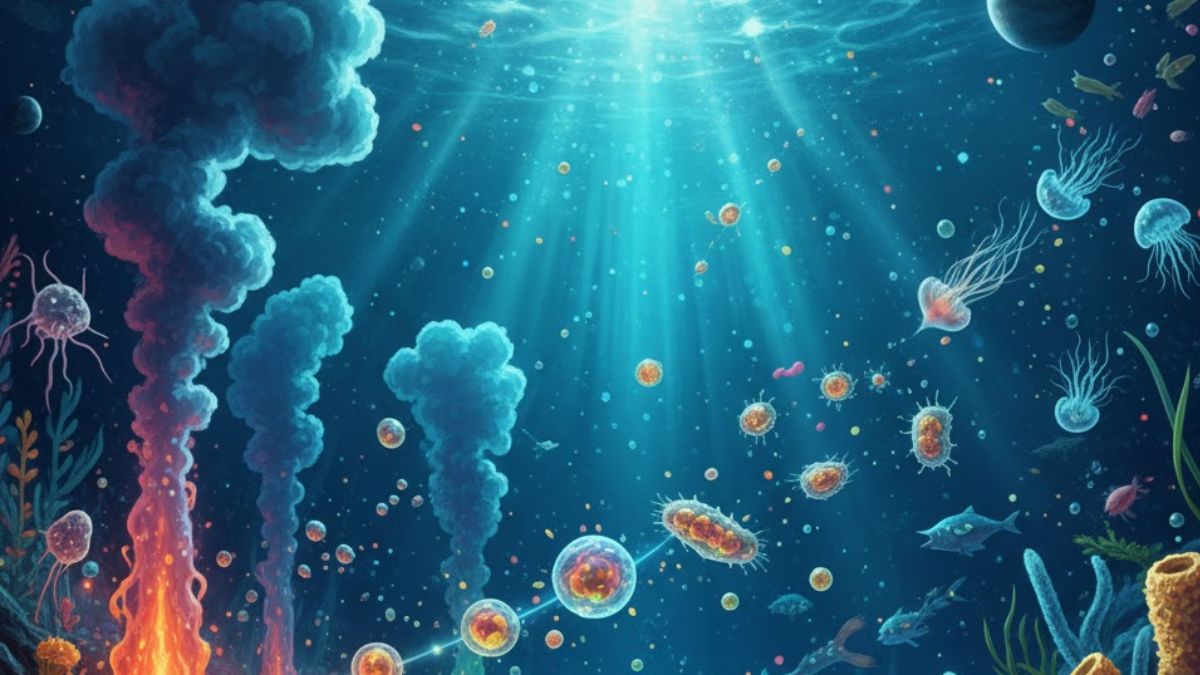
There’s a story written in every living thing around you. It’s a story that began billions of years ago, in the quiet, deep waters of a young planet. For the longest time, Earth was a world of the very small. The only life was single, tiny cells, floating alone in the vast oceans. They were successful in their own right, surviving and dividing for millions of years. But then, something incredible happened. One of these cells did something that would change the course of history forever—it swallowed another, and instead of destroying it, they joined forces.
This wasn’t a dramatic, overnight change. It was a quiet, biological partnership that set off a chain of events leading to the explosion of life we see today. From that first partnership, a new possibility emerged: complexity. This is the story of how life on Earth decided to stop being simple and start becoming complex, eventually leading to plants, dinosaurs, and us. It’s a tale of cooperation, chance, and a planet that was just right for a grand experiment. So, how did we go from a world of lonely cells to a world filled with such breathtaking variety?
What did the very first life on Earth look like?
To understand how complex life began, we need to go back to the very beginning. Picture Earth about 3.5 billion years ago. The air is thick with gases we couldn’t breathe, and the land is barren rock. There are no plants, no animals, no sounds. The only action is in the water. Here, the very first life forms were thriving. These were prokaryotes—simple, single-celled organisms without a nucleus, like tiny, living bags of chemicals.
They were incredibly small, so tiny that billions of them could fit in a single drop of water. Their world was simple: eat, grow, and divide to make copies of themselves. They fed on chemicals from the ocean or from underwater volcanic vents. For two billion years, this was the only game in town. Life was stable, but it was simple. It was a world of microscopic loners. The question is, what pushed these loners to finally start working together? The answer lies in a revolutionary new cell that changed everything.
What was the great leap forward for complex life?
The single most important event in the history of complex life was the rise of a new kind of cell, called the eukaryotic cell. The name sounds complicated, but the idea is simple. Think of the old, simple cells as a studio apartment—one room where everything happens. Eating, sleeping, and waste disposal all occur in the same open space. It works, but it’s limited.
Now, imagine building a large, modern house with separate rooms for different tasks. You have a kitchen for making energy, a dedicated office for storing blueprints, and a power generator in the basement. This is what a eukaryotic cell is like. It has special rooms inside it, called organelles, each with a specific job. The most important of these rooms are the mitochondria, which act as the cell’s power plants.
This incredible upgrade happened through a process called endosymbiosis. One day, a larger, simple cell engulfed a smaller, simpler one. Instead of being digested, the small cell—a bacterium that was very good at turning food into energy—set up shop inside its host. It started providing extra energy to the larger cell. In return, the larger cell gave it a safe home. This was the first business partnership in history, and it was a roaring success. This tiny internal powerhouse, the mitochondrion, gave the host cell a massive energy boost. With all this extra power, the cell could afford to get bigger, build more complex internal structures, and eventually, do something simple cells could never do: team up with others to form a multicellular organism.
Why did cells decide to team up and form one body?
With this new, super-powered eukaryotic cell, the door to complexity was flung wide open. But why would individual cells, which had been perfectly happy living on their own for billions of years, decide to stick together and form a single body? The reason is the same why people form communities: there is strength in numbers and specialization.
Imagine a single cell trying to do everything by itself. It has to find food, move around, defend itself, and reproduce. It’s a jack of all trades, but master of none. Now, imagine a group of cells deciding to cooperate. They can divide the labor. One group of cells could specialize in forming a tough outer skin for protection. Another group could specialize in moving the whole organism around. Another could focus on digesting food.
This is exactly what happened. The first multicellular organisms were likely like tiny algae or slimy films on the ocean floor. By sticking together, these cells could achieve things a lone cell never could. They could grow larger because they were supported by a structure. They could explore new environments. They could become more efficient. This was the birth of true multicellularity, where a group of cells function as one single, coordinated being. This was the humble beginning of every animal, plant, and fungus you see today.
Was this journey from simple to complex a smooth one?
If you think this journey from single cells to complex life was a straight, steady climb, think again. For a long, long time after the eukaryotic cell evolved, life on Earth remained relatively simple. The transition to multicellularity happened multiple times in different lineages, but for millions of years, these complex organisms were still mostly soft-bodied and small. Then, around 540 million years ago, the planet exploded with new life forms in an event scientists call the Cambrian Explosion.
It was as if evolution had been experimenting in a lab and suddenly opened the doors to show off all its wild creations. For the first time, life had hard parts—shells, spines, and claws. The oceans teemed with bizarre creatures that look like they’re from another world. This explosion of diversity was possible because of the foundation laid billions of years earlier. The high-energy eukaryotic cells could now support complex body plans, sensory organs, and predatory behaviors. It was the ultimate payoff for that first cell that decided to partner up.
What does this ancient story mean for us today?
The story of how life became complex is not just a history lesson. It’s our own origin story. Every time you take a breath, your mitochondria are working hard in your cells to turn that oxygen into energy. That power allows your trillions of cells to work in perfect harmony, letting you read, think, and feel. You are a walking, talking community of cells, a testament to a partnership forged in the deep past.
This journey shows us that the most powerful force in evolution isn’t just competition; it’s also cooperation. The greatest leap in the history of life wasn’t a fight, but a merger. It was a decision to work together that unlocked potentials far greater than what any cell could achieve alone. From that one event, a universe of possibilities unfolded, leading to the incredible tapestry of life that covers our planet. It makes you wonder, if life on Earth took such a cooperative path to complexity, what might life on other worlds look like?
FAQs – People Also Ask
1. What is the difference between a simple cell and a complex cell?
A simple cell, like a bacterium, is like a one-room studio where all life’s functions happen in an open space. A complex cell, which makes up plants, animals, and fungi, is like a large house with separate rooms for different tasks, such as a nucleus to hold its DNA and mitochondria to create power.
2. Why is the mitochondrion so important?
The mitochondrion is often called the powerhouse of the cell because it generates most of the cell’s supply of chemical energy. This extra energy allowed cells to grow larger and develop more complex structures, which was absolutely essential for the evolution of multicellular life.
3. Did multicellular life evolve more than once?
Yes, evidence suggests that multicellularity evolved independently several times in different lineages. Plants, animals, and fungi all developed their own versions of multicellular life, showing that it was a successful solution to the challenges of survival.
4. How long did it take for life to go from single-celled to multi-celled?
The transition was incredibly slow by human standards. Simple single-celled life appeared around 3.5 billion years ago, but the first multicellular organisms didn’t appear until about 1 billion years ago. The real explosion of complex animal life, the Cambrian Explosion, happened around 540 million years ago.
5. What was the Cambrian Explosion?
The Cambrian Explosion was a relatively short period in Earth’s history, about 540 million years ago, when most major animal phyla suddenly appeared in the fossil record. It was a time of rapid evolutionary innovation when life developed hard body parts and complex ecosystems.
6. Could complex life have happened without the eukaryotic cell?
It is highly unlikely. The massive energy requirements of complex bodies, with their specialized tissues and organs, can only be met by the powerful mitochondria inside eukaryotic cells. Simple cells simply do not have the energy capacity to support such complexity.
7. Are there any single-celled organisms left today?
Absolutely. Bacteria and archaea are still the most numerous and widespread organisms on Earth. They live in every environment imaginable and are vital to the planet’s ecosystems, proving that the simple, single-celled way of life is still incredibly successful.
8. What is the simplest multicellular life form we know of?
Some of the simplest multicellular life forms today are algae like volvox, which form hollow balls of cells, or sponges, whose cells are so independent that if you push one through a sieve, they can reassemble into a new sponge.
9. How do scientists know what happened so long ago?
Scientists piece together this story from multiple lines of evidence, including the fossil record, comparing the DNA of modern organisms to trace back their family trees, and by studying the biochemistry of cells to understand their ancient origins.
10. Does this mean all complex life is related?
Yes, in a very real way. Every complex organism on Earth—every plant, animal, and fungus—is built from eukaryotic cells that share that same ancient ancestor: the first cell that engulfed a bacterium and started a cooperative partnership. We are all family.
