
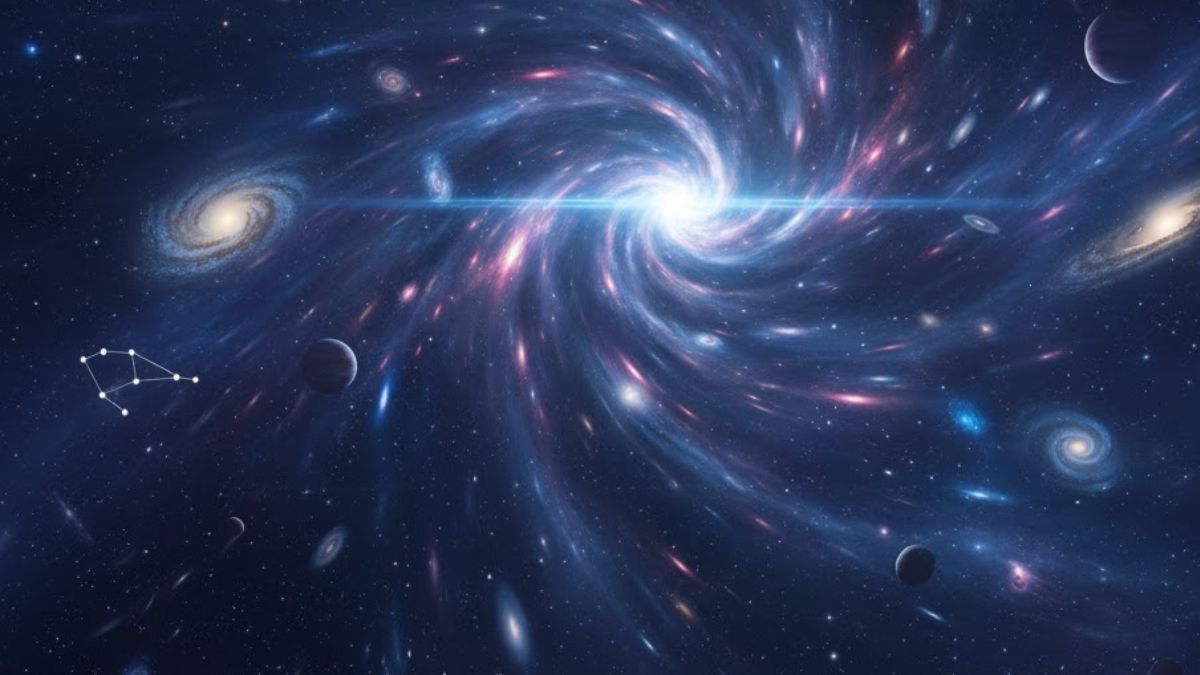
There’s a scene in so many of our favorite space movies. The heroes are trapped, light-years from home, with no hope of getting back in their lifetime. Then, someone points to a strange, swirling tunnel in the void of space. “Punch it,” they say. The ship leaps forward, diving into the tunnel and shooting out the other side, arriving at their destination in the blink of an eye. It’s a fantastic idea, a shortcut across the universe. But what if this wasn’t just science fiction? What if the universe has built its own secret passageways?
These theoretical tunnels are called wormholes. The name itself paints a perfect picture. Imagine an apple, and a worm needs to get from one side to the other. Instead of crawling all the way around the surface, it takes a shortcut by burrowing straight through the middle. In theory, a wormhole in space would act in a very similar way, creating a bridge between two incredibly distant points. One moment you’re here, the next, you could be in another galaxy.
This concept is one of the most thrilling in all of physics, blending the rules of the very large from Einstein with the bizarre rules of the very small from quantum mechanics. It suggests that the fabric of space and time might be folded, full of wrinkles and tunnels we have yet to discover. So, are these cosmic gateways just a fun idea for storytellers, or could they be real, natural structures woven into the cosmos itself? What would it actually take to find one, or even to use one?
What Exactly is a Wormhole in Simple Terms?
Let’s try to make this idea a little less abstract. Get a piece of paper and draw two dots on opposite ends. The normal distance between them is a straight line across the paper. This is how we travel through space now—we go from point A to point B across the surface of the universe. But what if you could fold that paper so the two dots are touching each other? Now, if you could only poke a hole through that single point where they meet, you would have a direct connection. That hole is your wormhole.
In real life, a wormhole is imagined as a tunnel, or a “throat,” connecting two separate points in spacetime. Spacetime is just a fancy word for the four-dimensional fabric of our universe—the three dimensions of space (length, width, height) combined with the fourth dimension, time. A wormhole would, in theory, create a shortcut through this fabric. The entrance might be a sphere, a shimmering portal hanging in the blackness, leading to a tunnel that spits you out in a completely different location, or perhaps even a different time.
The most famous person associated with this idea is Albert Einstein. Along with his colleague Nathan Rosen, he used his theory of General Relativity to explore the possibility of these bridges back in 1935. For this reason, wormholes are sometimes called “Einstein-Rosen bridges.” It’s important to remember that they weren’t talking about spaceships and travel. They were looking at the math of how gravity and spacetime work, and the math surprisingly allowed for such tunnels to exist. So, while we’ve never seen one, the rules of physics as we understand them don’t say they are impossible. They just say they would be incredibly, mind-bogglingly strange.
How Do Wormholes Work? The Science Made Simple
To understand how a wormhole might function, we first need to talk about gravity. Einstein taught us that gravity isn’t a mysterious force pulling on us, but rather a warp or a curve in spacetime caused by objects with mass. Think of placing a heavy bowling ball in the center of a stretched-out rubber sheet. The ball creates a deep dip. Now, if you roll a marble near the edge, it will spiral in towards the bowling ball. The marble isn’t being “pulled”; it’s just following the curve created by the heavy object.
Now, imagine that same rubber sheet, but now with two heavy balls creating two deep dips. If you press down on the sheet, you could make those two dips touch, forming a tunnel between them. This is the basic principle of a wormhole. It’s a ultra-strong warping of spacetime that connects two distant regions. To make this tunnel stable and able to be crossed, you would need something to hold the “throat” of the wormhole open. Otherwise, it would snap shut instantly.
This is where things get really weird. According to the math, the tunnel would be lined with what physicists call “exotic matter.” Don’t think of this as green, glowing goo. Exotic matter is a theoretical substance that has negative energy or negative mass. Normal matter, like you, me, and our planet, has positive mass and gravity that attracts. Exotic matter would have negative gravity—it would push. This repulsive force would be what props the wormhole’s throat open, fighting against the natural tendency of gravity to collapse the tunnel. Without this exotic matter holding it open, the wormhole would pinch closed faster than the speed of light, making it utterly useless for travel.
Are Wormholes and Black Holes the Same Thing?
This is a very common point of confusion, and it’s easy to see why. Both are predictions of Einstein’s theory of gravity, both involve incredibly intense gravitational fields, and both are often depicted as dark, mysterious voids in space. But they are fundamentally different concepts.
A black hole is like a cosmic one-way street. It’s a point in space where so much mass is packed into such a small area that its gravity is overwhelming. There’s a boundary around it called the “event horizon.” Once anything—be it a spaceship, a planet, or even light—crosses that horizon, it can never come back out. The gravitational pull is too strong. A black hole, as far as we understand, leads to a point of infinite density called a singularity, a place where the laws of physics as we know them break down.
A wormhole, on the other hand, would theoretically be a two-way street. If it were stable and traversable, you could go in one end and come out the other. Some early theories even suggested that a black hole might be one end of a wormhole, but this idea hasn’t held up. The event horizon of a black hole is a barrier of no return, while the entrance to a wormhole would not have such a barrier. You would, in theory, be able to pass through it and then turn around and come back. So, while they both involve extreme warping of space, a black hole is a dead end, and a wormhole is a bridge.
Could We Ever Travel Through a Wormhole?
This is the million-dollar question, the one that fuels our dreams of interstellar exploration. The short and honest answer is that with our current understanding and technology, it’s not possible. But let’s explore the “what if.”
First, you’d have to find a stable, naturally occurring wormhole. We have no idea how to do this, or even if they exist. Scientists have suggested that if they are out there, they might be microscopic, smaller than an atom, forming and disappearing in the quantum foam that makes up the fabric of spacetime. Finding one large enough for a person, let alone a spaceship, is a whole other challenge.
Second, let’s assume we found one. The journey itself would be unlike anything we can imagine. As you enter the tunnel, the forces of gravity and spacetime would be immense. You might be stretched and squeezed by tidal forces, a process physicists grimly call “spaghettification.” The stability of the tunnel would be paramount. If the exotic matter holding it open failed for even a moment, the tunnel would collapse, and you would be lost forever.
Then there’s the time factor. According to Einstein’s theories, a wormhole could potentially be a gateway not just through space, but through time as well. If you moved one end of the wormhole at near-light speed (which causes time to slow down for that end, a effect called time dilation) and then brought it back, the two ends would be out of sync in time. Stepping through could send you to the past. This introduces all sorts of mind-bending paradoxes, like the famous “grandfather paradox,” where you could go back in time and prevent your own grandfather from meeting your grandmother. This leads many scientists to believe that time travel to the past might be forbidden by the laws of physics, perhaps preventing wormholes from being used as time machines.
What Would a Wormhole Look Like in the Sky?
If a large, stable wormhole were floating in our solar system, what would we see? It probably wouldn’t look like a swirling vortex of light and color as it does in the movies, but its appearance would still be spectacular and strange.
Because a wormhole is a severe warp in spacetime, it would bend light in incredible ways. If you were to look at it from the side, it might appear as a perfect, shimmering sphere. This sphere would act like a giant, circular lens. The light from the stars behind it would be bent and distorted, wrapping all the way around the sphere. You wouldn’t see a dark hole in the middle; you would see a whole ring of distorted starlight, a window to another place.
If you were to fly towards it and look into the “throat,” you wouldn’t see a long, dark tunnel. You would see the other side. It would be like looking through a telescope, but instead of seeing a tiny, faint image, you would see a full, bright, and clear view of the star system at the other end. It would be a circular window hanging in space, showing you a scene from thousands or millions of light-years away. The effect would be both beautiful and deeply disorienting, a perfect circle of another world embedded in our own black sky.
The Biggest Problems with Wormholes
While the idea of wormholes is intoxicating, physicists have identified some major hurdles that make their existence, especially as travel routes, seem very unlikely.
The number one problem is stability. As mentioned, the wormhole tunnel wants to collapse. To keep it open, you need exotic matter with negative energy density. While tiny amounts of negative energy might be possible due to weird quantum effects, gathering enough of it to line a macroscopic wormhole is a fantasy with our current knowledge. This exotic matter isn’t something we can just mine from an asteroid; it’s a theoretical concept that may not even be possible to produce in large quantities.
Another huge problem is the “physics police.” Many theoretical physicists, like the late Stephen Hawking, proposed laws that would prevent things like time travel paradoxes. One of these is the “Chronology Protection Conjecture,” which is a fancy way of saying the universe might have a built-in mechanism that prevents time travel to the past. It’s possible that the moment anything tries to travel back in time through a wormhole, some physical process—like a massive buildup of energy—would destroy the wormhole, thus protecting the timeline from paradoxes.
Finally, there’s the sheer scale of energy required. Creating or stabilizing a wormhole large enough to be useful would require manipulating matter and energy on a scale we can’t even comprehend, possibly needing the energy of an entire star or more. It’s a technology that belongs to a civilization far, far more advanced than our own.
Conclusion
Wormholes sit in a beautiful and mysterious place in science. They are not proven fantasy, but nor are they confirmed reality. They exist as a tantalizing possibility within the pages of our most successful scientific theories, a “what if” that challenges our understanding of the universe. They represent a dream of connection, a hope that the vast, cold distances between the stars are not an unbreakable barrier.
They teach us that the universe is far stranger and more wonderful than it appears. The idea that space can be folded, and that tunnels through the cosmic fabric could exist, expands our imagination and drives scientific inquiry forward. Even if wormholes are never used for travel, studying them helps us ask better questions about gravity, quantum mechanics, and the fundamental nature of reality. So, the next time you look up at the night sky, consider the possibility that hidden within that starry tapestry are secret doors, waiting to be found. What do you think we would discover on the other side?
FAQs – People Also Ask
1. Has a wormhole ever been discovered?
No, a wormhole has never been discovered. They remain entirely theoretical at this point. Scientists have no observational evidence that they exist in nature, though they are a fascinating subject of research in theoretical physics.
2. Could the Large Hadron Collider create a wormhole?
This is a popular idea, but most scientists say it’s extremely unlikely. The Large Hadron Collider smashes particles together with immense energy, but this energy is still trillions of times too weak to warp spacetime enough to create any kind of detectable wormhole.
3. Are wormholes just science fiction?
They are a major theme in science fiction, but they originated from real scientific theory. While their practical use remains in the realm of fiction, the math of general relativity allows for their possibility, making them a legitimate, though unproven, area of scientific study.
4. How long would it take to travel through a wormhole?
In theory, the travel time through a stable wormhole could be almost instantaneous, or at least very short. This is the whole point—it creates a shortcut, so the journey would be much faster than traveling the long way across normal space.
5. Where would a wormhole take you?
In theory, a wormhole could take you to any point in the universe that its other end is connected to. This could be another part of our galaxy, a different galaxy entirely, or, if time is involved, a different point in time altogether.
6. Do wormholes violate the speed of light?
Not exactly. Nothing would be moving through the wormhole faster than light. Instead, the wormhole itself provides a shorter path, so you don’t have to break the light-speed limit to get to a distant location quickly. It’s like taking a secret tunnel that bypasses a long mountain road.
7. What is exotic matter?
Exotic matter is a theoretical concept for a substance that has properties opposite to normal matter, such as negative energy or negative mass. It has never been observed in bulk, but tiny quantum effects show that negative energy densities can exist for brief moments.
8. Can wormholes be created artificially?
With our current technology and understanding of physics, no. The energy requirements and the need for exotic matter are far beyond anything humanity is capable of, and may forever remain impossible.
9. Did Albert Einstein believe in wormholes?
Einstein did not “believe in” them as real objects. He and physicist Nathan Rosen discovered that the mathematics of his theory of General Relativity allowed for such structures, which is why they are called Einstein-Rosen bridges. He was exploring the math, not claiming they existed.
10. What is the difference between a wormhole and a white hole?
A white hole is a hypothetical opposite of a black hole. While nothing can escape a black hole, nothing can enter a white hole—it would only spew out matter and energy. Some theories have suggested a black hole could be connected to a white hole via a wormhole, but this is highly speculative and not supported by evidence.
