
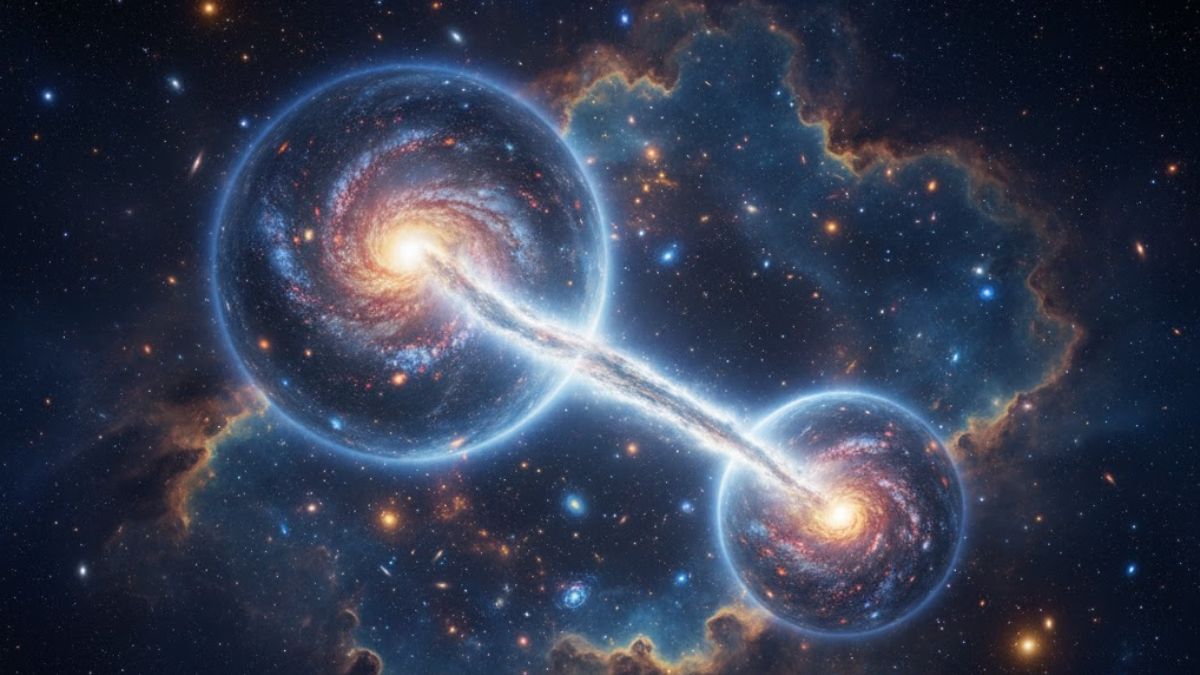
The story of our universe usually starts with a bang. A single, unimaginable moment where everything—every star, every planet, the very fabric of space and time—burst into existence. We call this the Big Bang, and for a long time, it was seen as the ultimate beginning. The moment something came from nothing.
But what if that wasn’t the true start? What if our universe is not the first and only one, but simply the next chapter in a much grander, older story? The idea that our universe could have been born from a previous one sounds like science fiction. Yet, some of the world’s leading physicists are seriously considering it. This concept challenges our deepest assumptions about existence, time, and creation itself. It suggests that the cosmos might be in a continuous, endless cycle of birth, death, and rebirth.
So, how could a whole universe come from another? If the Big Bang wasn’t the beginning, what was? Let’s peel back the layers of this cosmic mystery and explore a possibility that is as humbling as it is beautiful.
What came before the Big Bang?
For decades, asking “what came before the Big Bang?” was like asking “what is north of the North Pole?” It was considered a question without a meaning. The Big Bang wasn’t just an explosion in space; it was the sudden appearance of space and time. According to the classic theory, there was no “before” because time did not exist.
But this answer has never fully satisfied our curiosity. Our brains are wired to think in terms of cause and effect. A tree grows from a seed, a child is born from a parent. It feels natural to wonder if the universe itself also had a parent.
This is where new theories come into play. They propose that the Big Bang might not have been a singular starting gun, but rather a dramatic transition. Think of it like a phoenix. In mythology, a phoenix is a magnificent bird that, at the end of its life, bursts into flames, only to be reborn from its own ashes. Could our universe be the latest phoenix, born from the ashes of a previous cosmos? This idea opens the door to a cyclical model of the universe, where a “Great Bounce” or a cosmic replication might be the real story of our origins.
How could a universe give birth to another?
The idea of a universe giving birth to another universe is strange to picture. We are not talking about a planet or a star, but the entire, vast expanse of everything. How could such a thing happen? Scientists have proposed some fascinating, though complex, ways this could be possible.
One leading idea is called “cosmic inflation.” This theory suggests that right after the Big Bang, the universe underwent a period of incredibly fast expansion, much like a balloon being blown up at an unbelievable speed. Now, some theorists, like the renowned physicist Roger Penrose, suggest a variation called “Conformal Cyclic Cosmology.” In this model, our universe will continue expanding forever until everything—even the last dying stars and black holes—fades away into pure energy. At this distant, almost unimaginable end, the universe becomes so vast and empty that it effectively “resets” and triggers a new Big Bang, giving birth to a fresh universe. In this view, the end of one cosmos is the beginning of the next in an infinite loop.
Another theory comes from the world of quantum physics, which governs the very small. In the quantum world, strange things happen all the time. Particles pop in and out of existence for no reason. This has led to the concept of a “quantum fluctuation.” Some scientists suggest that our entire universe could be the result of a massive, cosmic-scale quantum fluctuation in a pre-existing space. Imagine a perfectly calm, infinite ocean. Suddenly, a single bubble forms out of nowhere. That bubble is our universe. If this is true, then this “ocean” of space could be constantly bubbling with new universes, making ours just one in a vast “multiverse.”
Is there any proof of a parent universe?
This is the big question. If we are inside this universe, how can we possibly find evidence of something that existed before it? It seems like an impossible task. Yet, scientists are detective’s at heart, and they are looking for clues that might have been imprinted on our cosmos at the very moment of its birth.
The most promising place to look is the oldest light in the universe: the Cosmic Microwave Background (CMB). This is the faint afterglow of the Big Bang, a fossilized light that fills all of space. Scientists have mapped this radiation in incredible detail. Some researchers, including Roger Penrose, believe they have found strange, circular patterns in this ancient light. They argue that these “Hawking Points” are the imprints of colossal black holes from a previous universe that collided long before our own Big Bang. It would be like finding a fossilized seashell on a mountain top—evidence of a world that existed long before the current one.
However, it is important to know that this is still a highly debated topic. Many other scientists have examined the same data and are not convinced. They suggest these patterns could be random fluctuations. The search for proof is ongoing, and it pushes our technology and our understanding of physics to their absolute limits. Finding such evidence would be one of the most profound discoveries in human history, fundamentally changing our story of where we came from.
What does a cyclical universe mean for us?
The implications of this idea are staggering. If the universe is cyclical, then there is no true end and no true beginning. There was never a moment of pure nothingness. Instead, there is an endless cycle of universes, each with its own laws of physics, its own stars and galaxies, and perhaps, its own forms of life.
This changes our perspective on time. We think of time as a straight line with a start and a finish. But if universes cycle forever, then time might be more like a vast, endless circle. It also means that our universe is not unique. There could have been an infinite number of universes before ours, and there may be an infinite number after. Our entire cosmic history, from the first star to the last black hole, might just be one verse in an endless cosmic poem.
For us, living on a tiny planet in a nondescript galaxy, it adds a new layer of connection to the cosmos. The atoms in our bodies were forged in the hearts of stars. But if the cyclical model is correct, the very space we live in and the energy that fuels the stars might be recycled from a universe that existed trillions of years ago. We are not just stardust; we are cosmic dust, remnants of a universe that lived and died long before our own was even a concept.
The question of our cosmic origins is one of the most profound we can ask. The standard Big Bang theory gives us a powerful story, but the possibility of a parent universe opens up a even grander narrative. It suggests that the cosmos is not a one-time event but an eternal, regenerative process. While we may not have definitive proof yet, the very fact that we can ask these questions and search for the answers is a testament to our endless human curiosity. We are a way for the cosmos to understand itself, and in seeking our own beginning, we might just discover that the universe has been through this all before.
What do you think—does it feel more awe-inspiring to think of our universe as a unique creation, or as one link in an infinite cosmic chain?
FAQs – People Also Ask
1. What is the Big Bang theory in simple terms?
The Big Bang theory is the idea that our universe began as an incredibly hot, dense point about 13.8 billion years ago. It then expanded and cooled down dramatically, eventually forming all the galaxies, stars, and planets we see today.
2. Could there be multiple universes?
Yes, the idea of multiple universes is called the multiverse. Some theories suggest that our universe is just one “bubble” in a vast cosmic foam, where many other universes with different physical laws might exist alongside our own.
3. How might a universe end?
There are several theories, but a leading one is the “Heat Death.” This suggests the universe will keep expanding forever, stars will burn out, and all matter will eventually decay, leaving a cold, dark, and empty universe.
4. What is the cyclical universe model?
The cyclical universe model proposes that the universe goes through an endless series of cycles. Each cycle begins with a Big Bang and ends in a way that triggers the next Big Bang, making the cosmos eternal and self-renewing.
5. Was there really nothing before the Big Bang?
According to the classic Big Bang theory, there was no “before” because time itself started then. However, newer theories suggest there might have been a previous universe or a different state of existence that led to our Big Bang.
6. What is the Cosmic Microwave Background (CMB)?
The CMB is the oldest light we can observe in the universe. It is the remnant heat from the Big Bang, now cooled to just a few degrees above absolute zero, and it fills all of space like a faint glow.
7. Can we ever know what happened before the Big Bang?
It is a huge challenge because the Big Bang may have erased all evidence of what came before. But scientists are looking for potential clues in the patterns of the CMB and through advanced theories of quantum gravity.
8. What is a black hole and could it create a universe?
A black hole is an area in space with such strong gravity that not even light can escape. Some speculative theories suggest that the extreme conditions inside a black hole could trigger the creation of a new, “baby” universe, separate from our own.
9. How old is our universe?
Our universe is estimated to be 13.8 billion years old. This age is calculated by measuring the expansion rate of the universe and the properties of the Cosmic Microwave Background.
10. Are the laws of physics the same in another universe?
If the multiverse theory is correct, it is possible that other universes could have completely different fundamental laws of physics. In some, gravity might be stronger, or the forces that hold atoms together might not exist.
