
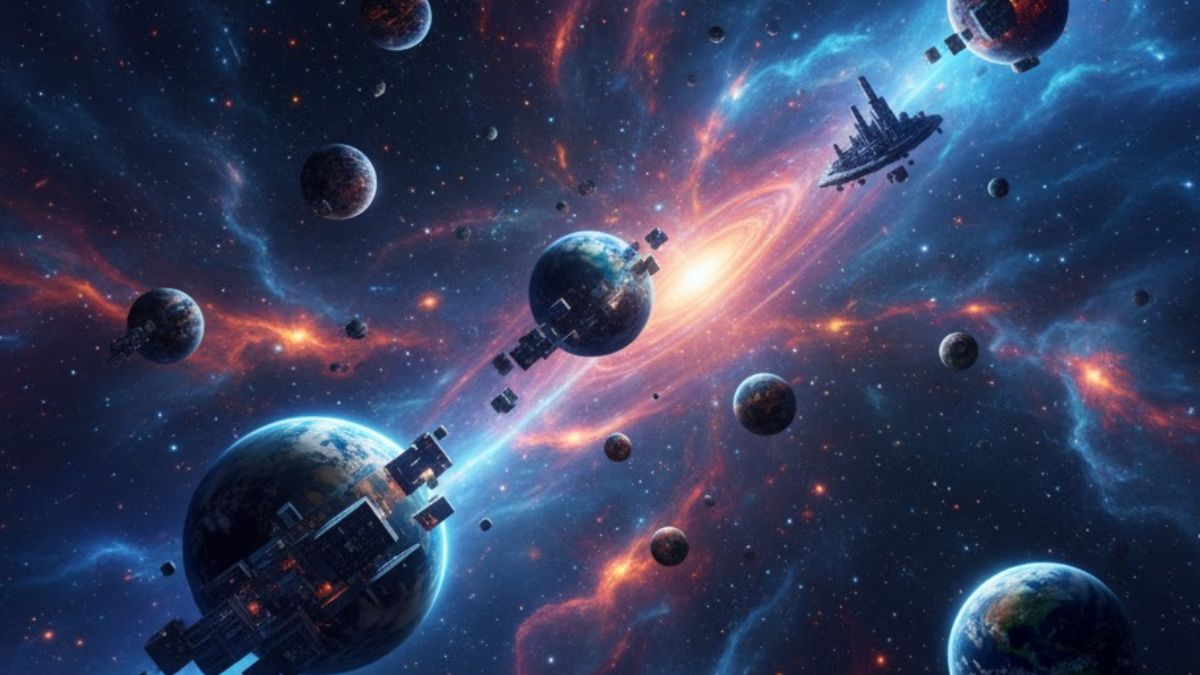
There’s a question that has tickled the human imagination for as long as we’ve looked up at the stars: is our universe all there is? We gaze into the night sky, seeing countless pinpricks of light, each one a sun like our own, and it feels overwhelmingly vast. Yet, what if this entire cosmic expanse—every galaxy, star, and planet we could ever hope to see—is just a single bubble in a frothing, infinite ocean of other bubbles? This is the heart of the multiverse theory, a idea that suggests our universe is not alone.
This concept might sound like the plot of a science fiction movie, but it’s a serious, though speculative, area of scientific discussion. Physicists and astronomers are exploring it not because they want to, but because their math and their observations of the strange rules that govern our reality seem to be pointing them in that direction. It’s a theory born from trying to solve the deepest puzzles of existence.
So, what if this idea is true? Could the multiverse be the ultimate answer, the key that unlocks every cosmic mystery from the birth of our universe to the strange fine-tuning that allows us to be here? Let’s take a journey to the very edges of reality and explore an idea that could change everything we think we know. Are you ready to see what might be beyond the cosmic horizon?
What is the Multiverse Theory, Really?
When we talk about the multiverse, we’re not suggesting a cosmic theme park with different versions of you riding dinosaurs. The core idea is much simpler, and in some ways, even more staggering. The multiverse theory proposes that our universe, with its own set of physical laws and constants, might be just one of many—perhaps even an infinite number—of universes. Together, they form a “multiverse.”
Think of it like this. Imagine you live in a single apartment in a gigantic, endless skyscraper. Your apartment has its own specific layout, its own temperature, and its own rules (like “no pets allowed”). This is your universe. You can only see what’s inside your own apartment. But outside your door is a long corridor, and behind every other door is a completely different apartment. One might be freezing cold with different furniture, another might be filled with water, and a third might have gravity that works in reverse. You are stuck in your apartment, so you can never visit these other spaces or even prove they are there, but the building’s blueprint suggests they exist. The multiverse is that cosmic skyscraper, and we are just one tenant.
Scientists don’t just dream this up for fun. The idea pops up in several of our most successful theories of physics, like cosmic inflation (which describes the universe’s rapid expansion after the Big Bang) and string theory. It’s a possible consequence of the math that tries to explain how our own universe works. So, while we can’t see, touch, or travel to these other universes, the multiverse theory is a fascinating possibility that emerges from our attempt to understand our own home.
Where Did the Idea of a Multiverse Come From?
The story of the multiverse doesn’t start with a big discovery, but with a big problem: the Big Bang. For a long time, scientists have described how our universe began from an incredibly hot, dense point and has been expanding ever since. But this led to some tricky questions. Why is the universe so uniform in every direction we look? It’s like baking a cake that rises perfectly and has the same number of chocolate chips in every single slice.
To solve this, scientists proposed a concept called “cosmic inflation.” This theory suggests that in the first fraction of a second after the Big Bang, the universe underwent a growth spurt so incredibly fast that it expanded faster than the speed of light. This sudden stretch smoothed everything out, explaining the uniform cake. But here’s where things get weird. Many scientists who study inflation now think that once this process starts, it might not ever stop completely.
Imagine a giant loaf of raisin bread baking in an infinite oven. The dough is constantly expanding. In some parts of the dough, the expansion stops and you get a stable, baked pocket—a universe like ours. But the rest of the dough keeps expanding and inflating, and new pockets keep forming. This is called “eternal inflation.” In this endless, ever-growing loaf of raisin bread dough, each raisin is its own self-contained universe. Our entire cosmic history is just the story of what happened inside one single raisin. The idea of the multiverse is, in a way, a natural side effect of our best explanation for how our own universe began.
How Could Different Universes Have Different Rules?
One of the most mind-bending parts of the multiverse idea is that other universes might not play by the same rules as ours. In our universe, we have certain fixed numbers, called constants, that seem to be set in stone. The strength of gravity, the charge of an electron, and the speed of light are all perfectly tuned. If any of these values were even slightly different, life as we know it would be impossible. Stars wouldn’t form, atoms wouldn’t hold together, and the universe would be a boring, empty void.
This is known as the “fine-tuning problem.” It’s as if someone set dozens of dials on a giant cosmic control panel to the exact, perfect positions needed for life to exist. Why are the numbers so perfect? The multiverse offers a compelling, if humbling, answer. If there are an infinite number of universes, each with its own random set of physical constants, then it’s no surprise that we find ourselves in one where the dials are set just right.
Think of it like a cosmic lottery. You buy a million lottery tickets, each with a different set of numbers. The chances of any single ticket winning are tiny. But because you have so many tickets, it’s almost guaranteed that one of them will be the winner. In the multiverse scenario, there are countless “losing” universes—ones that are too cold, too unstable, or too short-lived to support any kind of complexity. We, of course, couldn’t exist in those. We can only live in the one “winning” ticket universe that has the perfect conditions for us. It’s not that the universe was made for us; it’s that we are a product of a universe that happened to work.
Can the Multiverse Explain the Mystery of Dark Energy?
One of the biggest headaches for modern cosmologists is a mysterious force called dark energy. Observations show that the expansion of our universe is not slowing down; it’s speeding up. Something is pushing galaxies apart from each other at an ever-increasing rate, and we have no idea what it is. We just call this “something” dark energy. Its strength, or value, is another one of those perfectly tuned numbers. If it were much stronger, the universe would have been ripped apart before stars could form. If it were much weaker, the universe would have collapsed back on itself long ago.
The multiverse theory might offer an explanation for why dark energy has the value it does in our universe. In the vast landscape of all possible universes, most have a value for dark energy that makes them uninhabitable. Universes with too much dark energy expand too fast for galaxies to form. Universes with too little dark energy collapse into a Big Crunch. Our universe just happens to have a small, but not zero, amount of dark energy—the tiny “goldilocks” value that allows for galaxies, stars, planets, and us to exist.
So, within the multiverse framework, the puzzling weakness of dark energy isn’t a puzzle at all. It’s a selection effect. We shouldn’t be surprised to measure a value that allows for our existence. We would never be able to measure a value that doesn’t. In this way, the multiverse transforms a deep cosmic mystery into a simple, almost statistical, necessity.
Is the Multiverse Theory Science if We Can’t Prove It?
This is the most common and most important criticism of the multiverse idea. A core principle of science is that an idea should be testable and falsifiable. That means you should be able to design an experiment or an observation that could, in theory, prove the idea wrong. Since other universes are, by definition, beyond our cosmic horizon and disconnected from our own, how can we ever test if they are real? If we can’t test it, is it even science, or is it just philosophy?
Scientists who support the multiverse concept argue in a few ways. First, they say that even if we can’t visit other universes, the theory makes predictions about our own universe. For instance, if our universe collided with another bubble universe in the distant past, it might have left a unique imprint on the cosmic microwave background—the leftover heat from the Big Bang. We could, in theory, detect that. So far, we haven’t.
Other scientists are more skeptical. They worry that by explaining everything with an infinite number of universes, we risk making science untestable. If anything that can happen does happen in some other universe, then we stop looking for deeper, simpler laws that explain why our one universe is the way it is. It could be a “cop-out” that halts scientific progress. The debate is ongoing, and it forces us to think carefully about the very nature of science and discovery. Is science only about what we can see, or can it also be about what our best theories tell us must exist?
What Would a Parallel Universe Actually Be Like?
The idea of a parallel universe often conjures up images of a world where you have a different hairstyle or where dinosaurs never went extinct. While this is a fun thought, it’s probably not how most multiverse models work. The most dramatic differences would be at the fundamental level, in the very laws of physics.
Let’s imagine a few possibilities based on different multiverse ideas. In one “bubble universe,” the fundamental forces might be rearranged. Perhaps the strong nuclear force that holds atoms together is weaker. In that universe, atoms might never form, meaning no chemistry, no planets, and no life—just a sea of subatomic particles.
In another universe, the number of dimensions might be different. We live in three dimensions of space and one of time. But some theories suggest other universes could have two spatial dimensions, or five, or more. Life in those universes would be unimaginably different. A being in a two-dimensional universe would be completely flat and would have a biology we can’t even picture.
And yes, in an infinite multiverse born from quantum possibilities, there might be universes almost identical to ours, where every possible choice is played out. But these would be incredibly rare and forever out of reach. The vast majority of universes would be strange, barren, and hostile to any form of life we can recognize. The “multiverse” is less a collection of alternate Earths and more a cosmic zoo of unimaginable realities.
Could the Multiverse Be the Final Answer to Everything?
The multiverse theory is incredibly powerful. It has the potential to explain some of the most profound mysteries in science: Why does our universe seem so finely tuned for life? Why is there something rather than nothing? What happened before the Big Bang? The multiverse offers elegant, if speculative, answers. The constants are tuned because we live in one of the few universes where they are. Our universe is the “something” that emerged from an eternal, larger meta-reality. The Big Bang was just the start of our local cosmic bubble.
But is it the final answer? Some would argue that it simply pushes the mystery back one step. Instead of asking “Why is our universe like this?” we now have to ask “Why does the multiverse have the laws that allow it to produce such a variety of universes?” The ultimate laws that govern the entire multiverse would then become the new, even deeper mystery.
Perhaps the multiverse isn’t a theory of everything, but a theory of many things. It provides a new framework for thinking about our place in the cosmos. It suggests that our universe is not the grand, central show, but a single, humble act in an endless, eternal festival of reality. It solves some puzzles while creating new and profound philosophical questions about existence itself.
Conclusion
The multiverse theory stretches our imagination to its absolute limits. It asks us to consider that everything we can see, from the farthest galaxy to the closest star, is an infinitesimally small part of a reality so vast it defies comprehension. While we may never have direct proof, the idea emerges naturally from our quest to understand the cosmos, offering potential solutions to mysteries that have puzzled us for generations.
It teaches us humility, suggesting we are not the center of everything, but also incredible fortune, residents of a universe that, against staggering odds, allows us to exist and to wonder. The search continues, not for other universes, but for deeper laws within our own that might finally reveal our true cosmic address. If our universe is just one page in an infinite book, what do you think the rest of the story says?
FAQs – People Also Ask
1. What is a simple definition of the multiverse theory?
The multiverse theory is the idea that our universe, which contains everything we can see and observe, is just one of many universes that exist. Together, all these universes make up the “multiverse.”
2. Is there any real evidence for the multiverse?
There is no direct evidence for the multiverse yet. The idea is considered a possible consequence of other well-established scientific theories, like cosmic inflation and quantum mechanics, but it remains a speculative and unproven concept.
3. Could we ever travel to another universe?
Based on our current understanding of physics, it is highly unlikely. Other universes are thought to be completely separate regions of space-time, disconnected from our own. There is no known way to build a bridge or a spaceship that could make the journey.
4. Did Stephen Hawking believe in the multiverse?
Stephen Hawking was involved in developing theories that suggested a multiverse. In his final paper, he proposed a way to make the multiverse concept more testable, showing he took the idea seriously as a mathematical possibility, even if it remained unproven.
5. What is the difference between a universe and a multiverse?
A universe refers to a single, self-contained realm of space, time, matter, and energy. The multiverse is the hypothetical collection of all such possible universes, including our own.
6. Does the multiverse mean there are infinite versions of me?
In some specific interpretations of the multiverse, particularly the “Many-Worlds” interpretation of quantum mechanics, it is possible that there are universes with versions of you that made different choices. However, this is just one type of multiverse, and most would be too different for anything resembling you to exist.
7. What is the ‘fine-tuning’ problem?
The fine-tuning problem is the observation that the fundamental constants and laws of our universe appear to be perfectly calibrated to allow for the existence of life. If any of these values were slightly different, life could not have arisen. The multiverse is one proposed solution to why this is.
8. How does inflation theory lead to the multiverse?
The theory of eternal inflation suggests that the rapid expansion of the early universe never stopped completely. Instead, it continues forever in a larger background space, constantly spawning new “bubble universes” like ours, leading to a vast multiverse.
9. Are there different types of multiverse theories?
Yes, scientists propose several types. The main ones are the inflationary multiverse (bubble universes), the string theory landscape (universes with different physical laws), and the quantum multiverse (branching universes for every quantum event).
10. Why do some scientists dislike the multiverse theory?
Some scientists are skeptical because the multiverse theory is currently untestable. They worry that if a theory can’t be proven false by any experiment, it falls outside the realm of science and into philosophy, potentially halting the search for simpler explanations for our universe’s properties.
