
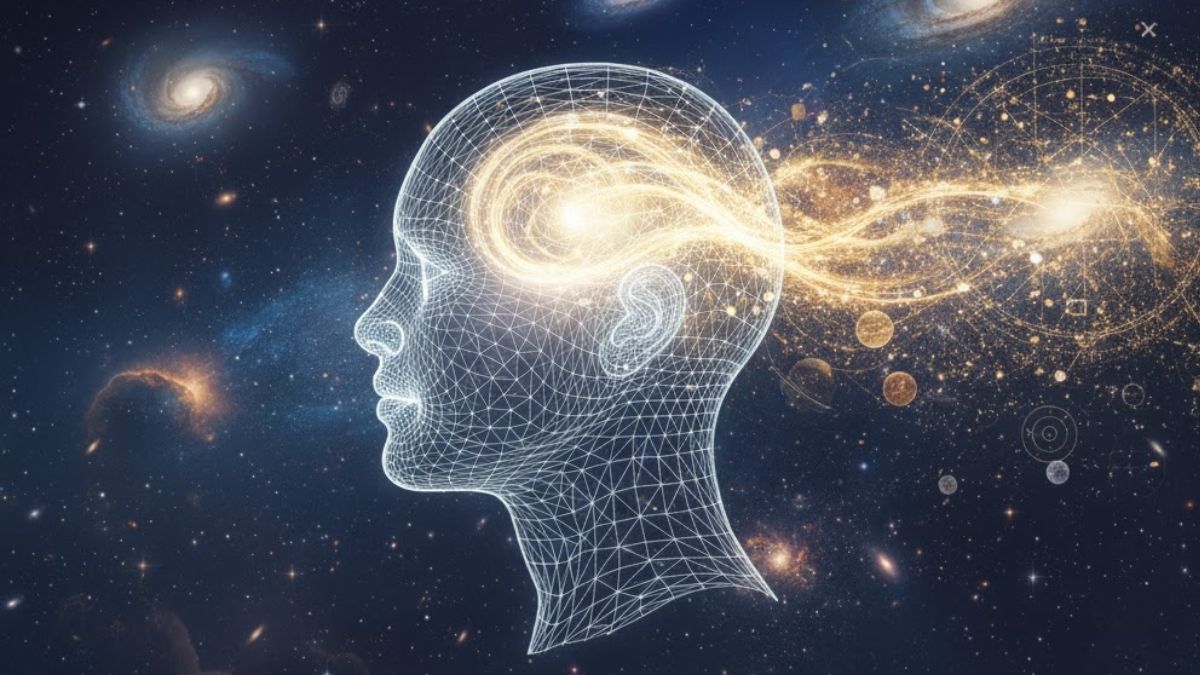
There’s a quiet mystery that follows us through life, one we rarely stop to examine. You’re looking at a tree outside your window. The light bounces off its leaves, enters your eyes, and signals travel through your brain. In that moment, you have an experience. You see the vibrant green, you feel the texture of the bark in your mind. That private, inner world of feelings, thoughts, and sensations is what we call consciousness. It’s the one thing we are all certain exists, and yet, it’s the thing science understands the least.
For centuries, the standard story has been that the physical world is all that exists. Your brain is a biological computer, and consciousness is just a kind of software that runs on it—a fascinating but passive byproduct. But a growing number of scientists and philosophers are asking a radical question: What if that’s not the whole story? What if consciousness isn’t just a passenger along for the ride? What if it actually has a role to play, a tiny but real ability to nudge the physical universe?
This idea pushes us to the very edge of what we know. It connects the deeply personal world of your mind with the cold, hard laws of physics. If there’s even a chance that our observation, attention, or intention can ripple out into reality, it changes everything. So, let’s gently unpack this big idea, one simple piece at a time. What if the universe is not just something we live in, but something we are in a constant, silent conversation with?
What is consciousness, really?
We use the word “consciousness” all the time, but when we try to pin it down, it slips through our fingers like water. It’s not your thoughts; it’s the awareness of your thoughts. It’s not the feeling of cold; it’s the experience of feeling it. Close your eyes and think about the color red. The image that pops into your mind, the personal sense of “redness” you have—that is a piece of your consciousness. It’s subjective. My “red” might be slightly different from your “red,” and we would never know.
Scientists can look at a brain scan and see which parts light up when you feel pain or love. They can map the neurons firing like a intricate city of lights. But they cannot see or measure the actual feeling of pain or love itself. That inner movie is invisible. This is known as the “hard problem” of consciousness: why and how do physical processes in the brain give rise to subjective experience? We have the map of the city, but we don’t know why there are people living inside it, looking out the windows. This gap between the physical brain and the mental experience is the very crack through which our big question slips in.
The quantum observer: Does looking at something change it?
To see if consciousness can influence the world, we have to go to the strangest place in all of science: the quantum world. This is the realm of the incredibly small—atoms, electrons, and photons. Here, the rules are not like the rules in our everyday world. One of the weirdest rules involves something called the “observer effect.”
Imagine you have a single electron. Before you look at it, the electron doesn’t exist in one specific place. Instead, it exists as a cloud of possible locations, a blur of “maybes” scientists call a probability wave. It’s like a spinning coin that is both heads and tails at the same time. But the moment a scientist sets up a detector to observe the electron, this cloud of possibilities collapses. The electron suddenly picks a single, definite location. The act of measurement, of observation, seems to force it to make a choice.
Now, here is the million-dollar question: What counts as an “observation”? Is it the physical detector, made of metal and wires? Or is it the moment a conscious human being sees the result from the detector? If it’s the conscious mind that causes the probability wave to collapse, then consciousness is not just a bystander; it is an active player in shaping reality at its most fundamental level. This idea is hugely debated, and many physicists have other explanations, but it remains one of the most compelling hints that mind and matter might be deeply intertwined.
The power of intention: Can your thoughts affect the world?
Stepping back from the bizarre quantum world, we can look at our own lives. Many people report experiences that suggest their focused thoughts or intentions had an effect on the physical world. Perhaps you were thinking intensely about a friend you haven’t spoken to in years, and suddenly they call. It could be a coincidence, but it feels meaningful. Or consider the well-known “placebo effect.” A patient is given a sugar pill with no medical value, but they believe it is a powerful medicine. Often, their body actually heals itself. Their conscious belief triggers a real, physical change in their biology.
These anecdotes lead to a fascinating question: if a belief can mend a body, could a focused intention influence something outside the body? Some experiments have tried to test this. For instance, researchers have asked people to concentrate on trying to make random number generators produce less random, more ordered sequences. The results in these studies are often very subtle and sometimes controversial, but they occasionally show a tiny statistical effect that suggests something may be happening. It’s as if focused consciousness might be a very weak force, like a gentle breeze, that can sometimes—just barely—be detected in the laboratory.
The universe as a conscious system
This line of thinking leads to the biggest idea of all. What if consciousness isn’t a rare thing that popped up in human brains? What if it’s a fundamental property of the universe, like space or time? This concept is called panpsychism. It suggests that all matter, from an electron to a human neuron, has some tiny, simple form of inner experience. Of course, an electron wouldn’t think or feel emotions. Its consciousness would be a primitive, dim flicker of awareness, nothing like our own.
In this view, the human mind isn’t a creator of consciousness but a kind of condenser or amplifier of it. Our complex brains don’t generate consciousness from nothing; they filter and concentrate this fundamental property that is already everywhere. It’s like a whirlpool in a river. The water was always there, but the whirlpool is a specific, organized form of it. This would mean that the universe is not a dead, mechanical place. Instead, it is alive with potential for experience, and we are a vivid expression of that potential. Our deep feeling of being connected to nature wouldn’t just be a feeling; it would reflect a deeper truth.
Where do we go from here?
The question of whether consciousness influences the physical world is far from settled. For every scientist who sees a profound connection, there is another who sees wishful thinking and poor experiments. The truth is, we are just beginning to explore this frontier. The tools of physics are brilliant for studying the outside world, but we have not yet invented the tools to study the inner world of subjective experience.
Yet, the question itself is thrilling. It invites us to reconsider our place in the cosmos. Are we simply biological robots, or are we participants in a universe that is, in some way, aware through us? The search for an answer is not just about data; it’s about meaning. It challenges the wall we’ve built between the mind and the world and asks us to imagine a universe that is far more mysterious, and far more interesting, than we ever thought.
If our inner world and the outer world are in a delicate dance, what kind of reality are we shaping with our thoughts, our attention, and our intentions every single day?
FAQs – People Also Ask
1. What is consciousness in simple terms?
Consciousness is your personal, inner world of experience. It is the awareness of your own thoughts, feelings, sensations, and the sense of “self” that experiences them. It’s not the brain itself, but what it feels like to be inside that brain.
2. Is consciousness produced by the brain?
Most scientists believe consciousness is generated by the brain’s complex network of neurons. However, how exactly this happens remains a deep mystery, leading some to propose that the brain might instead receive or filter consciousness rather than create it from scratch.
3. What is the observer effect in quantum physics?
The observer effect is the strange phenomenon where simply measuring or observing a tiny particle seems to change its behavior. For example, a particle exists in multiple possible states at once until it is observed, at which point it “chooses” one definite state.
4. Can your thoughts directly change physical reality?
There is no solid scientific evidence that our thoughts can directly move objects or change events in the world outside our bodies. However, the placebo effect shows that beliefs can powerfully change our own bodies, and some controversial studies hint that focused intention might have a very subtle influence.
5. What is panpsychism?
Panpsychism is the philosophical idea that consciousness is a fundamental and universal feature of all things. It suggests that even the smallest particles have a tiny bit of inner experience, and that human consciousness is a much more complex version of this universal property.
6. How is the mind different from the brain?
The brain is the physical, three-pound organ in your head made of cells and chemicals. The mind refers to the entire realm of thoughts, feelings, consciousness, and personality that arises from, or is associated with, the brain’s activity.
7. What are the different states of consciousness?
Beyond our normal waking state, consciousness can change dramatically. This includes states like dreaming sleep, deep meditation, hypnosis, and altered states caused by certain conditions or substances, each offering a different way of experiencing reality.
8. Can animals be conscious?
Most people who live with pets would say yes, and many scientists agree. While we can’t know exactly what an animal experiences, evidence of their emotions, problem-solving skills, and self-awareness strongly suggests they have their own forms of consciousness.
9. What is the “hard problem” of consciousness?
Coined by philosopher David Chalmers, the “hard problem” asks why and how physical processes in the brain create subjective, first-person experiences. It’s the problem of explaining why we have feelings and an inner life, rather than just mechanically processing information like a robot.
10. Do plants have consciousness?
This is a highly debated topic. While plants intelligently respond to their environment, most scientists do not believe they have a nervous system or centralized processing that could support consciousness as we understand it. Their “intelligence” is generally considered to be a complex set of biochemical reactions without an inner experience.
