
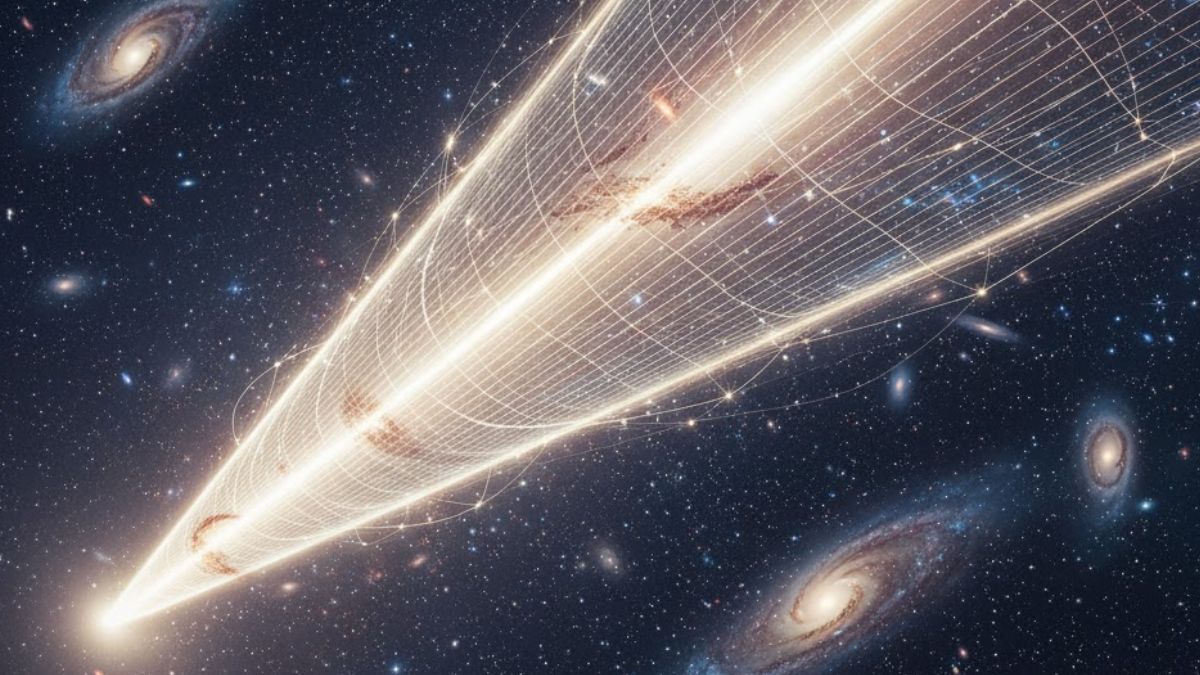
There’s a quiet hum to the universe, a deep, background rhythm that we can’t hear but that scientists can just barely detect. It’s the echo of the biggest explosion of all time—the Big Bang. For nearly a century, we’ve known that our cosmos is growing. Galaxies are drifting apart from one another, carried on the fabric of space like seeds scattered on the surface of a rising loaf of bread. But in recent years, astronomers have stumbled upon a puzzle so profound it challenges our very understanding of physics. It seems that in some places, the universe isn’t just expanding; it’s running away from us, and it might be breaking the ultimate speed limit.
We’re taught that nothing can travel faster than light. It’s one of the most famous rules in science, a cosmic speed limit set by Einstein. The idea of something outpacing light feels like science fiction. Yet, when we point our most powerful telescopes at the farthest edges of the observable universe, the data tells a strange and compelling story. The empty space between galaxies is stretching so fast that those distant galaxies appear to be moving away from us at speeds that could surpass the speed of light.
How can this be? If nothing can go faster than light, how can the universe itself seem to break its own rules? The answer lies in the strange difference between things moving through space, and space itself stretching apart. This isn’t a story about galaxies racing like cars; it’s a story about the road itself growing longer beneath their wheels. So, if the universe can expand faster than light, what does that mean for our future among the stars?
What does it mean for the universe to expand?
To understand this incredible idea, we first need to grasp what we mean by the “expansion of the universe.” It’s not that stars and galaxies are flying through space like rockets. Instead, think of the universe as a giant, stretchy rubber sheet. If you put a few dots on that sheet to represent galaxies and then slowly stretch the sheet, the dots will all move away from each other. You didn’t move the dots; you moved the sheet they were sitting on.
This is exactly what’s happening in our cosmos. The space between galaxies is literally stretching. This is why, no matter where you are in the universe, it would look like every other galaxy is moving away from you. It’s not that we’re at the center of everything; it’s that every point is moving away from every other point as the fabric of space grows.
Now, imagine two dots on our rubber sheet that are very far apart. If you stretch the sheet just a little bit, the gap between those two distant dots will grow by a large amount. A dot that is twice as far away will see its distance double by a much greater number of miles. This is a key to our mystery: the farther away a galaxy is from us, the faster it appears to be receding because there is simply more space between us to stretch.
So, when we talk about the universe expanding, we’re not talking about objects with engines speeding away. We’re talking about the stage on which everything exists getting bigger, and this can lead to some very surprising results.
What is the speed of light, and why is it a limit?
Before we get to the universe breaking the rules, let’s talk about the rules themselves. The speed of light is the fastest anything can travel in the universe. In a vacuum, light zips along at an incredible 186,282 miles per second. To put that in perspective, light could travel around the entire Earth about seven and a half times in just one second. It’s unbelievably fast.
Albert Einstein’s theory of special relativity established this speed as the ultimate cosmic speed limit. According to his math, as an object with mass moves faster and faster, it requires more and more energy to push it even a little bit faster. To actually reach the speed of light, an object with mass would need an infinite amount of energy, which is impossible. So, nothing with any mass at all—not a rocket, not a person, not a single atom—can ever reach or exceed this limit. Light itself, which is made of massless particles called photons, is the only thing that can travel at this speed.
This rule is fundamental. It governs everything from the particles in a lab to the most distant quasars. It’s why the idea of faster-than-light travel is so tantalizing and so frustrating in science fiction. It seems to be a law that cannot be broken. But then, how do we explain what we see at the edge of the universe?
How can something be faster than light if it’s impossible?
This is the heart of the mystery, and the solution is wonderfully sneaky. Einstein’s rule says that nothing can move through space faster than light. However, his theory of general relativity, which describes gravity and the large-scale structure of the cosmos, places no such limit on space itself. The fabric of the universe is allowed to stretch, shrink, and warp at any speed it likes.
Let’s go back to our stretchy rubber sheet. Imagine you have two ants on the sheet, and the fastest an ant can run is one inch per second. That’s their “speed of light.” No ant can run faster than that. But if you start stretching the sheet itself, the distance between the two ants will increase. If you stretch the sheet fast enough, the ants could be moving apart from each other at a speed of two, three, or even ten inches per second, even though both ants are standing completely still.
They aren’t running. The ground beneath their feet is moving. They haven’t broken any ant-law by running too fast; the rules of the sheet are different from the rules for the ants.
This is precisely what is happening in our universe. A galaxy billions of light-years away isn’t firing its engines to speed away from us. Instead, the vast expanse of space between us and that galaxy is stretching, and over such immense distances, the total stretching can add up to a speed that exceeds 186,282 miles per second. The galaxy isn’t moving through space faster than light; the space between us is growing faster than light can cross it.
Where is the universe expanding faster than light?
You might be wondering if this is happening right in our cosmic backyard. The answer is no. In our local group of galaxies, which includes our Milky Way and our neighbor Andromeda, gravity is strong enough to overpower the expansion. Andromeda is actually moving towards us and will eventually collide with our galaxy in a few billion years.
The expansion of space becomes noticeable over truly vast distances. The point where the expansion speed equals the speed of light is called the Hubble Sphere. Beyond this point, the universe is expanding so quickly that light from those distant galaxies can never reach us, and we can never reach them. This creates a boundary for our observable universe.
Think of it like a kayaker trying to paddle upstream against a current that is flowing faster than they can paddle. No matter how hard they try, they will be swept backwards. In the same way, a photon of light from a galaxy beyond the Hubble Sphere is fighting against the expansion of space. Even though it is moving towards us at the speed of light, the space behind it is stretching so fast that it is actually carried further away. Its light is lost to us forever.
This means that with every passing moment, the observable universe—the part we can see—is actually getting smaller. More and more galaxies are crossing that invisible horizon and disappearing from our view.
What is dark energy, and what role does it play?
For a long time, scientists thought the expansion of the universe should be slowing down. After the Big Bang, everything was flying apart, but the collective gravity of all the matter in the cosmos should have been pulling back, putting the brakes on the expansion. Then, in the late 1990s, two teams of astronomers made a shocking discovery. They found that the expansion isn’t slowing down at all. It’s speeding up.
Something is actively working against gravity, pushing galaxies apart ever faster. This mysterious “something” was named Dark Energy. We don’t know what it is. We can’t see it or detect it directly. But we can see its effects. It seems to be a property of space itself, a kind of anti-gravity that causes the stretching of the universe to accelerate.
Dark energy is the engine behind the faster-than-light expansion. It’s the invisible hand that is stretching our rubber sheet at an ever-increasing rate. The more the universe expands, the more space there is, and the more powerful dark energy’s pushing effect becomes. This is why the expansion is accelerating, and why galaxies that are far enough away are being carried beyond our cosmic horizon.
If those galaxies are moving away faster than light, can we still see them?
This is a fantastic question. It seems like a paradox. If a galaxy is now beyond the Hubble Sphere and its light can no longer reach us, how do we know it’s there? The answer lies in the age of the universe. The universe is about 13.8 billion years old. The light we see from the most distant galaxies has been traveling for billions of years to reach us.
We are seeing those galaxies not as they are today, but as they were in the distant past, when the universe was much younger and denser. Back when that light was emitted, the universe was expanding more slowly, and that galaxy was well within our observable sphere. Its light began the long journey towards Earth. It has taken so long to get here that in the meantime, the expansion of the universe has accelerated, and that galaxy has now been carried beyond the point of no return.
So, we have a sort of cosmic photo album of galaxies that are, in a sense, already gone from our view. We can still see their “old light,” but we will never receive any new light from them. They have vanished over the horizon.
What does this mean for the future of the universe?
This faster-than-light expansion paints a startling picture of our cosmic future. If dark energy continues to accelerate the expansion, the universe will become a much lonelier and darker place.
Billions of years from now, any civilizations living in our Milky Way galaxy will look up at a night sky that is almost completely black. All other galaxies will have been carried beyond the cosmic horizon. The evidence for the Big Bang and an expanding universe will be gone. It will seem as if our galaxy is alone in a static, empty void.
This future is often called the “Big Freeze” or “Heat Death.” As galaxies recede, stars will burn out, and energy will become evenly spread across an ever-vaster emptiness. The cosmos will become cold, dark, and silent. It’s a sobering thought, but it’s a future that is dictated by the strange and powerful force of dark energy.
Conclusion
The universe is a place of wonder and mystery, constantly challenging what we think we know. The idea that it is expanding faster than the speed of light seems to shatter a fundamental law of physics, but it does so by playing with the very definition of motion. It’s not the galaxies that are speeding, but the stage beneath them that is stretching. This revelation, driven by the mysterious force of dark energy, not only explains what we see at the edge of the cosmos but also predicts a future for the universe that is both beautiful and lonely.
It makes you wonder, if we are living in a cosmic era where we can still see the evidence of other galaxies, are we uniquely privileged to witness the grandeur of the universe before it fades from view?
FAQs – People Also Ask
1. What is the universe expanding into?
The universe isn’t expanding “into” anything. It’s better to think of it as the fabric of space itself stretching, making the distances between galaxies larger. There is no “outside” for it to expand into; all of space is just getting bigger.
2. Will the expansion of the universe ever stop?
Based on current evidence, it doesn’t look like it. The expansion is actually accelerating due to dark energy. Scientists believe this acceleration will continue indefinitely, leading to a very cold and spread-out universe.
3. Can we ever travel to galaxies moving away faster than light?
No, unfortunately. Since the space between us and those galaxies is expanding faster than light can travel, any signal or spacecraft we send could never catch up to them. They are permanently out of our reach.
4. How do we know the universe is expanding?
We know from observing the light from distant galaxies. Their light is shifted towards the red end of the spectrum, which tells us they are moving away from us. This is called “redshift,” and it’s the primary evidence for the expansion.
5. What is the Big Bang?
The Big Bang is the scientific theory that the universe began as an incredibly hot and dense point about 13.8 billion years ago and has been expanding and cooling ever since. It’s the starting point for everything we see today.
6. Is the Milky Way galaxy also expanding?
No, the Milky Way, along with our local group of galaxies, is held together by gravity. The expansion of the universe only becomes noticeable on the largest scales, in the vast voids between clusters of galaxies.
7. What is a light-year?
A light-year is the distance that light travels in one year. It’s about 5.88 trillion miles. Astronomers use it to measure the immense distances between stars and galaxies.
8. Could our understanding of this be wrong?
Science is always open to new evidence. While the expanding universe and dark energy are the best explanations we have based on current data, future discoveries could always lead us to revise our theories.
9. What is dark matter?
Dark matter is different from dark energy. It is an invisible substance that does not emit or reflect light, but we can detect its gravitational pull on galaxies and galaxy clusters. It helps hold the universe together, while dark energy is pulling it apart.
10. How big is the observable universe?
The observable universe is a sphere centered on us with a radius of about 46.5 billion light-years. This is larger than the age of the universe (13.8 billion years) because of the expansion of space while the light has been traveling to us.
