
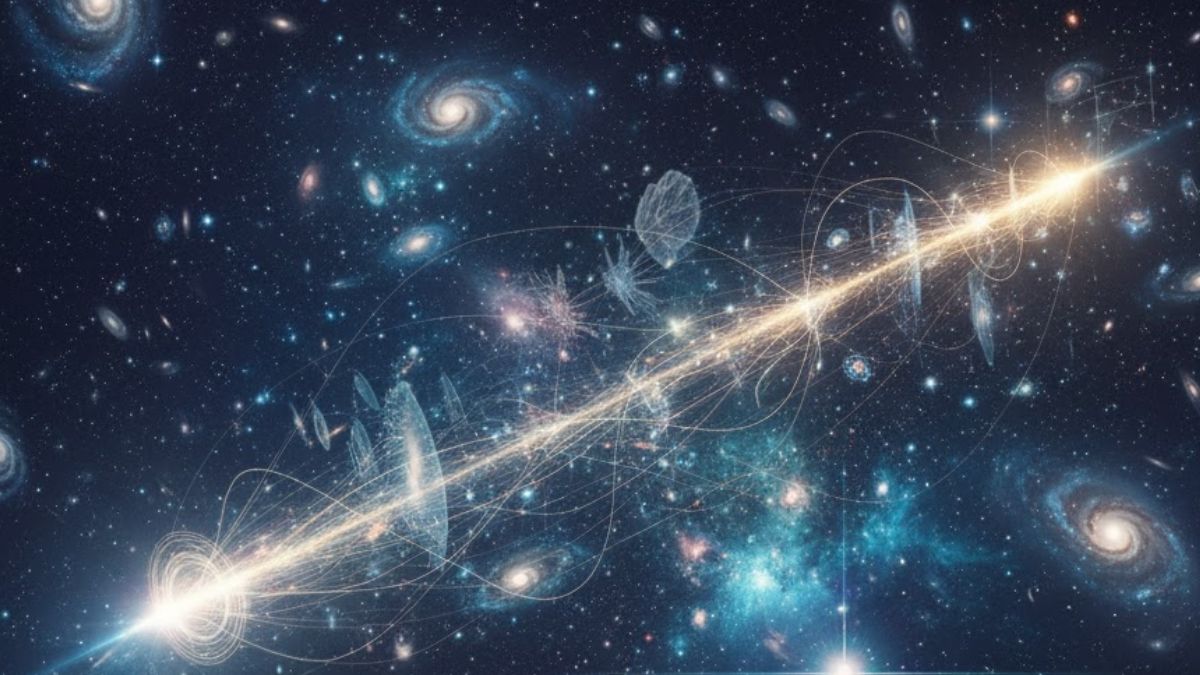
There’s a quiet hum to the universe, a faint signal that has been traveling across the emptiness of space for almost all of time. It’s not a sound we can hear, but a light we can see, if we know how to look. This light is the oldest story ever told, and it’s still arriving here, on our tiny planet, every single day and night.
We often think of space as a black void, dotted with stars and galaxies. But if we could tune our eyes to see a particular kind of glow, the entire sky would light up with a uniform, soft light. This isn’t the light from stars or galaxies. It’s something much, much older. It’s the afterglow of the birth of the universe itself. Scientists call it the Cosmic Microwave Background, but a much better name for it is ancient light.
This article is a journey to understand that light. We’ll explore what it is, how we managed to capture it, and what its faint whispers tell us about where everything came from. So, if this ancient light has been traveling for over 13 billion years, what secrets did it bring with it from the dawn of time?
What is this ‘Ancient Light’ everyone is talking about?
To understand ancient light, we need to rewind the clock—way, way back. Imagine the universe not as a vast, spread-out place, but as an incredibly hot, dense, and tiny point. Everything that now exists—every galaxy, star, planet, and person—was contained in this speck. Then, in a monumental event, it began to expand. This wasn’t an explosion into space; it was the rapid expansion of space itself. We call this the Big Bang.
In the very first moments, the universe was so hot and dense that it was like a thick, blinding fog. Light couldn’t travel freely. It would bounce off particles, trapped in a chaotic soup. For about 380,000 years, the universe was an opaque fireball. But as it expanded, it also cooled. Eventually, it cooled enough for atoms to form. This was the moment the fog cleared. The light that was once trapped suddenly broke free and rushed outwards in all directions.
That first burst of light is what we call the ancient light. It has been traveling ever since, stretching with the expansion of the universe. Its journey began before the first stars were born, before the first galaxies swirled into existence. It is the oldest thing we can possibly observe, a baby picture of the cosmos.
How can we see light from the beginning of the universe?
It seems almost impossible, doesn’t it? To see light from the very beginning of everything. The key is that this light is everywhere. It fills every part of the sky. It’s a background glow that underlies everything else. You can’t see it with your regular eyes because it’s not in the form of visible light anymore.
Think of a hot piece of metal. When it’s very hot, it glows white, then yellow, then red as it cools. Finally, when it’s cool, it stops glowing in visible light, but it still gives off a different kind of energy—heat, which is a form of infrared light. The ancient light of the universe has done the same thing. After traveling for over 13 billion years and stretching with the expanding cosmos, it has cooled down dramatically. It now exists as very faint microwave radiation.
To detect this, we need special telescopes. These aren’t your ordinary telescopes that look like long tubes. They are sophisticated radio telescopes and satellites designed to listen to the sky in microwave frequencies. The most famous of these was the COBE satellite, and later the Planck satellite, which were sent into space to map this faint glow with incredible precision. They essentially took a picture of the sky, subtracted all the bright stars and galaxies, and were left with the uniform, ancient light from the cosmic dawn.
What does this ancient light tell us about the baby universe?
When scientists finally managed to create a detailed map of this ancient light, they didn’t just see a smooth, uniform glow. They saw tiny, tiny variations—little spots that were ever so slightly warmer or cooler than their surroundings. These tiny fluctuations are the most important part of the story.
Imagine the early universe as a pot of very smooth soup just beginning to simmer. The first tiny bubbles that form are the seeds of everything to come. In the cosmic soup, those tiny fluctuations in temperature and density were the seeds for the future structure of the universe. The slightly denser spots had a little more gravitational pull. Over billions of years, they pulled in more and more matter.
These specks grew into the first clumps of gas, which collapsed to form the first stars. Those stars gathered into galaxies, and galaxies clustered into the vast cosmic web we see today. So, the pattern of galaxies and voids we observe in the modern universe was imprinted in that ancient light. By reading these faint patterns, scientists can understand the original ingredients and laws that shaped our cosmos, confirming that the universe is indeed 13.8 billion years old and is made up of mysterious things like dark matter and dark energy.
Why is the discovery of this light such a big deal?
The discovery of the Cosmic Microwave Background in 1964 was a monumental moment in human history. Before this, the Big Bang was just one of several competing theories about how the universe began. The main competing idea was the Steady State theory, which suggested the universe had no beginning and has always looked the same.
The detection of this ancient light was the smoking gun evidence that the universe did, in fact, have a hot, dense beginning. It confirmed the Big Bang theory. Two scientists, Arno Penzias and Robert Wilson, accidentally discovered this background noise while working with a large radio antenna. They found a persistent hiss that came from every direction in the sky and couldn’t be eliminated. At first, they thought it was a problem, even cleaning out pigeon droppings from their antenna! But they soon realized they had stumbled upon the echo of creation. For this accidental discovery, they won the Nobel Prize in Physics.
This discovery transformed cosmology from a field of speculation into a precise science. It gave us a tangible piece of evidence to study from the universe’s infancy, allowing us to test our ideas about physics at energies far beyond what we can create in laboratories.
How do scientists study something so faint and old?
Studying this ancient light is like trying to listen to a whisper in a hurricane. The signal is incredibly faint and there are many modern sources of interference. This is why satellites like Planck were so important. They were sent above Earth’s atmosphere, which blocks a lot of this microwave light, to get a clear, unobstructed view.
These satellites are equipped with incredibly sensitive instruments that can measure temperature differences of less than a millionth of a degree. They scan the entire sky, over and over again, to build up a map. It’s a painstaking process that takes years. The data is then processed by powerful computers to remove any interference from our own Milky Way galaxy and other foreground sources, leaving just the pristine signal from the early universe.
It’s a testament to human ingenuity that we can build machines that not only leave our planet but also peer back in time, capturing the faint remnants of the first light. Each new, more detailed map teaches us something new, pushing the boundaries of what we know about fundamental physics and the origin of the cosmos.
What are the tiny wrinkles in the ancient light?
If the ancient light is a baby picture of the universe, then the tiny temperature variations are the wrinkles in that picture. And just like wrinkles on a person’s face can tell a story of their life, these cosmic wrinkles tell the story of the universe’s infancy. They are the imprint of the first sounds—pressure waves—that traveled through the hot plasma of the early universe.
These ripples were created by quantum fluctuations, tiny random jumps in energy that happened in the first fraction of a second after the Big Bang. During a period of incredibly rapid expansion called inflation, these microscopic fluctuations were stretched to enormous sizes, becoming the seeds for all future structure. By studying the precise pattern of these wrinkles—their size and distribution—scientists can learn about the physics of the universe when it was only a tiny fraction of a second old.
This is one of the most profound ideas: that the largest structures we see in the universe today, like superclusters of galaxies, originated from subatomic quantum jitters. The ancient light is the bridge that connects the world of the very small to the world of the very large.
Could this light tell us about the fate of the universe?
Absolutely. The story this light tells isn’t just about the past; it also holds clues about the future. The way the universe expanded and cooled, and the pattern of the wrinkles in the ancient light, are all governed by the contents of the cosmos. By analyzing this light, scientists have been able to create a precise recipe for the universe.
We now know that the ordinary matter that makes up stars, planets, and us, accounts for less than 5% of the universe. About 27% is dark matter, an invisible substance that holds galaxies together with its gravity. And a whopping 68% is something even more mysterious: dark energy. This is a force that is causing the expansion of the universe to speed up.
The properties of this dark energy are written into the ancient light. By understanding how it has influenced the growth of the universe, we can make predictions about the ultimate fate of everything. Will the universe continue to expand forever at an accelerating rate, eventually leading to a cold, dark end? The answers are hidden in the subtle details of that first light.
Conclusion
The idea that we can point our telescopes at the sky and capture light from the very beginning of time is one of the most beautiful and humbling discoveries in all of science. This ancient light is a universal messenger, a time traveler that has witnessed the entire history of the cosmos, from a hot, dense beginning to the vast, structured universe we live in today.
It connects us directly to our origins, showing us that the grand tapestry of galaxies was woven from the tiniest of threads. The next time you look up at a dark, starry sky, remember that you are not just seeing points of light. You are looking at a universe with a history, a story that began with a flash of light that we are still learning to read. If we can learn this much from a faint whisper of microwaves, what other stories is the universe waiting to tell us?
FAQs – People Also Ask
1. What is the Cosmic Microwave Background in simple terms?
It is the leftover heat glow from the Big Bang. It’s the oldest light in the universe, which has cooled down over billions of years and now appears as a very faint microwave signal that fills all of space.
2. How old is the ancient light we can see?
The ancient light we detect is about 13.8 billion years old. It was released when the universe was roughly 380,000 years old, and it has been traveling through the expanding cosmos ever since.
3. Can I see the Cosmic Microwave Background with my own eyes?
No, you cannot see it with your naked eye. The light has stretched into the microwave part of the light spectrum, which is invisible to human eyes. We need special radio telescopes and satellites to detect it.
4. Who discovered the Cosmic Microwave Background?
It was discovered accidentally in 1964 by two American astronomers, Arno Penzias and Robert Wilson, who were working with a large radio antenna and noticed a persistent background noise they couldn’t explain.
5. Why is it called a ‘background’?
It is called a background because it is a uniform glow that comes from every direction in the sky, and it lies behind all other astronomical objects like stars and galaxies.
6. What caused the wrinkles or variations in the ancient light?
The tiny variations were caused by quantum fluctuations in the very early universe. These tiny differences in density were stretched by a period of rapid inflation and became the seeds for galaxies and clusters of galaxies to form.
7. How does the ancient light prove the Big Bang theory?
The discovery of this pervasive, cool background radiation was a key prediction of the Big Bang theory. It provided the direct evidence that the universe was once in an extremely hot and dense state, confirming the theory over other competing ideas.
8. What is dark energy, and how is it related to the ancient light?
Dark energy is a mysterious force causing the universe’s expansion to accelerate. By studying the patterns in the ancient light, scientists were able to measure how much dark energy exists and how it has influenced the expansion history of the cosmos.
9. Will the Cosmic Microwave Background ever fade away?
Yes, but over an incredibly long time. As the universe continues to expand and cool, the Cosmic Microwave Background will become even colder and fainter, but it will always be there as a remnant of the universe’s hot beginning.
10. What did the Planck satellite tell us about the universe?
The Planck satellite gave us the most detailed map of the ancient light. Its data provided precise measurements of the universe’s age, composition, and the density fluctuations that gave rise to the cosmic structures we see today.
