
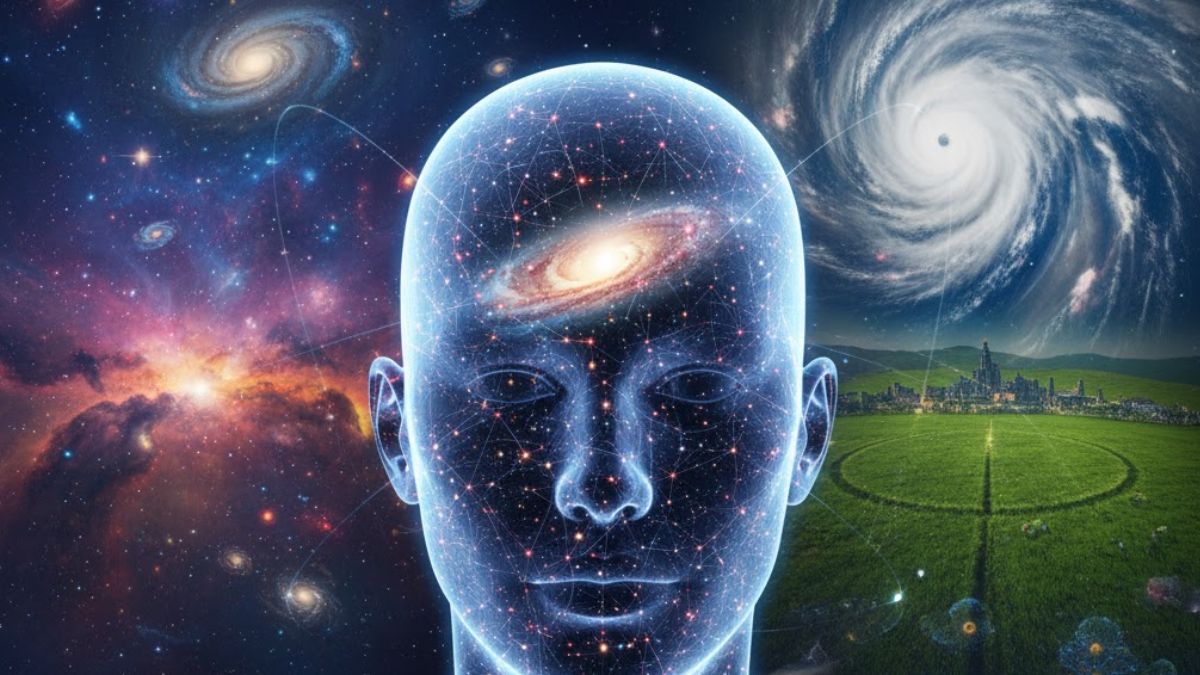
There’s a silent, invisible factory humming away inside your head, working 24 hours a day, even while you sleep. It doesn’t need fuel, it never takes a break, and its main product is something you experience every single moment: your thoughts. Right now, as you read these words, this factory is busy. It’s taking these squiggles on the page and transforming them into ideas, images, and understanding. But if you were to pause and ask, “How is it doing that?” you’d stumble upon one of the greatest mysteries left to solve. The very tool we would use to solve the mystery—the brain—is the mystery itself.
We know our brains are made of cells, mostly neurons, and that they send tiny electrical signals to one another. We can map which parts of the brain light up when you feel sad, hear a song, or remember your first day of school. But there is a giant leap between a neuron firing and the rich, colorful, and sometimes completely random thought of a pink elephant wearing a top hat. How does the squishy, wet, three-pound lump of tissue in our skulls create the entire universe of our conscious experience?
This isn’t just a question for scientists in white lab coats. It’s a question for all of us. What is a thought, really? Where does it come from? And why, after centuries of study, does the process of how the brain creates a thought remain one of the most profound puzzles in all of science? Let’s take a gentle journey into the incredible world inside your head to explore what we know, and more excitingly, what we don’t.
What is a thought, anyway?
If you had to grab a thought out of the air and hold it in your hand, what would it be? You can’t. It has no weight, no color, and no smell. Yet, its effects are powerful. A thought can make you laugh out loud on a quiet bus. A thought can make your heart race with fear, even when you’re safe in your bed. So, if we can’t see or touch a thought, how can we even begin to define it?
Think of your brain as a vast, incredibly complex network of roads. The neurons are the houses, and the connections between them are the streets. A thought is like the traffic flowing through this network. It’s not a single car on a single street; it’s a pattern of movement, a specific route that thousands of cars take at once. When you think of the word “apple,” it’s not one neuron lighting up. It’s a coordinated dance of activity in the areas responsible for its round shape, its red or green color, the crisp sound it makes when you bite it, and even the memory of the pie your grandmother used to bake. This pattern of activity is the thought.
But here’s the tricky part. We can see the traffic pattern from a satellite—we can see which brain areas are active using machines. What we can’t see is the experience of the apple. Why does that particular traffic pattern feel like the taste of a sweet, juicy apple to you? This gap between the physical brain and the personal, private experience of a thought is often called the “hard problem” of consciousness, and it’s the core of the mystery. We can describe the mechanics, but the magic of the inner movie screen in your mind remains unexplained.
Where in the brain do thoughts happen?
It’s tempting to imagine a little command center in your brain, a tiny person sitting at a control panel, receiving messages and creating thoughts. This idea, called the “homunculus,” leads to an endless loop. Who is inside the head of that tiny person? Another, even tinier person? Obviously, that doesn’t work. So, if there’s no central boss, where does the thinking happen?
The surprising answer is: everywhere and nowhere in particular. Different parts of the brain have special jobs, but a thought requires them to work together like a symphony orchestra. The frontal lobes, right behind your forehead, are like the conductors. They help with planning, decision-making, and focusing your attention. The temporal lobes, near your ears, are your memory banks, storing facts and personal experiences. The occipital lobe at the back processes what you see.
When you have a thought, like remembering your best friend’s face, it’s not located in one spot. The visual cortex at the back pieces together the image, the memory centers in the temporal lobe recall who that person is, and the emotional centers add a feeling of happiness. The thought is the entire network lighting up in a specific sequence. There is no single “thought center.” It’s the result of a conversation between billions of neurons across the whole brain, happening in the blink of an eye.
Are thoughts just electrical signals?
When you watch a brain scan, you see colorful blobs lighting up on a screen. These blobs represent areas with increased blood flow and electrical activity. It’s easy to then think, “Aha! A thought is just an electrical spark, like in a computer.” But is that all there is to it? Is the beautiful, complex symphony of your mind just a series of on/off switches?
It’s true that electricity is the brain’s language. Neurons communicate by sending electrical impulses down their lengths. When this impulse reaches the end, it triggers the release of tiny chemicals called neurotransmitters, which float across a tiny gap to the next neuron, like a message in a bottle. This electrochemical process is the fundamental basis of all brain activity. It’s how a signal travels.
But a single spark is not a thought. A thought is a pattern. Imagine the dots and dashes of Morse code. Individually, they are just taps. But when arranged in a specific, complex pattern, those taps can convey a poem, a secret, or a declaration of love. Similarly, a thought is the specific, intricate pattern of millions of these neural sparks firing in a precise sequence and combination. The electricity is the medium, but the thought is the message written in that medium. And we still don’t know how the physical medium creates the intangible message.
How does a brand new thought form?
We spend a lot of time thinking thoughts we’ve had before—what to have for lunch, a song stuck in our head. But what about a truly new, original thought? Where does the idea for a new invention, a solution to a problem you’ve been stuck on, or a creative story come from? This is where the mystery deepens even further.
Your brain is a prediction machine. It’s constantly taking in information from the world and comparing it to what it already knows. Most of the time, it’s on autopilot. But when faced with something new or a problem, it starts connecting old ideas in new ways. This often happens when you’re not even trying, like when you’re in the shower or taking a walk. Your brain’s “default mode network” kicks in, a kind of background processing that quietly links different pieces of information.
This process is like making a new soup by throwing different leftovers from your fridge into a pot. Your brain takes a memory from one area, a feeling from another, and a piece of knowledge from a third, and suddenly—pop—a new connection is made. A new thought is born. This “Aha!” moment, or insight, is one of the most magical processes. It feels like it comes from nowhere because the crucial connections were being made subconsciously, below the surface of your awareness. The brain created something that didn’t exist before, all by itself.
Can we ever build a machine that thinks like us?
This is the ultimate test of our understanding. If we truly knew how the brain creates thoughts, we should be able to replicate it, right? We have built incredible computers that can beat world champions at chess and diagnose diseases from medical scans. These machines are brilliant, but are they thinking?
The difference lies in the words “processing” and “understanding.” A powerful computer can process vast amounts of data on apples—it can list every known variety, its genetic code, and its average weight. It can even generate a picture of an apple. But it doesn’t understand what an apple is. It has never felt the sun on its skin, it doesn’t know the joy of a crunchy bite on a autumn day, and it has no childhood memories associated with apple pie. It has information, but it has no experience.
Our brains are not just cold, calculating machines. They are wet, messy, and emotional. Our thoughts are woven together with our feelings, our memories, and our physical sensations. A computer can simulate a thought, but whether it can ever have a genuine, conscious thought—with all the subjective experience that comes with it—is a wide-open question. Creating such a machine would mean we have finally bridged the gap between biology and consciousness, and we are nowhere near that yet.
Conclusion
The journey to understand how the brain creates thoughts is a journey into the very essence of who we are. We have mapped the stars and split the atom, but the universe within our own skulls remains the final and most fascinating frontier. We understand the players—the neurons, the electricity, the chemicals—and we are beginning to see how they work together. But the leap from that biological symphony to the private, vivid experience of a thought is a leap we still cannot fully make.
Every time you daydream, solve a puzzle, or get lost in a memory, you are experiencing a miracle that science is still striving to explain. It’s a reminder that the most ordinary things about being human are, in fact, the most extraordinary. So the next time a random thought pops into your head, take a second to appreciate it. You’ve just witnessed a magic trick performed by the most complex object in the known universe, and the secret to the trick is still beautifully, wonderfully hidden.
If your thoughts are just the products of a biological machine, does that make them less magical, or does it make the machine itself the greatest wonder of all?
FAQs – People Also Ask
1. How fast does the brain create a thought?
Thoughts are incredibly fast, forming in just a few hundred milliseconds. The initial electrical signal between neurons takes only 1 to 5 milliseconds, but a complex thought involves a wave of activity spreading through many brain regions almost instantly.
2. Do animals have thoughts like humans?
Animals certainly have thoughts, but they are likely very different from ours. They can think about immediate needs like food, safety, and social bonds, but without human language, their thoughts are probably based more on senses, images, and instincts rather than complex inner narratives.
3. Why do we hear our own voice in our head when we think?
This is called “internal monologue.” It’s believed to be a part of how we plan and control our behavior, using the same brain areas involved in actual speech. It’s like the brain rehearsing or simulating talking without moving any muscles.
4. Can a brain think about two things at once?
Not really. What feels like multitasking is actually your brain switching its focus very rapidly between two tasks. This switching makes us less efficient and can lead to more mistakes than if we focused on one thing at a time.
5. What happens in the brain when we have a great idea?
A great idea or “Aha!” moment often involves the anterior superior temporal gyrus. It’s a moment when your brain suddenly reorganizes information, making a new connection between distant concepts that it hadn’t linked before.
6. Are thoughts made of matter?
The thought itself is not made of matter; it is a pattern of information and energy. It is a process happening in the physical matter of the brain, much like a movie is a process happening on the physical screen of a television.
7. How many thoughts does a person have per day?
While it’s very hard to count, some researchers estimate that the average person has between 6,000 and 60,000 thoughts per day. The number varies hugely depending on how you define a single “thought.”
8. Can we control our thoughts?
We can direct our thoughts through focus and practice, like in meditation, but we cannot fully control them. Our brains often generate thoughts automatically based on our environment, memories, and subconscious processes, which is why random thoughts often pop into our heads.
9. Why do we forget thoughts so quickly?
Many of our thoughts are transient because the brain is constantly processing new information. Unless a thought is emotionally significant, repeated, or consciously stored in long-term memory through effort, the neural pattern quickly fades away to make room for new ones.
10. Where do random thoughts come from?
Random thoughts often arise from the brain’s “default mode network,” which is most active when we are not focused on a task. It’s a state of mind-wandering where the brain freely connects memories, ideas, and future plans, often leading to unexpected and seemingly random combinations.
