
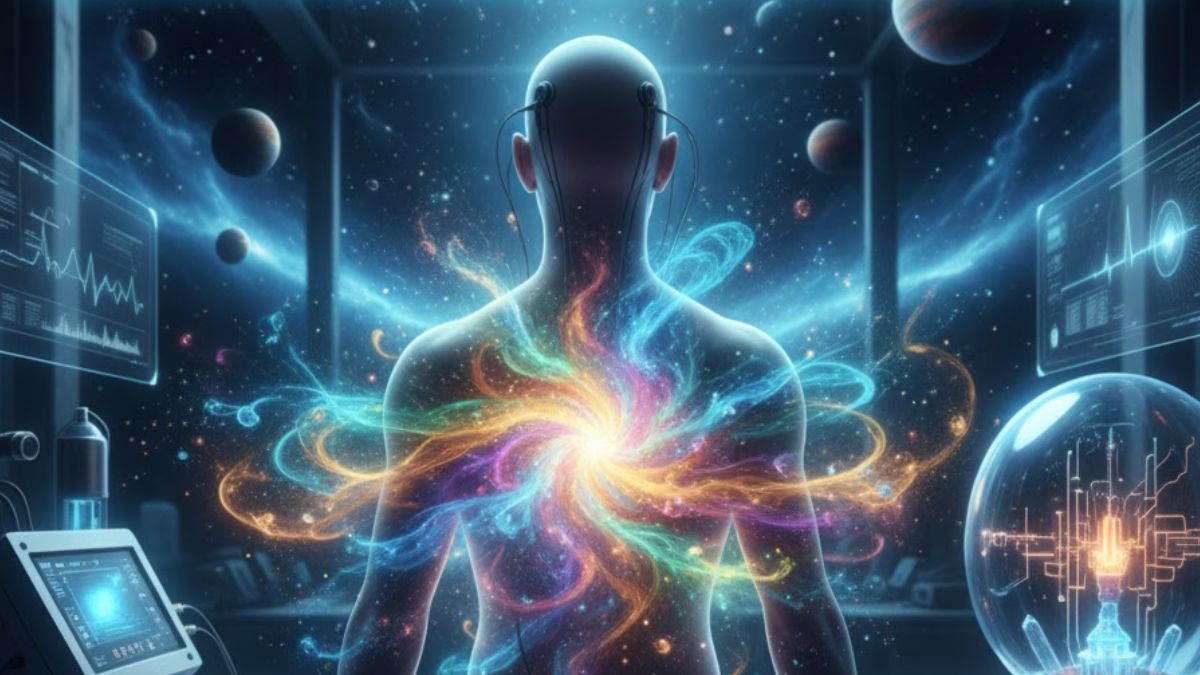
We all know what it feels like to be swept away by an emotion. That sudden burst of joy that makes you feel like you’re floating. The heavy weight of sadness that seems to press down on your shoulders. The hot flash of anger that makes your face feel warm. These experiences are so powerful and so real that we often use physical words to describe them. We say our heart “aches” with grief, or that news “sent a shiver down our spine.”
But are these just figures of speech? Or could it be that our feelings are not just thoughts in our brain, but something more tangible? What if emotions actually create a kind of energy that affects our bodies and maybe even the world around us? We already know that stress, which is tied to emotion, can cause physical symptoms like headaches or a faster heartbeat. So, the line between the mental and the physical is already blurry.
This leads us to a fascinating question that scientists are actively exploring. If emotions cause such clear physical changes, could they be producing a form of physical energy that we could, in theory, measure with the right tools? Could the warmth of happiness or the chill of fear be more than just a feeling? Let’s dive into this intriguing idea and see what science has to say about the hidden energy of our inner world.
What do we really mean by ‘physical energy’?
When we talk about “energy” in everyday life, we might think of the electricity that powers our homes or the fuel that makes our cars go. In science, energy is the ability to do work or cause change. It comes in many forms. Heat is a form of energy—you can feel it radiating from a cup of coffee. Light is energy that travels in waves, allowing us to see. Sound is energy created by vibrations, moving through the air to reach our ears.
Crucially, these forms of energy are measurable. We can use a thermometer to measure heat energy in degrees. We can use a light meter to measure the brightness of a lamp. We can use a decibel meter to measure the loudness of a sound. They are all part of the physical world, governed by the laws of physics.
Now, think about emotion. When you feel a strong emotion like excitement, what happens? Your heart beats faster, your breathing quickens, and you might even feel a bit warmer. These are undeniable physical changes. Your body is using chemical energy, stored in your cells, to power these reactions. So, in a very direct way, emotions trigger the expenditure of physical energy within your body. The emotion itself might start as a signal in your brain, but it sets off a chain reaction that results in measurable physical events.
How does our body turn feelings into physical reactions?
The connection between a thought and a physical sensation is one of the most incredible processes in the human body. It all starts in your brain. When you experience an emotion, a part of your brain called the limbic system lights up with activity. This is your emotional command center.
Once the limbic system is activated, it sends signals through your nervous system, specifically the autonomic nervous system, which controls all the automatic functions of your body—things you don’t have to think about, like your heartbeat, digestion, and sweating. This system has two main branches: the “accelerator” and the “brake.”
Imagine you’re walking home and a dog suddenly barks loudly at you. Your brain perceives a threat. Fear kicks in. Instantly, your brain’s emotional center hits the accelerator—the sympathetic nervous system. It sends a signal to your adrenal glands, which flood your body with chemicals like adrenaline and cortisol. This is often called the “fight-or-flight” response. Your physical energy is redirected in an instant. Your muscles tense, ready for action. Your heart pumps more blood to deliver oxygen. Your pupils widen to let in more light so you can see better. All of these changes require and consume a significant amount of your body’s physical energy reserves.
Conversely, when you feel calm and safe, your brain engages the “brake”—the parasympathetic nervous system. This slows your heart rate, deepens your breathing, and tells your body to rest and digest. This state also uses energy, but it’s for repair and maintenance rather than emergency action. So, every emotion you feel has a direct, physical energy signature inside your body, expressed through your nervous system and hormones.
Can modern machines detect the energy of our emotions?
Since we can measure the physical effects of emotion, like a racing heart or a spike in stress hormones, the answer is a partial yes. Machines in hospitals and labs can absolutely detect these downstream energy changes.
An electrocardiogram (EKG) can measure the electrical energy of your heartbeat and show how it changes when you’re stressed versus when you’re relaxed. A functional Magnetic Resonance Imaging (fMRI) machine can track blood flow in the brain, showing which areas become more active when you feel love, anger, or fear. This blood flow is a sign of increased metabolic energy use in that part of the brain. We can even measure the electrical energy of the brain itself using an electroencephalogram (EEG), which shows different brainwave patterns associated with different states of mind, like calm meditation or focused attention.
However, this is where we hit a fascinating boundary. Scientists can measure the energy changes that emotions cause inside the body. But can they measure the emotion itself as a standalone energy field outside the body? For example, can we put a sensor in an empty room and detect that a happy person was just there, the same way a thermal camera can detect the leftover heat from a person? This is a much trickier question. The emotion, as a subjective experience, is still locked inside the person. We measure its footprints, its consequences, but not the essence of the feeling as a separate, measurable force like magnetism or gravity.
Is there a connection between emotional energy and the world of quantum physics?
This is where the conversation gets really interesting and also highly theoretical. Quantum physics is the science of the very, very small—the world of atoms and particles. In this strange world, things don’t behave like the solid objects we’re used to. One of the key ideas in quantum physics is that particles can be connected in ways that seem to defy classical physics, a phenomenon known as “entanglement.”
Some scientists and philosophers have wondered if consciousness—our mind and our awareness, which includes emotion—could somehow interact with this quantum world. The famous “double-slit experiment” showed that the act of observation can change how a particle behaves. This has led to bold questions: Could our focused intention or emotional state influence matter on a quantum level?
While this is a captivating idea that blurs the line between mind and matter, it’s crucial to know that this is not a proven scientific fact. It remains a hypothesis, a topic of intense debate and ongoing research. Mainstream science does not yet have instruments that can measure a “quantum emotion field” emanating from a person. The connection is a beautiful and mysterious possibility, but for now, it lives more in the realm of philosophy and cutting-edge theoretical exploration than in established, measurable science.
What about the idea of ‘vibes’? Could that be a real energy?
You’ve probably said it yourself: “I’m getting good vibes from this place,” or “That person has a negative energy.” This is a very common human experience. We often feel the “energy” of a room when we walk into a party or a meeting, even if no one has spoken.
Scientifically, this “vibe” is likely not a mysterious, unknown energy field. Instead, it’s our brain’s incredibly sophisticated subconscious system reading thousands of tiny cues from our environment. We are picking up on body language, facial micro-expressions, tone of voice, and even pheromones—chemical signals that animals, including humans, use to communicate.
Your brain processes all this information without you even realizing it, and it gives you a “gut feeling” or a “vibe.” So, while we aren’t measuring an emotional aura with a meter, we are absolutely detecting the physical manifestations of other people’s emotions through our senses. It’s a form of social and biological energy that we are wired to understand intuitively. The “vibe” is real in its effect, but it’s likely a complex cocktail of observable signals rather than a single, measurable energy force.
Conclusion
Our journey into the energy of emotions shows us that the line between feeling and force is incredibly thin. We know for a fact that emotions cause dramatic, measurable changes in our body’s energy systems. From the electricity of our brainwaves to the chemical energy of our hormones, our feelings are powerful drivers of physical events. Science can track these internal storms and calms with impressive precision.
Yet, the core of the emotion—the subjective experience of joy or sorrow—remains a private, internal event. We can measure its shadows and its consequences, but we cannot yet bottle the feeling itself and analyze its energy in a jar. This doesn’t make it any less real. Perhaps the wonder isn’t in proving that emotion is a physical energy like light, but in appreciating how a non-physical thought can so powerfully command the physical world of our own bodies. It makes you wonder, if our feelings can so profoundly change us, what kind of energy are we creating in the world every single day?
FAQs – People Also Ask
1. Can emotions make you feel physically tired?
Yes, absolutely. Intense emotions like stress, anxiety, or even great excitement use up a lot of your body’s energy resources. Your muscles may tense for long periods, and your brain works overtime processing feelings, which can leave you feeling completely drained and physically exhausted.
2. Is there a device that can read a person’s emotions?
There is no device that can directly “read” an emotion like a barcode scanner. However, devices like polygraph tests (lie detectors) and wearable tech can measure physical signs associated with emotion, such as heart rate, sweating, and brain activity, and then make an educated guess about the emotional state.
3. What is the strongest human emotion?
This is debated, but many psychologists point to fear as a very powerful and primal emotion because it is directly linked to our survival instinct. However, emotions like love and grief can also be incredibly intense and long-lasting, influencing a person’s entire life.
4. Can emotions affect your physical health?
Yes, in very significant ways. Chronic stress and negative emotions can weaken your immune system, raise blood pressure, and contribute to heart disease. Conversely, positive emotions like happiness and contentment can boost your immune system and contribute to a longer, healthier life.
5. What is emotional energy in psychology?
In psychology, “emotional energy” isn’t a physical force but a metaphor for a person’s capacity to engage in emotional life. Someone with high emotional energy might feel resilient, motivated, and able to connect with others, while low emotional energy can feel like apathy or emotional exhaustion.
6. Why do we feel emotions in specific parts of our body?
Researchers have found that different emotions can trigger distinct sensations in the body. For example, anxiety might be felt as a knot in the stomach, while pride might create a warm feeling in the chest. This is because different emotional signals activate different parts of our nervous system, affecting blood flow and muscle tension in unique areas.
7. Can two people’s brainwaves sync up through emotion?
Some fascinating studies suggest that when people share a strong emotional experience, like watching a compelling movie or making music together, their brainwave patterns can become synchronized. This “neural coupling” might be part of what we experience as a deep connection with someone.
8. Do animals have emotions that we could measure?
Most scientists and animal behaviorists agree that animals do experience basic emotions like fear, joy, and anger. We can measure this through their physical reactions—like a dog’s wagging tail (joy) or a cat’s raised fur (fear)—and through observing their brain activity, which is similar to ours in emotional centers.
9. What is the link between emotion and body temperature?
Strong emotions can directly influence your body temperature. Anger or embarrassment can cause vasodilation, bringing more blood to the skin’s surface and making you feel hot and flushed. Fear can cause vasoconstriction, pulling blood away from the skin to your core, making you feel cold and pale.
10. Is crying a release of emotional energy?
Many people report feeling a sense of relief after a good cry. Scientifically, crying, especially emotional tears, is thought to release stress hormones and other chemicals from the body. It also activates the parasympathetic nervous system, which helps your body calm down, making it a physical release of built-up emotional tension.
