
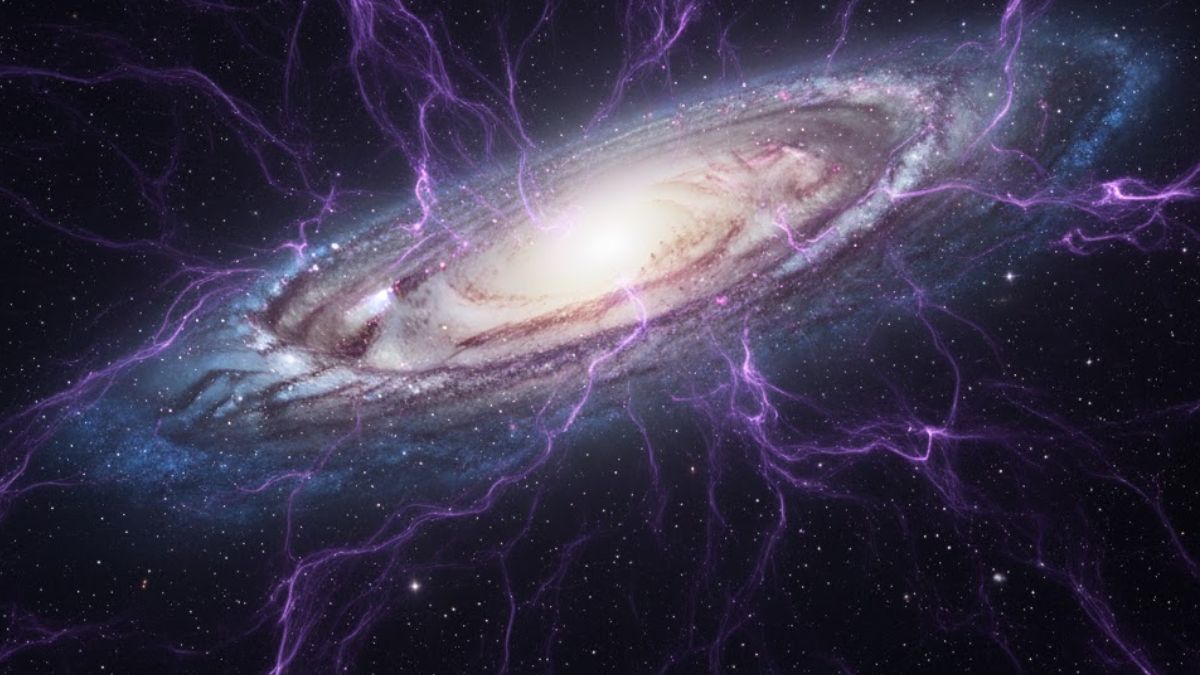
There’s a secret ingredient to our universe, a kind of cosmic ghost that holds everything together. We know it’s there because without it, galaxies would fly apart and the night sky would look completely different. Yet, for all its importance, we have never seen it, touched it, or directly detected it. This mysterious substance is called dark matter, and it makes up about 85% of all the matter in the cosmos. Think about that for a moment. Everything you can see—the planets, stars, galaxies, and even your own hands—accounts for less than one-fifth of what’s actually out there. The rest is an invisible presence, a silent partner in the dance of the universe.
The story of dark matter begins not in a lab, but in the motions of distant stars. Back in the 1930s, a sharp-minded astronomer named Fritz Zwicky was watching how galaxies move within a vast cluster. He noticed they were whizzing around so fast that they should have torn themselves apart long ago. The gravity from all the visible stars and gas clouds wasn’t nearly strong enough to hold the cluster together. It was as if an invisible glue, providing extra mass and extra gravity, was keeping everything from flying off into the void. He called this missing stuff “dunkle materie,” or dark matter.
So, what exactly is this hidden material that dominates our universe? If we can’t see it, how do we know it’s real? And why is it so important to the very structure of everything we know? The journey to understand dark matter is one of the greatest detective stories in science, full of clever clues, puzzling gaps, and a universe that is far stranger and more wonderful than it appears.
What is the first clue that dark matter exists?
The first solid evidence came from watching how things move in space, much like Zwicky did. Imagine you are spinning a lasso over your head. The rope pulls taut, and the weight at the end swings around in a circle. The force of your arm pulling on the rope is what keeps the weight from flying away. Now, picture a galaxy like our Milky Way. It’s a gigantic cosmic lasso, with stars orbiting around its center. Scientists expected that stars closer to the bright center would orbit very fast, while stars out on the dim edges would move much more slowly, just as the outer planets in our solar system orbit the sun more slowly than the inner ones.
But when they measured the speeds of these stars, they got a shock. The stars on the outer edges of galaxies were moving just as fast as the ones near the center. This was impossible according to the laws of gravity and the amount of visible matter. The galaxy didn’t have enough gravity to hold onto these speedy outer stars. It should have been flinging them into deep space. The only explanation was that there had to be a huge amount of extra matter we couldn’t see. This matter forms an enormous, invisible sphere around the galaxy, a “halo” of dark matter that provides the extra gravitational pull to keep the stars from escaping.
How do we know dark matter is there if we can’t see it?
We know it’s there because of its gravitational effects. Gravity is the force that pulls things together, and the amount of gravity an object has depends on its mass. Dark matter has mass, and a lot of it, so it tugs on the things we can see. One of the most amazing ways we detect it is through a phenomenon called “gravitational lensing.” Albert Einstein taught us that very massive objects can warp the fabric of space and time, like a heavy ball sitting on a stretched-out rubber sheet. Light travels in a straight line, but if space itself is bent, the light path will bend, too.
When light from a distant galaxy travels toward us and passes through a cluster of galaxies, the immense gravity of the cluster—mostly from its dark matter—acts like a giant lens. It bends the light, distorting the image of the background galaxy into strange arcs and smears. By studying these distortions, astronomers can literally map out where the dark matter is. It’s like looking at the shadow of an invisible object. We can’t see the object itself, but we can see the shape of its shadow and know something is blocking the light.
What could dark matter possibly be made of?
This is the million-dollar question, and scientists are still working on the answer. We know what it is not. It is not planets, asteroids, or black holes made from regular atoms. We call those things MACHOs, or Massive Compact Halo Objects, and while they exist, there simply aren’t enough of them to account for all the dark matter. The leading idea is that dark matter is made of something entirely new and exotic, a particle we haven’t discovered yet.
The most popular candidate is a WIMP, which stands for Weakly Interacting Massive Particle. Imagine a ghostly particle that barely interacts with normal matter. It doesn’t reflect light, absorb light, or emit light. It doesn’t bump into atoms in your body. It could be streaming through you right now, and you would never feel a thing. Its only interaction seems to be through gravity, which is why it has remained so hidden. Scientists are trying to catch these elusive particles using incredibly sensitive detectors located deep underground, in old mines and tunnels, where they are shielded from other cosmic radiation. So far, no definitive catch has been made, but the search continues.
Why can’t our regular science tools detect it easily?
Our everyday tools, and even our most advanced telescopes, are designed to see things using light—whether it’s visible light, radio waves, or X-rays. They rely on matter interacting with electromagnetic force. Dark matter, by its very nature, ignores this force completely. It is “dark” not because it’s black, but because it is transparent to light. It doesn’t block light, glow, or shimmer. It is completely and utterly invisible to our eyes and our telescopes.
This is why we have to be so clever in our search. We can’t build a better camera to see it. Instead, we have to observe its gravitational footprint. It’s like trying to study the wind. You can’t see the wind itself, but you can see the leaves rustling, feel it push against your skin, and watch it bend the branches of a tree. Dark matter is the cosmic wind; we see its effects on the things around it, but we have yet to feel its direct push.
How does dark matter help to shape our universe?
Dark matter is the cosmic architect. In the early universe, after the Big Bang, everything was a hot, smooth soup of particles. But there were tiny, random fluctuations in density. The gravity of dark matter, which doesn’t get pushed around by light like normal matter, began to pull on these slight clumps. It acted as a gravitational scaffold, pulling more and more matter together. Normal matter, which is affected by radiation pressure, was able to then fall into the gravitational wells created by these dark matter clumps.
Over billions of years, this process allowed galaxies to form. The dark matter formed vast, invisible halos, and the visible gas and stars condensed at the centers. Without dark matter’s strong gravitational pull, there wouldn’t have been enough time or enough force for the universe to form the magnificent structures we see today. There would be no grand spiral galaxies, no colossal clusters, and perhaps no stars or planets. We owe our very existence to this unseen framework.
What is the difference between dark matter and dark energy?
It’s easy to get these two “dark” concepts confused, but they are completely different and, in some ways, total opposites. Think of it like this: dark matter is an invisible substance that pulls things together with its gravity. It is the glue that holds galaxies and clusters together. Dark energy, on the other hand, is a mysterious force that is pushing things apart. It is causing the expansion of the entire universe to speed up.
So, dark matter is about attraction and structure-building. Dark energy is about repulsion and cosmic expansion. One pulls, the other pushes. Both are invisible and dominate the cosmos, but they work in opposite ways. Together, they make up about 95% of the total mass-energy content of the universe, leaving the familiar world of atoms and light as just a tiny fraction of what’s really out there.
Could we be completely wrong about dark matter?
This is a fantastic and important question. Science is always about testing ideas, and some scientists have proposed that maybe we don’t need dark matter at all. Perhaps, they suggest, our understanding of gravity is wrong. On the very large scales of galaxies, maybe gravity works differently than how Isaac Newton or Albert Einstein described it. This idea is known as Modified Newtonian Dynamics, or MOND.
MOND proposes that the effects we blame on dark matter are actually just a result of gravity being stronger at very low accelerations. It’s an intriguing idea, and it can explain the rotation speeds of some galaxies quite well. However, it has trouble explaining all the evidence, especially the observations of colliding galaxy clusters and the detailed patterns in the cosmic microwave background, the leftover heat from the Big Bang. For now, the dark matter explanation, with its invisible particle, seems to fit the widest range of observations, but scientists remain open to all possibilities.
What are scientists doing right now to find dark matter?
The hunt for dark matter is a global scientific effort happening on three main fronts. First, there are the particle colliders, like the Large Hadron Collider. Scientists are smashing particles together at incredibly high speeds, hoping to create a dark matter particle in the debris of the collision. Second, there are the direct detection experiments buried deep underground. These ultra-sensitive devices are waiting for the very rare occasion when a dark matter particle might bump into the nucleus of a normal atom, creating a tiny signal.
The third front is in space. Telescopes like the Hubble and the James Webb Space Telescope are mapping the distribution of dark matter across the universe through gravitational lensing. Other space-based instruments are looking for indirect signals, like the unusual gamma-rays or other radiation that could be produced if two dark matter particles were to collide and annihilate each other. It’s a multi-pronged attack, and a discovery from any of these methods would revolutionize our understanding of physics.
Will we ever be able to use dark matter?
This ventures into the realm of science fiction, but it’s a fun thing to ponder. Since dark matter doesn’t seem to interact with light or normal matter in any significant way, it would be incredibly difficult to harness. You couldn’t build a wall out of it or use it as fuel in a conventional sense. You can’t contain it in a box because it would likely just drift right through the walls.
However, its gravitational properties are immense. If we could somehow understand its nature completely, perhaps a future, far more advanced civilization could learn to manipulate it. Imagine being able to shape gravitational fields for propulsion or to create stable wormholes for travel. For now, this is pure speculation, but the potential of understanding the fundamental stuff that makes up most of our universe is a powerful driver for scientific exploration.
The universe is a place of profound mystery. We live in a world of light and matter, but we are surrounded by an invisible cosmos that dictates the fate of galaxies. Dark matter is the silent, unseen majority, the hidden framework upon which the visible universe is built. It challenges our assumptions and pushes the limits of our knowledge. The search for it is more than just a quest to find a new particle; it is a journey to understand what the universe is truly made of.
So, the next time you look up at the stars, remember that you are only seeing a tiny part of the story. The rest is hidden in plain sight, waiting for a brilliant mind to finally reveal its secrets.
FAQs – People Also Ask
1. Has dark matter been proven to exist?
While we haven’t directly detected a dark matter particle, the evidence for its existence is very strong. We observe its gravitational effects on galaxies, galaxy clusters, and even the light from distant objects, which leaves little doubt that a massive, invisible substance is out there.
2. Is dark matter dangerous to humans?
No, dark matter is not considered dangerous. It is thought to pass through normal matter, and through our bodies, without any interaction. Trillions of these particles are likely streaming through you every second without any effect.
3. Can dark matter form planets or stars?
No, dark matter cannot clump together to form dense objects like planets or stars. Because it doesn’t interact with itself or light, it can’t lose energy and collapse into tight spheres. It instead forms vast, diffuse halos around galaxies.
4. Who actually discovered dark matter?
The concept was first proposed by Swiss astronomer Fritz Zwicky in the 1930s. However, the most compelling evidence came decades later from astronomer Vera Rubin, who meticulously studied the rotation of galaxies and confirmed the need for unseen mass.
5. What is the connection between dark matter and black holes?
They are different things. Black holes are extremely dense regions of space made from regular matter where gravity is so strong that not even light can escape. Dark matter is a widespread, invisible substance that does not collapse into such dense points.
6. How much of the universe is dark matter?
Dark matter makes up about 27% of the total mass-energy content of the universe. The ordinary matter that makes up stars, planets, and us makes up less than 5%. The rest, about 68%, is the even more mysterious dark energy.
7. Can we create dark matter in a lab?
Scientists are trying to create dark matter particles by colliding normal particles at high speeds in machines like the Large Hadron Collider. If dark matter is a WIMP, it might be produced in such collisions, but we have not confirmed this yet.
8. Why is it so hard to study dark matter?
It is hard to study because it does not emit, absorb, or reflect any form of light or electromagnetic radiation. Its only known interaction is through gravity, which is a very weak force, making direct detection incredibly challenging.
9. Does dark matter have weight?
Yes, dark matter has mass, which is why it exerts a gravitational pull. Its mass is what influences the motion of stars and bends the path of light, allowing us to infer its presence.
10. Could dark energy and dark matter be the same thing?
No, they are considered two entirely different phenomena. Dark matter pulls things together with gravity, while dark energy pushes the universe apart, causing its expansion to accelerate. They have opposite effects on the cosmos.
