
 By SAJID ali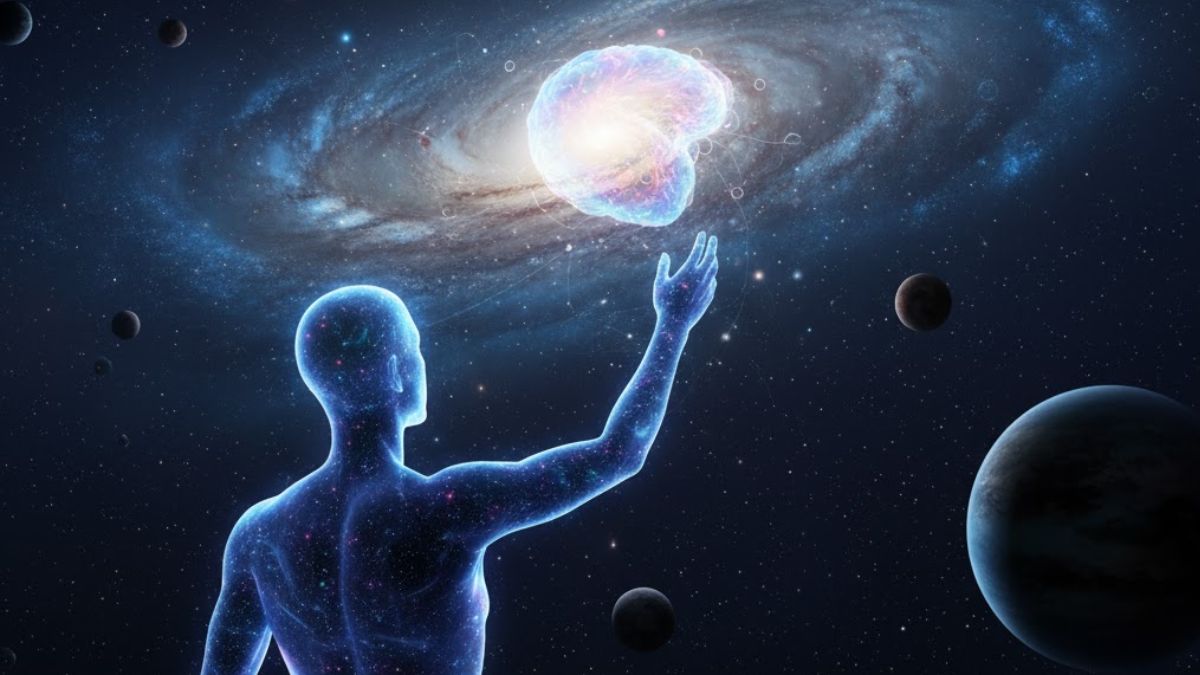
For thousands of years, people have looked at a loved one and felt there was something more than just a physical body looking back. There’s a light in the eyes, a warmth in a smile, a sense of a person being truly present. This feeling has led nearly every culture and religion to believe in a soul—an invisible essence that makes us who we are. It’s the part of you that feels joy, that remembers your childhood, that loves. But what is it, really? We can’t see it, weigh it, or touch it. So where does it live, and what is it made of?
Science has done an amazing job explaining our physical world. It tells us our thoughts are electrical signals in the brain and our bodies are made of atoms. But when it comes to consciousness—that inner experience of being you—the map still has blank spaces. How do these electrical signals create the feeling of watching a beautiful sunset or the deep love for a family member? It’s a mystery that sits at the border between science and philosophy.
This is where a fascinating idea comes in. What if the soul isn’t a magical ghost, but something more grounded in the rules of the universe? What if it is a form of energy that we haven’t discovered or understood yet? We know energy can’t be created or destroyed, only transformed. It powers our cities and our bodies. Could it also power our very being? This question takes us on a journey from ancient beliefs to the edges of modern physics, exploring the possibility that the most intimate part of us might be woven into the fabric of the cosmos itself.
So, if the soul is a type of unknown energy, what would that mean for life, for death, and for our understanding of reality?
We use the word “energy” all the time. We say we don’t have any energy in the morning before coffee, or we talk about the energy from the sun. But to understand this idea of the soul, we first need to grasp what energy actually is. In the simplest terms, energy is the ability to do work or make something happen. It’s not a physical object you can hold; it’s a property, a potential. Think of a rock sitting at the top of a hill. It has potential energy. Push it, and that energy becomes movement, tumbling down the slope.
The most important law in science regarding energy is the First Law of Thermodynamics. It states that energy cannot be created or destroyed; it can only change from one form to another. The electricity that powers your lamp started as another kind of energy, maybe in a power plant. The food you eat contains chemical energy, which your body transforms into the energy you need to move and think.
Now, think about a campfire. You have a physical log. When you burn it, it doesn’t just disappear. It transforms. The solid wood becomes heat (thermal energy), light (radiant energy), and smoke. The physical matter changes into different forms of energy that we can feel and see. If energy is fundamental, eternal, and constantly shifting shape, it starts to sound a little like how many people describe the soul—as an immortal, invisible essence that is the core of a person. This doesn’t prove anything, but it opens a door to a very interesting conversation.
If we are considering the soul as energy, we have to look at the place where “we” seem to live: the brain. Science has a very good understanding of how the brain works on a mechanical level. Your brain is an incredibly complex network of about 86 billion tiny cells called neurons. These neurons communicate with each other using tiny electrical impulses and chemical signals.
When you decide to raise your hand, your brain sends a lightning-fast electrical command down your nerves to your muscles. When you smell fresh bread, specific neurons fire to create that sensation. We can even see this activity with machines like an EEG, which shows the brain’s electrical waves. Scientists can pinpoint which parts of the brain handle vision, sound, memory, and emotion. If part of the brain is damaged by an injury, a person can lose very specific abilities, like the capacity to form new memories or recognize faces.
This all points to a clear conclusion: our mind is a product of our physical brain. But here is the puzzling part, often called the “hard problem of consciousness.” Science can explain how the brain works, but it hasn’t yet explained why we have a subjective experience. Why do those electrical signals feel like anything at all? Why isn’t it all just happening in the dark, like a computer processing data without any inner feeling? The gap between the brain’s mechanics and the experience of consciousness is where the idea of an additional component—a soul, a life force, an unknown energy—finds room to exist.
This is perhaps the most profound question tied to the idea of the soul. If the soul is a form of energy, and energy cannot be destroyed, what happens to our energy when our physical body stops functioning? From a purely biological standpoint, when a person dies, the body’s processes shut down. The heart stops pumping oxygen, the brain cells cease their electrical firing, and the body begins to decompose.
According to the law of conservation of energy, the energy that was in that body must go somewhere. The chemical energy stored in our cells is released as heat as the body breaks down. In a way, our physical energy returns to the earth, nourishing the soil and the life within it. It is recycled back into the ecosystem, just like the log in the campfire.
But if the soul is a separate, conscious energy that is merely housed by the body, then its journey might be different. Perhaps this personal, conscious energy is released in a way we cannot yet measure. Many people who have had near-death experiences report a feeling of leaving their body, of moving towards a light, or of a profound sense of peace. While these experiences are deeply personal and not scientific proof, they are consistent with the idea of a conscious self detaching from its physical shell. If the soul is energy, death might not be an end, but a transformation—a change from one state of being to another, just as solid wood transforms into heat and light.
Human history is a story of discovering things that were always there but we just couldn’t see. For a long time, we couldn’t see bacteria, we didn’t understand radiation, and we had no concept of radio waves. Yet, these things were always real, always affecting our world. They were unknown forces until we developed the tools and the knowledge to detect and understand them.
Radio waves are a perfect example. They are a form of invisible energy that carries music, voices, and data all around us, right through our homes and our bodies. If you told someone from the 1700s about this, they would think it was magic. We only discovered this energy because we learned how to build devices like radios and antennas that could translate this invisible energy into something we can perceive.
So, it is entirely possible, even likely, that there are other forms of energy or matter in the universe that we haven’t discovered yet. Physicists today talk about dark matter and dark energy, which seem to make up most of the universe, but we can’t see or interact with them directly. We only know they exist because of their gravitational effects on galaxies. The idea of the soul as an unknown energy fits into this category. It might be a type of energy that is so subtle or operates on such a different principle that our current scientific instruments cannot detect it. It doesn’t mean it’s not real; it might just mean our science isn’t advanced enough to find it.
The idea that our essence is a kind of energy is not new. In fact, it’s a concept that appears in spiritual traditions all over the world, often using different words. In many Eastern philosophies, this life force energy is a central belief. In Hinduism and Yoga, it is called “Prana,” the vital energy that flows through all living things. In Chinese culture, it is “Qi” or “Chi,” the energy that flows through pathways in the body called meridians. The goal of practices like yoga and tai chi is to balance and enhance this inner energy.
These traditions have believed for millennia that this energy is the force behind life and consciousness. It is seen as a real, tangible force that can be cultivated and felt, even if it can’t be put in a box. In the West, the concept is often more tied to religion, where the soul is a spiritual entity created by God. But even here, descriptions of the soul often use words like “light” or “fire,” which are metaphors for energy. The shared thread across these diverse beliefs is the conviction that there is more to a human being than just a physical body. There is an animating spark, a vital force, that distinguishes a living person from a corpse.
While mainstream science focuses on the brain, some brave researchers and doctors have ventured into studying phenomena that might relate to the soul as energy. One of the most discussed areas is the study of near-death experiences (NDEs). Dr. Bruce Greyson, a psychiatrist, has spent decades collecting and analyzing thousands of these accounts. People from different backgrounds consistently report similar events: floating outside their body, watching doctors work on them, traveling through a tunnel, and meeting a being of light.
Another intriguing concept from the world of physics is the law of conservation of information, sometimes playfully called the “physics of immortality.” It suggests that information, like energy, cannot be destroyed. If our consciousness is a form of information—the unique pattern that makes you you—then according to this law, that information would not be lost when the body dies. Some theoretical physicists, like Roger Penrose, have even proposed that consciousness might arise from quantum processes within the brain’s neurons, suggesting a connection between our inner world and the most fundamental, and strange, level of reality.
It’s crucial to note that this is frontier science. It is controversial and not widely accepted. There are always attempts to find biological explanations for NDEs, such as oxygen deprivation in the brain. But the consistency of the experiences and the fact that some people report verifiable details they could not have known while unconscious keep the debate alive and fascinating.
If the soul is a form of energy, and if that energy is eternal, then our connection to the cosmos becomes much deeper and more literal. The atoms that make up our bodies were forged in the hearts of ancient stars that exploded long before our solar system was born. We are, quite literally, made of stardust. Our physical connection to the universe is already a scientific fact.
Now, take that a step further. If our conscious essence is also a form of energy, then that, too, is part of the universe’s great dance of energy transformation. The same energy that powers the sun, that spins the galaxies, and that sparked the first life on Earth could be the same fundamental substance that animates you and me. This idea is both humbling and empowering. It suggests that we are not just isolated biological machines living on a tiny rock, but integral, conscious parts of a vast, dynamic, and energetic universe.
This perspective bridges the gap between the spiritual and the scientific. The feeling of awe when looking at a starry night sky, the sense of deep peace in nature, or the feeling of a universal connection during meditation—these could be more than just emotions. They could be glimpses of our true nature, a resonance between the energy within us and the infinite energy of the cosmos. We are not in the universe; the universe is in us.
The question of the soul is one of humanity’s oldest mysteries. We may never have a definitive answer that satisfies both the spiritual seeker and the rigorous scientist. But by exploring the idea that the soul could be a form of unknown energy, we find a beautiful middle ground. It’s an idea that respects the laws of physics while leaving room for the magic of consciousness. It suggests that the love, memories, and light that make us who we are might not be confined to our bodies, but could be part of the eternal, unbreakable flow of energy that defines the cosmos. Perhaps we are not just human beings having a spiritual experience, but spiritual beings—energy beings—having a human experience.
What do you think your consciousness would feel like if it were pure energy, free from the limits of a physical body?
1. What is the soul made of?
There is no scientific answer, as the soul is not a scientific concept. From a spiritual or philosophical view, it is often described as an immaterial essence, consciousness, or life force that makes a person who they are. Some theories suggest it could be made of a form of energy or information that we cannot yet measure.
2. Is there any proof that the soul exists?
There is no widely accepted scientific proof for the soul. Evidence is largely personal, philosophical, or based on anecdotal accounts like near-death experiences. These experiences are deeply meaningful to those who have them but are difficult to test and verify under controlled scientific conditions.
3. What is the difference between the soul and the mind?
The mind is generally associated with the brain’s functions—thoughts, memories, emotions, and personality—which are seen as products of physical processes. The soul is typically considered a deeper, spiritual essence that may contain or be separate from the mind, and is often thought to survive physical death.
4. Can the soul be weighed?
A famous but highly disputed experiment from 1907 by Dr. Duncan MacDougall claimed the soul had weight, about 21 grams. However, his methods were flawed, his results were inconsistent, and his experiment has never been successfully replicated under scientific conditions. Most scientists dismiss this idea.
5. Do animals have souls?
This depends entirely on cultural and religious beliefs. Many religions believe only humans have souls. Others, including some spiritual traditions and many pet owners, feel that animals do possess a soul or spirit, pointing to their capacity for love, loyalty, and consciousness.
6. What does energy mean in spirituality?
In spirituality, energy often refers to a non-physical life force or vibration. Concepts like Chi, Prana, or life force energy are believed to flow through all living things, influencing health, consciousness, and spiritual connection. It is seen as a subtle energy distinct from the types science typically measures.
7. Where is the soul located in the body?
There is no scientific location for the soul. Philosophically and religiously, it is often seen as non-local—meaning it isn’t in one specific place but is the animating principle of the entire body. Some traditions associate it with the heart or the pineal gland in the brain, but this is symbolic, not scientific.
8. What is consciousness made of?
From a scientific standpoint, consciousness is a product of the brain’s complex neural networks and their electrical and chemical interactions. However, how these physical processes create subjective experience is still a mystery, leading some to theorize it might involve unknown physical or energetic properties.
9. Can you lose your soul?
In religious contexts, the concept of “losing your soul” usually refers to damnation or spiritual separation from a divine source due to sin or negative actions. It is not a concept that exists in science, as there is no entity to lose.
10. How does the idea of the soul fit with physics?
It doesn’t fit directly with known physics, but the laws of physics, like the conservation of energy, leave the door open for speculation. If consciousness is a form of energy or information, these fundamental laws suggest it would not be destroyed, only transformed, at death. This is a theoretical idea, not an established fact.