 By SAJID ali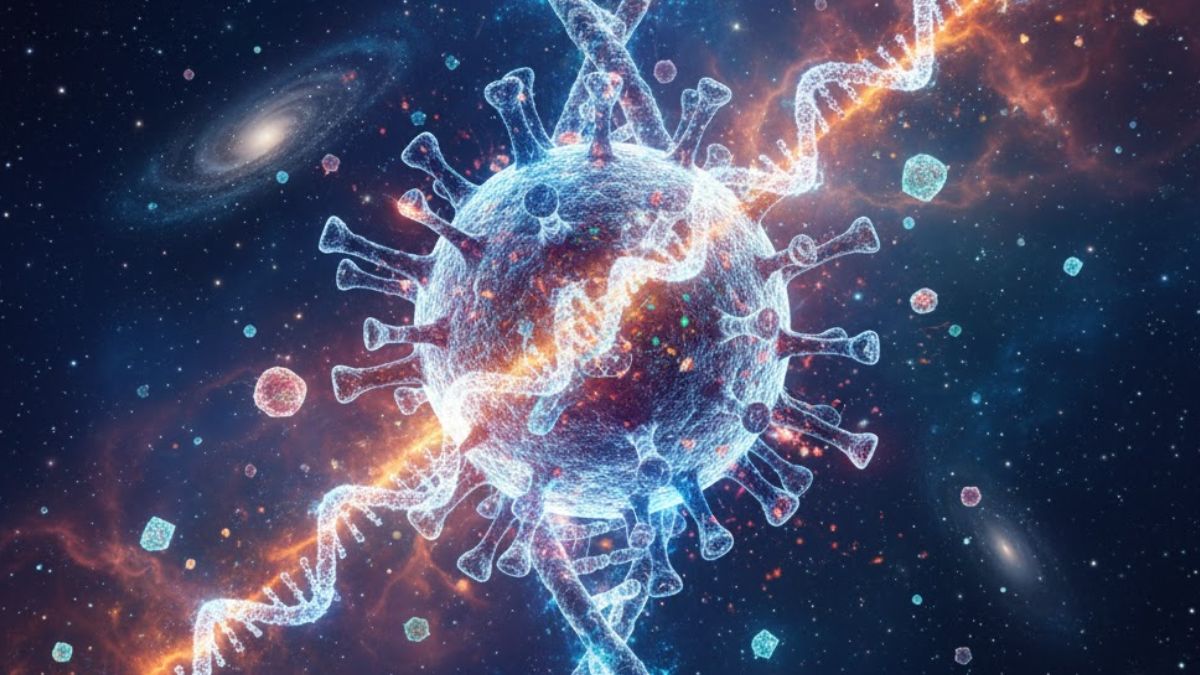
We often think of the world in simple terms: things are either alive, or they are not. A rock is not alive. A tree, a dog, or a person is alive. It seems like a clear line. But what if that line is blurrier than we think? What if there is something that exists right on the edge, something that challenges our very definition of what it means to be alive?
This mystery brings us to one of the most common, and yet most puzzling, entities on our planet: the virus. We know viruses as the causes of colds and flu, but they are far more than just germs. They are incredibly simple structures, little more than a package of genetic instructions wrapped in a protein coat. They can’t eat, they can’t grow, and they can’t reproduce on their own. They seem as lifeless as a speck of dust. Yet, when they enter a living cell, they kick into action. They hijack the cell’s machinery and create copies of themselves, spreading and sometimes causing disease. In that moment, they seem very much alive.
So, which is it? Are viruses alive or not? Scientists have been debating this for about a century. This isn’t just a trivial question. The answer might help us solve one of biology’s biggest puzzles: how did life first begin on Earth? Exploring viruses could be like finding a key piece of a lost ancient artifact. It might just show us the missing link between the chemistry of a dead world and the vibrant biology of the living one we know today. How can something so small be so central to the story of life itself?
To understand why viruses are so strange, we first need to know what they are. Imagine a tiny, tiny lockbox. This lockbox is so small that you could line up thousands of them across the width of a single human hair. Inside this lockbox, there is a set of instructions, written in a code made of either DNA or RNA. This is the virus. On the outside, it has special keys that allow it to attach to one very specific type of lock—a particular kind of living cell.
On its own, this lockbox does nothing. It doesn’t move with purpose. It doesn’t consume food for energy. It doesn’t grow. If you left a virus on a table, it would just sit there for years, unchanged, like a grain of sand. It has none of the processes we usually associate with life. It is, for all intents and purposes, inert. A crystal is more complex in its structure than a virus.
The magic, or the menace, happens when this lockbox randomly bumps into the right kind of cell. Its surface keys fit the cell’s lock perfectly. It attaches itself and injects its genetic instructions inside. Suddenly, the quiet lockbox is gone, and its instructions are now inside a bustling, living factory—the cell. The virus’s code is a single, simple command: “Make more of me.” The cell, now hijacked, has no choice but to obey. It stops its normal work and starts using its own raw materials and energy to read the viral code and assemble hundreds of new, identical lockboxes. These new viruses then burst out, ready to find new cells to invade. So, is the virus a living thing? Or is it just a set of instructions that becomes active only when inside a living thing?
This question forces us to think about what “life” really means. Biologists have a checklist of characteristics that living things share. Let’s see how a common bacterium, a very simple living organism, fits this list, and then compare it to a virus.
A bacterium can reproduce on its own by dividing in two. A virus cannot; it needs to commandeer a cell to make copies.
A bacterium can grow by taking in nutrients from its environment. A virus does not grow; it is assembled, fully formed.
A bacterium responds to its environment; it might move towards food or away from poison. A virus just drifts until it hits something.
A bacterium maintains a stable internal environment, a process called homeostasis. A virus does none of this.
Most importantly, living things have a metabolism. They have a complex set of chemical reactions that they use to take in energy, use that energy to build and repair themselves, and get rid of waste. A virus has no metabolism. It doesn’t eat or breathe. It has no engine of its own.
By this official checklist, a virus fails. It is not alive. But here is where it gets tricky. The moment a virus infects a cell, it starts to direct the activities of a living being. It can evolve. Over time, viruses change and adapt. The flu virus you catch one year is slightly different from the one the year before. Evolution is a key feature of life, and viruses clearly evolve. So, while they don’t tick the boxes for being alive on their own, they participate in the processes of life once they are inside a host. They exist in a gray area, a biological twilight zone.
This gray area is precisely what makes viruses so interesting to scientists who study the origin of life, a field called abiogenesis. The prevailing theory is that life began in a “primordial soup” of simple chemicals in Earth’s early oceans. Over millions of years, these chemicals somehow organized themselves into the first simple cells. But how did that huge leap happen? How did non-living chemicals become a living, reproducing cell?
This is where the virus-like world hypothesis comes in. Some scientists propose that before there were true cells, there were simpler, virus-like entities. Think of them as the first, crude sets of self-replicating instructions. They wouldn’t have been as complex as today’s viruses, but they would have had the same basic idea: a piece of genetic code inside a protective capsule.
These ancient molecular machines wouldn’t have been “alive” by our definition. They would have been part of the non-living world. But they would have had one crucial, life-like behavior: they could make copies of themselves. In the chaotic chemical soup of early Earth, these replicators would have become more and more common. They were the first things subject to evolution. The ones that were better at copying themselves became more numerous. This was the very first, most basic form of natural selection acting on non-living matter.
Over an immense amount of time, these replicators may have started working together. Perhaps one was good at making a protective shell, while another was good at harvesting energy from the environment. They could have teamed up, eventually leading to the formation of the first true cell. In this story, viruses aren’t just hitchhikers on the tree of life; they might be ancient relics of the very processes that built its trunk. They could be living fossils of a time when the line between life and nonlife was first being drawn.
The search for this missing link isn’t confined to Earth. The study of viruses has become crucial in the field of astrobiology—the search for life in space. If we ever find evidence of life on another planet, like Mars or on one of the watery moons of Jupiter and Saturn, it might not be a little green man. It might not even be a bacterium. It might be something much simpler.
When our robots and landers search for signs of life, they are often looking for the chemical building blocks, like amino acids and nucleotides, which are the pieces that make up viruses and living cells. The discovery of a virus-like structure on another world would be a monumental discovery. It would suggest that the path from chemistry to biology is a universal one. It would mean that the same steps that likely happened on Earth—from simple replicators to complex life—could be happening right now in oceans beneath the icy crust of Jupiter’s moon Europa.
Furthermore, some viruses are incredibly tough. They can survive in the vacuum of space, in extreme heat, and in freezing temperatures. This hardiness suggests that if life’s ingredients can travel between planets on asteroids and comets, as some theories suggest, then viruses would be the perfect passengers. They could potentially seed life, or at least its precursors, across the solar system. So, the humble virus, often seen only as a cause of disease, might also be a cosmic messenger, carrying the potential for life from one world to another.
Another fascinating way to look at viruses is to consider where they came from. While one theory says they are ancient precursors to life, another major theory suggests almost the exact opposite. This idea proposes that viruses are actually pieces of escaped genetic code. Imagine a simple cell that breaks apart. A small piece of its DNA or RNA, one that knows how to build a protective shell around itself, escapes. This runaway fragment then becomes a virus.
In this view, viruses are not a missing link to the beginning of life, but rather a product of it. They are like biological ghosts, echoes of living cells that have now taken on a strange, parasitic existence of their own. They are life that has simplified itself, shedding the complex needs of a cell to become a lean, mean, replicating machine.
This creates a fascinating paradox. Are viruses a glimpse into life’s past, a primitive starting point? Or are they a glimpse into a possible future, showing how life can simplify and adapt in the most extreme ways? Either way, they force us to expand our thinking. The tree of life might not be a simple tree with a clear trunk. It might be a tangled web, with viruses weaving in and out of its branches, connecting everything in ways we are only beginning to understand.
The question of whether viruses are alive may never have a simple yes or no answer. And that is what makes them so wonderfully important. They defy our neat categories and challenge our understanding of the world. By sitting in the shadowy realm between life and nonlife, they act as a bridge. They show us that the journey from inert chemicals to a living, breathing cell was probably a gradual process, not a single miraculous event.
Viruses teach us that life is perhaps better defined not by a strict checklist, but as a process—a continuum. They are a reminder of our own deep connection to the non-living universe. The same atoms and molecules that make up a star or a stone can, under the right conditions, come together to make a virus, a bacterium, or a human being. In studying these tiny, powerful entities, we are not just studying germs; we are exploring the very boundaries of existence itself. So, the next time you hear about a virus, will you see it as just a bug, or as a clue to one of biology’s oldest mysteries?
1. Why are viruses not considered living organisms?
Viruses are not considered living because they lack most of the key characteristics of life. They cannot reproduce on their own, they have no metabolism to create energy, they don’t grow, and they cannot maintain a stable internal environment. They only become active when they infect a living cell.
2. How do viruses multiply if they are not alive?
Viruses multiply by hijacking the machinery of a living cell. They inject their genetic material into the cell, and this material takes over, forcing the cell to stop its normal work and start producing new virus particles until the cell is filled and bursts open.
3. What is the difference between a virus and a bacterium?
Bacteria are single-celled living organisms that can eat, grow, and reproduce on their own. Viruses are not cells and cannot do any of these things without a host. Antibiotics kill bacteria but are useless against viruses, which is why you can’t take an antibiotic for a cold or the flu.
4. Could viruses exist on other planets?
It is possible. If life exists on other planets, it would likely have a genetic code similar to DNA or RNA. Virus-like entities, which are just packages of genetic material, could easily be part of that alien ecosystem, perhaps even playing a role in its evolution.
5. What was the first virus on Earth?
No one knows what the first virus was, as they don’t leave fossils. Scientists believe ancient viruses appeared very early in Earth’s history, possibly before or around the same time as the first simple cells, but their origin remains a mystery.
6. Do viruses have DNA?
Some viruses have DNA, which is the same genetic material found in all living things. Other viruses use a similar molecule called RNA. This shared genetic language is one of the reasons scientists think viruses are deeply connected to the history of life.
7. Can a virus be considered a parasite?
Yes, viruses are considered obligatory parasites. This means they are completely dependent on their host for their reproduction and cannot complete their life cycle without invading and using a host cell.
8. How do viruses change and evolve?
Viruses evolve through mutations, which are small changes in their genetic code as it is copied. When a mutation helps the virus survive or spread more easily, that new version will become more common. This is why we get new flu strains every year.
9. Are there good viruses?
Yes, some viruses can be beneficial. Bacteriophages are viruses that infect and kill bacteria and are being studied as an alternative to antibiotics. Some viruses also help control other pests, and scientists believe they may play important roles in ecosystems we don’t yet fully understand.
10. If viruses are not alive, why is it so important to kill them?
We try to “kill” viruses, or more accurately, inactivate them, because they can disrupt the life processes of the organisms they infect (like us). While they aren’t alive, their chemical structure is still intact and can cause harm, so destroying that structure stops them from being able to infect cells.