
 By SAJID ali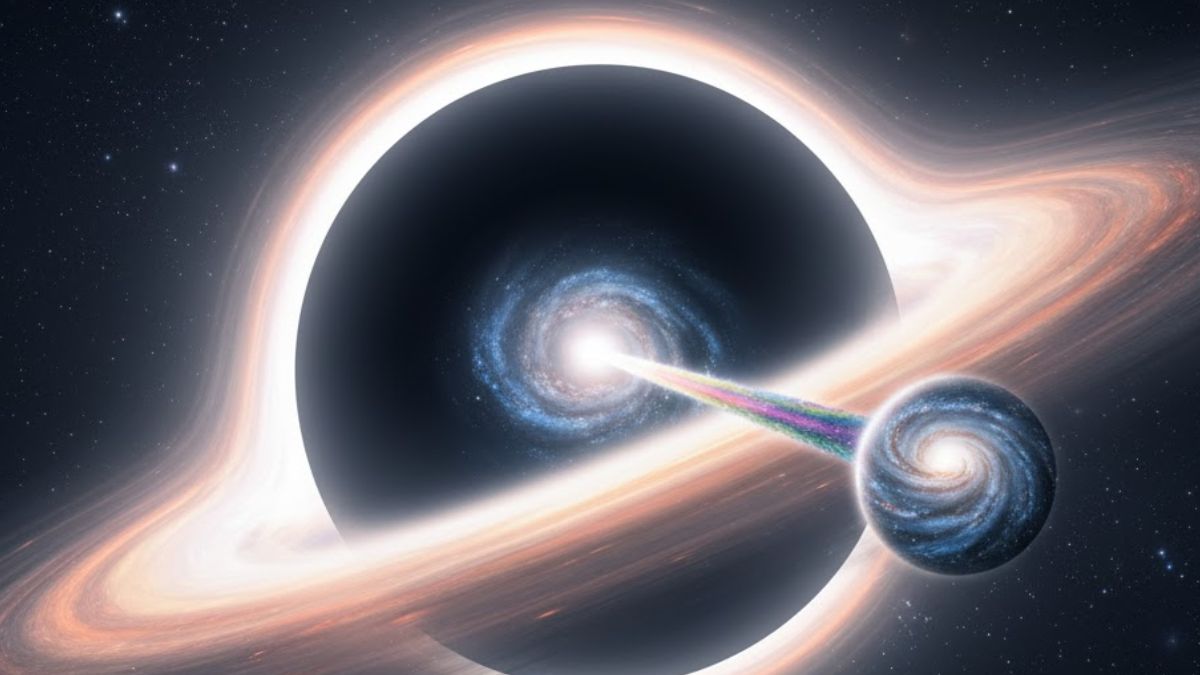
There’s a place in space where the rules we know stop working. A place where gravity is so strong that not even light can escape its pull. We call these places black holes, and for a long time, they were the ultimate endpoints of the universe—cosmic vacuum cleaners that only took and never gave back. But what if that’s not the whole story? What if, hidden inside that immense darkness, something new is being born?
For decades, scientists have seen black holes as the final period at the end of a star’s sentence. But a wild and wonderful idea is growing in the world of theoretical physics. It suggests that a black hole might not be an end at all. Instead, it could be a cosmic doorway. A place where the crushing of one universe leads to the big bang of another.
This isn’t just science fiction. Some of the brightest minds in physics are exploring the possibility that our own universe could have been spawned from a black hole in a larger, parent cosmos. It’s a idea that turns everything we thought we knew on its head. If it’s true, then every black hole dotting our night sky could be a fledgling universe, growing in a space and time completely separate from our own.
So, how could a destructive force like a black hole become a creative one? How could the end of a star lead to the beginning of everything?
To understand how a black hole could create a universe, we first need to understand what it is. Imagine space is a giant, stretchy rubber sheet. If you put a heavy bowling ball in the middle, it would make a deep dip. Now, imagine a object so incredibly heavy that it makes a dip so deep that the sides become vertical walls. That’s the basic idea of a black hole’s gravity.
A black hole forms when a massive star, much bigger than our Sun, runs out of fuel and can no longer fight against its own gravity. The star collapses, falling in on itself. All that immense mass gets crushed into a tiny, tiny point of infinite density called a singularity. The gravity around this point is so overpowering that it creates an invisible boundary called the event horizon. Think of the event horizon as a one-way door. Once anything—a spaceship, a planet, or a particle of light—crosses that line, it can never come back out. It’s lost to our universe forever.
We can’t see black holes directly because no light escapes them. But we know they’re there by watching how they affect their surroundings. We see stars whipping around an invisible center, and we see disks of superheated gas and dust, called accretion disks, swirling around the black hole’s edge, glowing fiercely with X-rays and radiation before they vanish. They are the ghosts of the cosmos, revealed only by their shadow.
This is the million-dollar question. The truth is, no one knows for sure. Our laws of physics, which work so well everywhere else, break down at the singularity. But physicists have some theories, and this is where things get really strange.
Once you cross the event horizon, the pull of gravity becomes unimaginable. It’s not just a strong pull; it’s a tidal force. If you fell in feet-first, the gravity pulling on your feet would be so much stronger than the gravity at your head that you would be stretched out into a long, thin strand of atoms. Scientists call this, quite literally, spaghettification.
At the very center lies the singularity. This is a point where all the matter that ever fell in is crushed to zero volume and infinite density. It’s a place where the concepts of space and time as we know them cease to exist. This is the great unknown. Some theories suggest that at this point, the fabric of spacetime itself is torn, and new rules take over.
It’s in this chaotic, lawless core that the seed of a new universe might be planted. The incredible energy and the breakdown of physics might not be a dead end, but a new beginning in disguise.
To see the connection, let’s look at our own universe’s beginning. The Big Bang is the name we give to the moment our universe exploded into existence from an incredibly hot, dense state. For a long time, scientists pictured it as a giant fireball appearing in the middle of nothing. But what was there before the Big Bang? What caused it?
This is where the black hole connection gets interesting. Think about what happens at the center of a black hole: all matter is crushed into an incredibly hot, dense point—a singularity. Now, think about the starting point of the Big Bang: an incredibly hot, dense point. The similarities are striking.
What if the Big Bang was simply the formation of a black hole in another, larger universe? In this mind-bending idea, when a star collapses in a parent universe, it creates a singularity. But instead of that singularity being a final destination, it “pops” out the other side, expanding rapidly as a new universe. From our perspective inside this new universe, we would experience that pop as our own Big Bang.
This would mean our entire cosmos—every galaxy, star, and planet—exists inside a black hole that is part of a much bigger universe. And every black hole in our own universe could contain a brand new cosmos, completely disconnected from our own space and time.
So, how does a point of infinite density become a whole universe? The key might lie in a process called inflation. Right after the Big Bang, our universe is thought to have gone through an incredibly fast expansion, much faster than the speed of light. In a fraction of a second, it blew up from smaller than an atom to a vast cosmic landscape.
A similar process could happen inside a black hole. The moment of the black hole’s formation, with its immense energy and the bizarre physics of the singularity, could trigger its own version of inflation. The new universe would inflate, but it would do so into its own dimensions, its own space and time. It’s like blowing up a balloon inside a sealed box. The balloon gets bigger, but it’s forever separate from the space outside the box.
This baby universe would be connected to its parent only by a umbilical cord—the black hole’s event horizon. But since nothing can escape back through the event horizon, the two universes are forever cut off from each other. The parent universe continues on, unaware of the new cosmos that has just begun to grow inside one of its black holes.
This idea, often called cosmological natural selection, was pioneered by a physicist named Lee Smolin. He proposed that universes could evolve, much like living things. A universe that produces a lot of black holes would produce a lot of “baby universes.” These baby universes would inherit the physical laws of their parent, with tiny random changes, just like genetic mutations.
Over cosmic time, the universes that are best at making black holes would become the most common. It’s a fascinating blend of cosmology and Darwinian evolution. Not every scientist agrees with this theory, of course. It’s very difficult to test, since we can’t travel into a black hole to see for ourselves.
However, the mathematics behind some of our most important theories, like Einstein’s general relativity, does allow for the possibility. The equations that describe a collapsing star look very similar to the equations of an expanding universe, just running in reverse. For many physicists, this mathematical mirror image is a compelling clue that the two phenomena are deeply connected.
If this theory is true, it would completely reshape our place in the cosmos. We would not be in a single, lonely universe, but part of a vast multiverse—a tree of countless universes, each born from a black hole in a parent universe.
It would answer the puzzling question of why our universe seems so perfectly tuned for life. The physical constants—the strength of gravity, the mass of an electron—seem just right to allow for stars, planets, and us to exist. If universes are being born all the time with slightly different laws, then it’s no surprise we find ourselves in one that is life-friendly. The others simply couldn’t support us.
This idea turns black holes from monstrous destroyers into cosmic mothers. They are the engines of creation, responsible for spawning new realities. Every time a star dies and forms a black hole, it might be giving birth to an entire cosmos, with its own galaxies, stars, and perhaps, its own intelligent life wondering where it all came from.
It’s a humbling and beautiful thought. The dark spots in our sky may not be endings, but nurseries for new beginnings.
The idea that black holes are cosmic cradles is one of the most thrilling in modern science. It suggests that creation and destruction are two sides of the same coin, and that the end of a star in our sky could be the first moment of a new reality. While we may never have definitive proof, the possibility alone expands our imagination and reminds us that the universe is far stranger and more wonderful than we can often conceive.
So, the next time you look up at the night sky, consider this: is that distant black hole a final grave, or is it a universe being born? What kind of worlds might be taking their first breath within its invisible walls?
1. Can a black hole eat the Earth?
It is extremely unlikely. The nearest known black hole is thousands of light-years away, and black holes do not roam around space sucking up everything like cosmic vacuum cleaners. A black hole would only be dangerous if we wandered very close to its event horizon.
2. What is at the center of a black hole?
The center is called a singularity, a point where matter is thought to be crushed to infinite density and where the laws of physics, as we know them, break down. It is a region of extreme mystery and is the focus of much theoretical research.
3. How are black holes formed?
Most black holes form when a very massive star, at least three times heavier than our Sun, runs out of nuclear fuel. Its own gravity causes it to collapse inward in a supernova explosion, leaving behind an incredibly dense core that becomes a black hole.
4. What is the Big Bang theory?
The Big Bang theory is the leading explanation for how the universe began. It proposes that the universe started from an extremely hot, dense state about 13.8 billion years ago and has been expanding and cooling ever since.
5. Could our universe be inside a black hole?
It is a speculative theory proposed by some physicists. The idea suggests that the singularity of a black hole in a larger “parent” universe could have been the trigger for our own Big Bang, meaning our entire cosmos exists within a black hole.
6. What is a white hole?
A white hole is a theoretical opposite of a black hole. While nothing can escape a black hole, nothing can enter a white hole; it only spews out matter and energy. Some theories suggest a black hole in one universe could be connected to a white hole in another.
7. How do we know black holes exist if we can’t see them?
We detect black holes indirectly by observing their effects on nearby objects. We can see stars orbiting invisible companions, and we can detect the intense X-rays emitted by superheated gas as it is pulled into a black hole’s accretion disk.
8. What is spaghettification?
Spaghettification is the vertical stretching and horizontal compression of objects into long, thin shapes (like spaghetti) due to the extreme tidal forces of a black hole’s gravity. It would happen to any object falling past the event horizon.
9. What is a multiverse?
The multiverse is a hypothetical group of multiple universes, including our own. These universes comprise everything that exists—space, time, matter, and energy. The idea that black holes create new universes is one proposed mechanism for a multiverse.
10. Will our Sun become a black hole?
No, our Sun is not nearly massive enough to become a black hole. When it dies, it will swell into a red giant and then collapse into a dense stellar remnant called a white dwarf, which will slowly cool down over billions of years.