
 By SAJID ali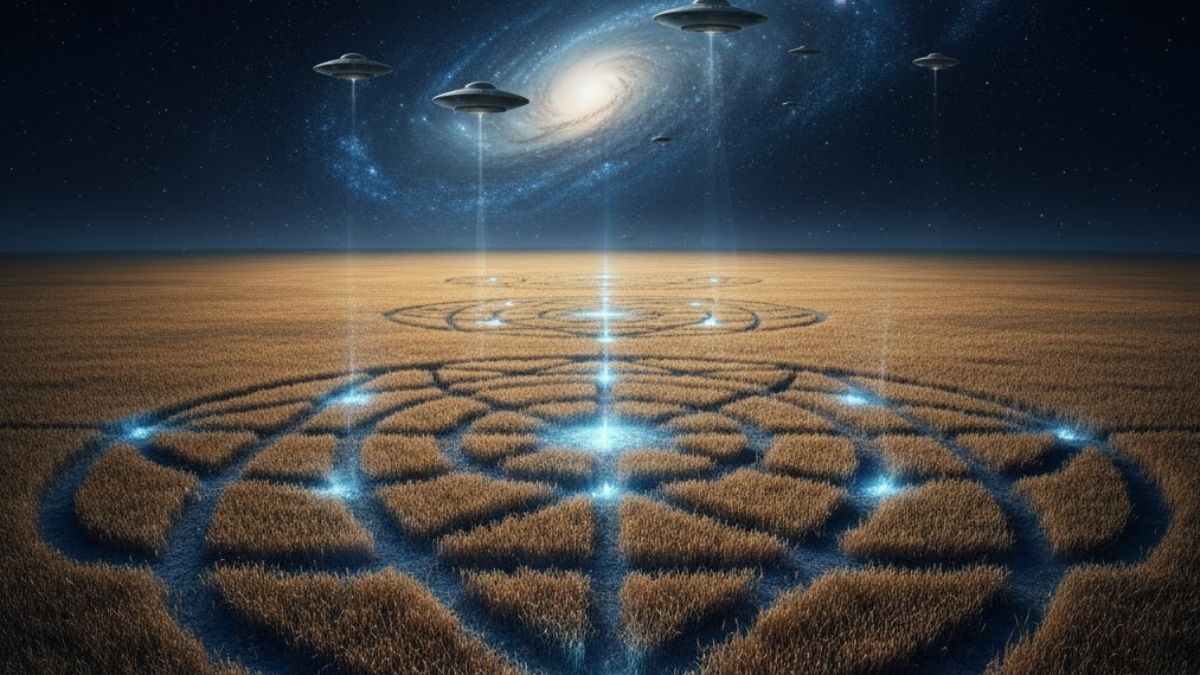
You’re walking through a quiet, golden wheat field in the English countryside early one morning. The sun is just starting to warm the air, and the only sound is the gentle rustle of the stalks in the breeze. Then, you come over a small hill and see it. Stretched out before you is a vast, intricate pattern, perfectly woven into the crop itself. The stalks are bent, not broken, laid down in a swirling, geometric design that seems too large and too perfect to be the work of any human. There are no footprints leading in or out, no traces of machinery. Just this stunning, mysterious artwork that appeared as if by magic overnight.
This is the enduring mystery of the crop circle. For decades, these formations have been popping up, mostly in Southern England but also all over the world. The official story, the one we often hear on the news, is that they are nothing more than elaborate hoaxes, the work of clever artists with planks of wood and ropes. And indeed, some people have proudly come forward to show how they’ve made them. They’ve demonstrated that creating a basic circle is possible with simple tools.
But what about the rest? What about the formations that are incredibly complex, spanning the length of several football fields, and appearing in the dead of night in a matter of a few hours? What about the strange physical changes reported in the plants and soil inside these circles? When you start to dig a little deeper, the simple hoax explanation begins to feel a little… thin. It makes you wonder if we’re too quick to dismiss something we don’t fully understand. What if there is a deeper, more fascinating story waiting to be told about these patterns in our fields?
So, if it wasn’t just a couple of people with a board, what other possibilities are out there? What evidence suggests that crop circles might be a genuine, unsolved mystery?
This is the first and most important question. If we’re going to explore the idea that some crop circles are not hoaxes, we need to know how to tell them apart. Researchers and enthusiasts who have spent years studying this phenomenon point to several key differences that are very hard to fake.
First, let’s look at the plants themselves. In a man-made circle, created by people stomping with boards, the plants are usually crushed and broken. The stalks snap under the pressure because the process is forceful and clumsy. However, in what investigators call a “genuine” or “anomalous” formation, the stalks are bent, often at a swollen node near the base. It’s as if they were softened by a brief, intense heat—like steam—and then gently laid down to continue growing horizontally. Farmers have reported that plants from these complex circles can often be harvested weeks later because they haven’t died; they’ve just been redirected.
Second, the construction is mind-bogglingly precise. We’re not just talking about simple circles anymore. Some formations are based on complex mathematical principles like fractals or sacred geometry, such as the Fibonacci sequence. The designs can be perfectly symmetrical, with thousands of stalks woven together in a layered, lattice-like pattern. Creating this in pitch darkness, without a single misplaced stalk or visible path of entry, is a logistical nightmare. Some formations would take a large team of people many days to complete, yet they are known to have appeared within a single, quiet night.
Finally, there are often strange physical effects reported. Electronic equipment like cameras and phones can malfunction inside the circles. People speak of feeling a strange silence, a shift in the air pressure, or a gentle buzzing sensation. Some even report feelings of peace and well-being. These subjective experiences are hard to measure, but they are a consistent part of the testimony from many visitors. When you add up the biological changes to the plants, the mathematical complexity of the designs, and the unusual physical reports, the “plank and rope” theory starts to feel like trying to explain a masterpiece painting by saying someone spilled a bucket of paint.
If humans aren’t responsible for all of them, what natural forces could possibly create such intricate art? One theory points towards the power of our own planet. The idea is that certain spots on Earth might hold or generate strange energies that can affect the landscape.
Some scientists have looked into the possibility of plasma vortices. This is a scientific term for a spinning ball of energized gas, like a miniature, ground-level tornado made of lightning. In theory, a powerful and precise burst of energy from the atmosphere—such as a type of ball lightning or a rare, downward strike of charged air—could blast the crops flat in a pattern. The heat from the event could swell the nodes in the plant stalks, explaining why they bend instead of break. This could potentially create the simpler circular shapes, but it struggles to account for the highly detailed, pictographic designs that look like conscious artwork.
Another natural theory involves “earth energies.” Some researchers have found that many ancient sacred sites, like Stonehenge and Avebury, are located along straight lines in the landscape known as “ley lines.” Interestingly, a huge number of crop circles appear near these very same ancient sites. The theory suggests that these ley lines carry a subtle electromagnetic energy from the Earth. In certain conditions, this energy might rise to the surface and, in a burst of spinning force, imprint a geometric pattern onto a field. It’s a fascinating idea that connects ancient human history with a modern mystery, suggesting our planet itself might be an artist we don’t yet understand.
Let’s think about this from another angle. What if the artists are human, but their tools are far beyond planks and rope? Could some crop circles be the accidental or intentional footprints of advanced, secret military technology?
Think about how quickly technology advances in the public world. The smartphone in your pocket is more powerful than the computers that sent astronauts to the moon. Now, imagine what kind of technology a military organization might have developed in secret, 50 or 60 years ahead of what we know. Some speculate that crop circles could be the test marks or side effects of new energy weapons or advanced aircraft.
Perhaps the military is testing powerful microwave or directed-energy beams from satellites or stealth aircraft. These beams could, in theory, flatten crops in a precise pattern from a great distance, leaving no trace of human activity on the ground. The heat from the beam would explain the swollen nodes on the plants. This theory would also explain why the phenomenon became so common in the 1980s and 90s—it was the peak of the Cold War, a time of intense secret weapons development. If this were true, it would mean these beautiful formations are not messages from the stars, but rather, secret signatures from our own species, written in wheat and corn.
Of course, we can’t talk about crop circles without mentioning the most famous and controversial idea: that they are messages or markers from an intelligent, non-human source. The Extraterrestrial (ET) hypothesis is what captures the public’s imagination most strongly.
The idea is that a highly advanced civilization is using these formations to communicate with us. The patterns are a universal language, based on mathematics and geometry, which any intelligent species would understand. They could be saying “hello,” they could be displaying their knowledge of the cosmos, or they could even be providing diagrams for advanced technology. Some researchers claim to have decoded messages within the patterns, though these are often debated.
The biggest question with this theory is, why? If an alien species is advanced enough to travel across the vastness of space, why would they choose to write messages in cornfields instead of just landing on the White House lawn? Proponents suggest it could be a gentle, non-threatening way to make us aware of their presence. They are slowly acclimating humanity to the idea that we are not alone, using beautiful art to spark our curiosity and wonder without causing panic. It’s a slow, patient way of making first contact, letting us come to the conclusion on our own terms.
It’s a crucial part of the story. In the early 1990s, two men from Southampton, England, Doug Bower and Dave Chorley, came forward and announced that they had been creating crop circles for years. They demonstrated their technique using a simple plank, a ball of string, and a wire sighting device attached to a baseball cap. They admitted it was a prank, originally inspired by the idea of UFO landing sites.
Their confession was seen by many as the final word on the subject. The media declared the mystery solved. But did it really explain everything? While Bower and Chorley were undoubtedly responsible for many circles, especially the simpler ones from that era, their confession created a new problem. It acted as a blanket explanation, making it easy to dismiss every single formation, past and future, as a hoax.
Many other hoaxers have since come forward, but their achievements often don’t match the scale and complexity of the most spectacular formations. They can create beautiful designs, but they take large teams, work with GPS, and leave clear signs of their activity. The existence of human artists proves that some circles are fake, but it doesn’t logically prove that all of them are. In fact, the original hoaxers, Doug and Dave, themselves stated that they believed a “supernatural force” had taken over their idea and was creating the more complex patterns that were beyond their own abilities.
In the end, the mystery of crop circles is a perfect example of a phenomenon where the official story doesn’t seem to tell the whole truth. It’s a mystery that sits at the crossroads of art, science, and the unknown. Dismissing it entirely might mean we are closing the door on a fascinating scientific discovery.
Perhaps the answer isn’t one single thing. Maybe some are brilliant human art, some are the result of strange plasma weather events, and a small, puzzling minority are something else entirely—something we can’t yet explain. The real value of the crop circle phenomenon may not be in proving who or what makes them, but in what they do for us. They challenge our assumptions. They force us to ask questions. They remind us that the world might still be full of wonders that we can’t easily explain away.
In a world where we have an answer for everything at our fingertips, isn’t it exciting to think that there are still patterns in fields that make scientists, farmers, and curious people like us stop and wonder? The next time you see a picture of one of these incredible formations, instead of just thinking “hoax,” maybe ask yourself, “What if?”
1. How are crop circles really made?
While many crop circles are made by people using boards and ropes, the most complex ones have features that are hard to explain this way. These include plants bent by a heat-like force without breaking, intricate mathematical designs, and a lack of any human traces, suggesting other methods might be involved in some cases.
2. Where are most crop circles found?
The majority of crop circles appear in Southern England, particularly in the county of Wiltshire, which is also home to ancient sites like Stonehenge and Avebury. However, they have been reported in many other countries around the world, including the United States, Canada, and Germany.
3. Have people ever been caught making a crop circle?
Yes, many people have been caught or have confessed to creating crop circles. The most famous are Doug Bower and Dave Chorley, who in 1991 claimed responsibility for many circles in England starting in the 1970s.
4. What is inside a real crop circle?
Visitors to complex, unexplained formations often report strange sensations, like a buzzing sound or a feeling of static electricity. Electronics like cameras and phones can malfunction, and the plants inside show biological changes, such as swollen nodes and elongated stalks.
5. Why are crop circles always in fields?
Crops like wheat, barley, and corn provide a perfect, large-scale “canvas” for creating visible patterns from the air. The tall, flexible stalks can be laid flat to create a contrast with the standing crop, making the design clearly visible.
6. What is the most famous crop circle?
One of the most famous is the “Julia Set” formation that appeared near Stonehenge in 1996. It was a massive and incredibly complex spiral pattern that appeared in broad daylight in under an hour, stunning researchers and the public alike.
7. Do farmers get angry about crop circles?
Reactions are mixed. Some farmers are frustrated by the damage and trespassing, as it can cause a loss of income. Others have capitalized on the mystery, charging tourists for access and even having their fields “chosen” for a new formation, which can bring significant tourist revenue.
8. Are crop circles a new phenomenon?
While they became a worldwide phenomenon in the 1980s, reports of “mowing devils” and strange flattened circles in fields date back hundreds of years. A woodcut from 1678 even shows a strange creature creating a circular pattern in a field of oats.
9. Can all crop circles be explained?
No. While a large percentage are admitted hoaxes, a small number of formations each year display characteristics—such as complex geometry, altered plant biology, and rapid formation—that researchers have not been able to fully explain using conventional methods.
10. What is the government’s official stance on crop circles?
Most governments, including the UK and US, have no official investigation into crop circles and officially regard them as hoaxes or artistic pranks. They are generally not considered a subject for serious scientific or military inquiry.