
 By SAJID ali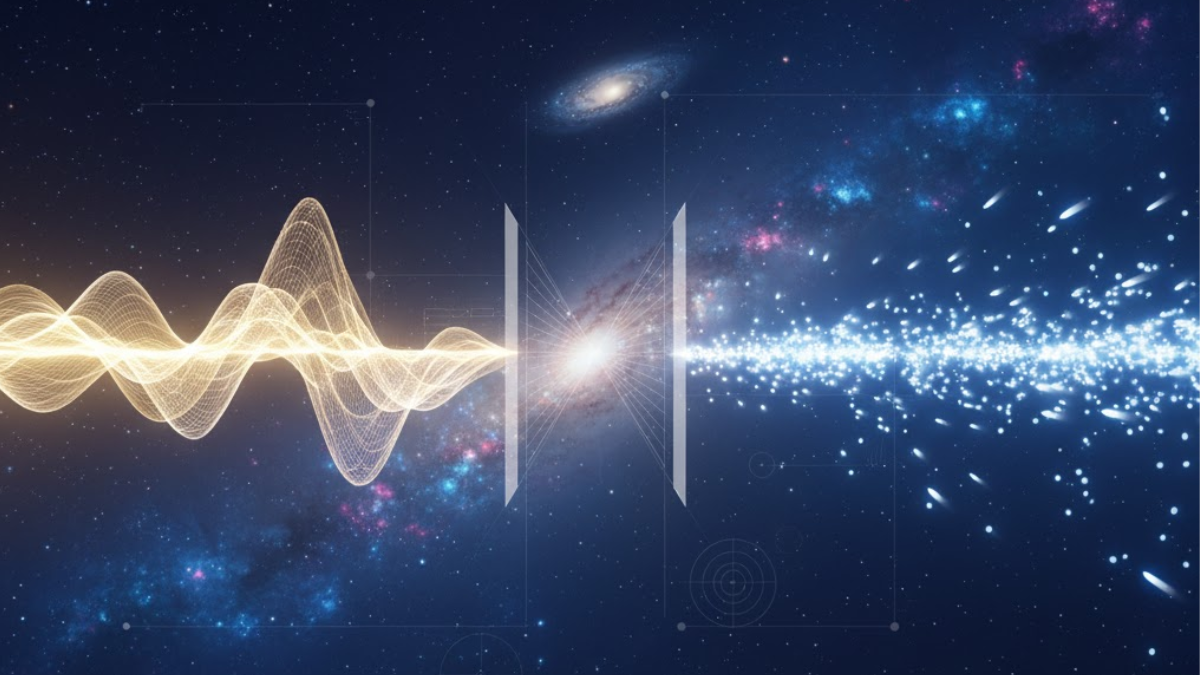
There’s a tiny, everyday miracle happening right in front of you. It’s the glow from your screen, the warmth of sunlight on your skin, the colours of a rainbow after a storm. This miracle is light. For most of history, we thought we had it figured out. It was either one thing or another. But then, scientists peered a little closer and found something that truly boggles the mind. Light doesn’t play by our simple rules. It refuses to be just one thing.
It’s like a person who can be both a quiet librarian and a rock star on the weekends. In one moment, light behaves like a gentle, spreading wave on a calm lake. In the next, it acts like a tiny, hard bullet, a particle zipping through space. This isn’t a switch it flips; it’s both at the same time. This dual nature is one of the most profound and strange secrets of the universe, and it’s the key to understanding everything from how our eyes see to how stars are born.
So, how can one thing be two completely different things at once? How does light manage this incredible double life, and what does it tell us about the fabric of reality itself?
We often think of light as just the thing that lets us see. But if you could hold a bit of light in your hand, what would it be? Is it a substance, an energy, or something else entirely? For a long time, this was one of the biggest debates in science. Two groups of brilliant thinkers were pitted against each other, each with compelling evidence for their own idea.
On one side, you had figures like Isaac Newton, who argued that light must be made of incredibly tiny, fast-moving particles. He called them “corpuscles.” Think of a machine gun firing an endless stream of microscopic bullets. This explained why light travels in straight lines and how it bounces off mirrors so perfectly. It made a lot of sense. On the other side, scientists like Christiaan Huygens argued that light was a wave, like a ripple moving across the surface of a pond. This explained how light beams can bend around corners slightly (a process called diffraction) and how colours can mix and create patterns. For centuries, the debate went back and forth, with evidence stacking up for both ideas. The truth, as it turned out, was that everyone was both right and wrong at the same time. Light wasn’t a particle or a wave. It was something more complex, something that could show either face depending on how you looked at it.
Imagine you’re at a calm beach. You toss a single pebble into the water. What happens? A series of ripples spreads out from the spot where the pebble landed, creating a perfect circle that gets larger and larger. This is the essence of wave behaviour. It’s not a single object moving from the center to the shore; it’s a disturbance that carries energy across the water. The water itself mostly just moves up and down, but the wave travels forward.
This is exactly how light can behave. A light wave is a travelling disturbance in electric and magnetic fields—an electromagnetic wave. It has crests (the high points) and troughs (the low points), just like a water wave. The distance between two crests is called the wavelength, and this distance is what our eyes perceive as colour. Red light has long, lazy waves, while blue light has short, choppy waves. This wave nature explains so much of what we see. It explains how we get the beautiful spectrum of colours in a rainbow, as sunlight is split into its different wavelengths by raindrops. It explains the shimmering colours on a soap bubble, caused by light waves overlapping and interfering with each other, some waves canceling out and others getting stronger. If light were only a particle, these effects would be impossible. The wave is the gentle, spread-out, and colourful side of light’s personality.
Now, let’s go back to that beach. Instead of throwing a pebble to make waves, imagine you have a bucket of tiny, perfect marbles. You start throwing them, one by one, at a wooden plank floating in the water. Each marble that hits the plank makes it bob. If you throw more marbles, the plank bobs more. This is a very particle-like interaction. Each marble is a separate, distinct packet of energy hitting a target.
This is the other side of light, known as a photon. A photon is a tiny, massless packet of pure energy. Think of it not as a solid ball, but as a fundamental “piece” of light. This particle-like behaviour was discovered when scientists looked at a phenomenon called the photoelectric effect. They found that when you shine a light on certain metals, it can knock electrons loose, like marbles knocking other marbles off a table. But here’s the weird part: using a very bright, gentle red light (long waves) did nothing. But a dim, harsh blue light (short waves) would immediately start knocking electrons out. This was baffling for a wave model. If light were just a wave, a bright red wave should eventually transfer enough energy to knock an electron loose. But it didn’t. It was as if the energy was delivered in discrete packets. Only a “bullet” with enough individual punch—a photon with a short enough wavelength—could do the job. Albert Einstein won his Nobel Prize for explaining this, cementing the idea that light also behaves as a particle. It’s the sharp, precise, and bullet-like side of light.
This is the million-dollar question. Is light a wave, or is it a particle? The most honest and mind-bending answer modern physics can give us is: it is both. It is something more fundamental that manifests as a wave or a particle depending on the situation. We don’t have a perfect everyday object to compare it to because nothing in our daily experience behaves this way. It’s like asking if a coin is “heads” or “tails.” The coin itself is both possibilities, and it only becomes one when you flip it and catch it.
This is the core of quantum physics. Light has what is called “wave-particle duality.” When we are not looking at it, when we are not measuring it, light exists in a state of potentiality. It doesn’t commit to being one or the other. It’s only when we set up an experiment to detect waves that light obliges and shows us its wave nature. And when we set up an experiment to detect particles, it shows us its particle nature. The act of measurement, of asking the question, forces light to give us an answer. It’s as if light is an actor that can perfectly play any role we ask of it. The real nature of light is the script from which both the wave and particle characters are drawn—a script we are still trying to fully understand.
You might think this is all stuff for high-tech physics labs, but the truth is, you are surrounded by the evidence of light’s double life. The technology you use every single day relies on us understanding both sides of light’s personality.
Your microwave oven, for example, uses the wave nature of light (microwaves are a form of light our eyes can’t see) to make water molecules in your food wobble back and forth, creating heat. The camera in your phone relies on the particle nature of light. Individual photons, like tiny bullets, strike the camera’s sensor, and each one creates a small electric signal that builds up the picture you see. A solar panel is another perfect example. It needs the particle-like photons to come in and hit the electrons in the panel with enough energy to knock them loose and create an electric current. If light were only a wave, solar power wouldn’t work the way it does. Even your own eyes work by detecting particles of light. Photons enter your eye and strike cells in your retina, which send a signal to your brain. So, while you can’t “see” the duality with your naked eye, you are constantly using devices that speak both of light’s languages. The modern world is, in many ways, built upon this strange quantum truth.
The discovery that light is both a wave and a particle was more than just a curious fact about light itself. It was the key that unlocked a new understanding of reality—the world of quantum mechanics. It told us that at the very smallest scales, the universe does not operate like the world we see around us. Things can be in two places at once, particles can be connected over vast distances, and reality is fuzzy until it is observed.
This duality forces us to let go of our everyday intuition. We want things to be either this or that. We are comfortable with categories. But the universe, it seems, is far more fluid and mysterious. If something as fundamental as light can be two contradictory things at once, what else is possible? This principle doesn’t just apply to light. Scientists soon found that electrons, and even entire atoms, also have this wave-particle duality. Everything that makes up you and the world around you has this strange, dual nature at its heart. It tells us that the solid, predictable world we experience is a kind of illusion, an average of countless bizarre quantum events. By studying light, we are not just learning about illumination; we are peering into the deepest rules that govern existence.
For centuries, we tried to put light in a box, to give it a single, simple definition. But light, in its beautiful, confounding complexity, broke that box wide open. It is a wave that spreads and ripples, painting our world with colour. It is a particle that strikes and energizes, powering our technology and our vision. It is both at once, a constant reminder that the universe is far more wonderful and strange than we can often imagine. If something as simple as a beam of light can hold such a profound secret, what other mysteries are waiting just out of sight, ready to change everything we think we know?
What other everyday phenomenon do you think might have a hidden, quantum secret behind it?
1. Why is light so important in physics?
Light is fundamental because it’s one of the basic ways we interact with the universe. Studying its strange behaviour led directly to the theories of relativity and quantum mechanics, which form the foundation of all modern physics.
2. How fast does light travel?
Light travels at an incredible speed of about 186,282 miles per second (299,792 kilometers per second) in a vacuum. This is the universe’s ultimate speed limit; nothing can travel faster.
3. What is a photon?
A photon is a fundamental particle and a “packet” of light. It has no mass and always moves at the speed of light. It is the basic unit of all electromagnetic radiation, from radio waves to gamma rays.
4. Can humans see all types of light?
No, we can only see a tiny sliver of the full spectrum of light, which we call “visible light.” Other types, like radio waves, microwaves, infrared, ultraviolet, X-rays, and gamma rays, are invisible to our eyes without special tools.
5. How do we know light is a wave?
We know from experiments like the double-slit experiment, where light creates an interference pattern of bright and dark bands. This pattern can only be explained if light is behaving as a wave, with crests and troughs overlapping.
6. How do we know light is a particle?
The photoelectric effect proved this. When light shines on metal, it knocks electrons loose. The effect depends on the colour (wavelength) of the light, not its brightness, which only makes sense if light is made of particle-like photons carrying discrete amounts of energy.
7. What colour of light has the most energy?
Violet and blue light have the shortest wavelengths and the highest energy per photon. Red light has the longest wavelengths and the least energy per photon.
8. Is sunlight a wave or a particle?
Sunlight, like all light, exhibits both wave and particle properties. The warmth we feel involves its wave nature, while the chemical reactions it causes (like sunburn) are due to its particle (photon) nature.
9. What is the double-slit experiment?
It’s a famous experiment where light is shone through two parallel slits. Instead of creating two bright lines on a screen behind it, it creates many lines, an “interference pattern,” proving its wave nature. Incredibly, even single photons shot one at a time will eventually build up this pattern.
10. Does anything else have wave-particle duality?
Yes, this is a fundamental property of all quantum objects. Electrons, protons, neutrons, and even large molecules have been shown to exhibit wave-like behaviour under the right conditions.