
 By SAJID ali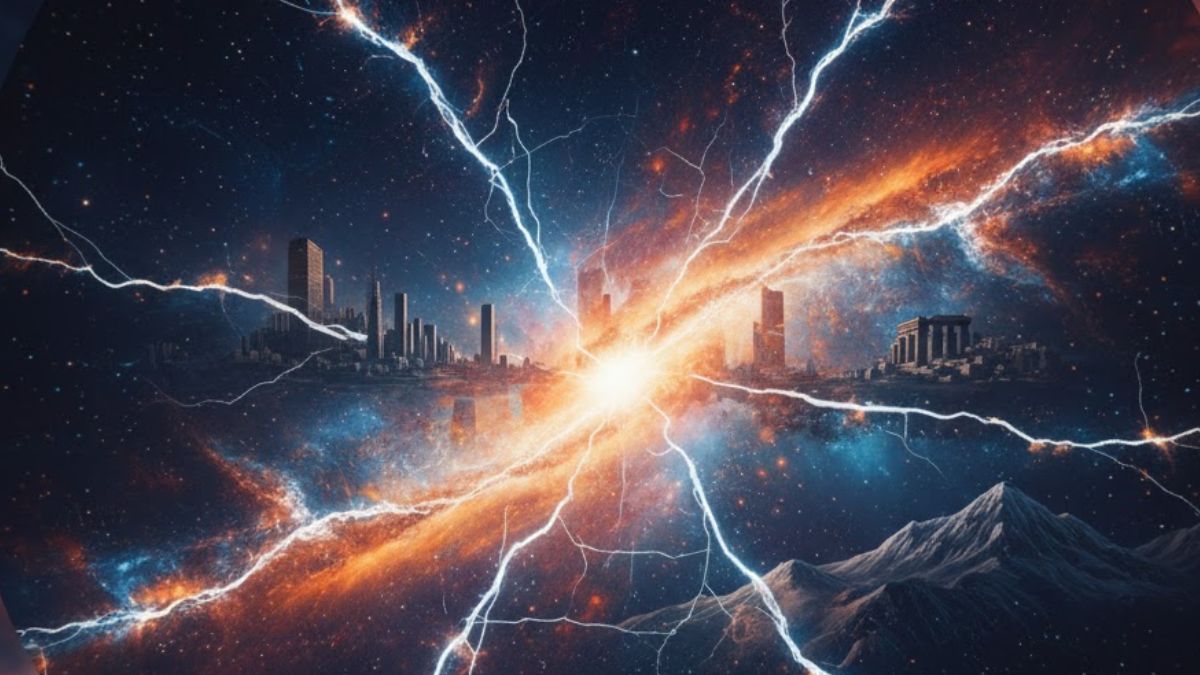
There’s a strange feeling we all get sometimes, a sudden sense that something just happened differently than we remember. Maybe you could have sworn you left your keys on the counter, but they’re dangling from the front door. Or you have a powerful memory of a conversation that the other person swears never took place. Most of the time, we just shrug it off and call it a brain glitch. But what if it wasn’t a glitch at all? What if these tiny, unexplained moments were actually little ripples from another universe brushing up against our own?
The idea of parallel universes sounds like the wildest science fiction, something from a superhero movie. Yet, for many scientists, it’s a serious scientific possibility growing out of the weirdest rules of quantum physics. It’s a theory that suggests our universe, with all its galaxies, stars, and you reading this right now, might be just one page in an infinite cosmic book. Every other page is a separate, slightly different universe.
This isn’t about finding a secret portal or a magic wardrobe. The reality, if it’s true, would be far more subtle and woven into the very fabric of our existence. So, if these other worlds are out there, how could they possibly be touching ours? What would that even look like? Let’s explore the incredible idea that we might be living in a cosmos where universes constantly bump into each other, leaving behind clues for us to find.
To understand how universes could collide, we first need to grasp what a parallel universe even is. Think of the universe as a giant, expanding bubble containing everything we know—every person, planet, and particle of light. Now, imagine there’s not just one bubble, but countless others, each floating in a vast ocean of nothingness we call the multiverse. This isn’t just one idea; it comes from different areas of physics trying to solve big cosmic puzzles.
One of the most popular ideas comes from something called “inflation.” This theory says that right after the Big Bang, our universe expanded incredibly fast, like a balloon being blown up at an unimaginable speed. Some scientists suggest that this inflation never really stopped. It kept going in other places, creating new universe-bubbles all the time. In each of these new bubbles, the laws of physics might be slightly different. In one, gravity might be stronger; in another, light might not exist. Our universe just happens to have the right rules for us to be here.
Another idea comes from the strange world of quantum mechanics, which deals with how tiny particles like electrons behave. In that world, a particle can be in many places at once until we look at it, and then it “picks” a location. This leads to the thought that every time a particle has a choice to make, the universe splits. In one universe, you turned left on your walk today; in another, you turned right and had a completely different day. So, parallel universes could be endless versions of our own reality, branching off every second.
If these universe-bubbles are all floating around out there, it makes sense that they might sometimes drift too close. Picture a calm, foamy hot tub. Each bubble is separate, but as more bubbles form, they jostle and push against each other. Sometimes, two bubbles might even merge into one. Scientists think something similar could happen in the multiverse.
When two of these universe-bubbles are born close together in the multiverse, they might expand until their edges touch. This wouldn’t be a dramatic, world-ending crash like in the movies. It would be a very gentle, subtle meeting of the fundamental fields that hold reality together. The “skin” of our universe-bubble would press against the skin of another one. This collision would leave a mark, a kind of cosmic scar on the very oldest thing we can observe: the Cosmic Microwave Background, which is the leftover heat from the Big Bang that fills all of space.
Researchers have actually looked for these scars. They are like faint, circular patterns imprinted on the map of the early universe. Finding one would be like finding a fingerprint from another cosmos. While we haven’t found definitive proof yet, the search continues. It’s a hunt for the ultimate evidence that we are not alone, not in terms of aliens, but in terms of other entire realities.
This is where our imagination can really run wild. If another universe bumped into ours, would we see a giant rip in the sky? Would there be a cosmic earthquake? The truth is, it would probably be far less dramatic and much weirder. Since the laws of physics could be different in the other universe, the collision might not be a physical one like two cars crashing. Instead, it would be a clash of fundamental rules.
For a moment, in the place where the universes touch, the way nature works might get confused. Gravity might suddenly become weaker or stronger in a specific spot in space. Light might behave in strange ways, bending for no reason or creating phantom images. Matter might briefly not know how to act. These effects would be very faint and spread out across vast distances in space, so we likely wouldn’t “feel” it in our daily lives.
The most noticeable effects might be the tiny, personal glitches we started with—the déjà vu, the misplaced keys, the strong memory with no source. Of course, these are much more likely just quirks of our amazing, but sometimes unreliable, human brains. But it’s a fun thought that a sudden, unexplained chill or a moment of intense familiarity could be a ghostly echo from a version of you in another world, a world that just brushed a little too close for a split second.
The search for proof is one of the most exciting challenges in modern science. Since we can’t travel to these other universes, scientists have to be detectives, looking for clues they left behind in our own cosmos. The main piece of evidence, as we mentioned, is the Cosmic Microwave Background (CMB). Think of the CMB as a baby picture of our universe, taken when it was just 380,000 years old. Any major event, like a collision with another universe, would have left a bruise on that picture.
Cosmologists use powerful space telescopes to scan this ancient light, looking for any unusual patterns—specifically, perfect circles where the temperature is slightly different. Finding such a pattern would be a huge discovery. It would be like finding a fossilized footprint of a giant, unknown creature, proving it once walked the Earth. Other methods involve studying the mysterious dark energy that is pushing our universe to expand faster. The strength of this dark energy might be a result of our universe rubbing against another one.
It’s a slow and difficult process, and the evidence is incredibly faint. But the mere fact that brilliant minds are developing ways to test this idea shows that it’s moved from pure fantasy into the realm of legitimate science. We are building the tools to potentially answer one of the biggest questions ever asked: Are we alone in the cosmos of universes?
It’s easy to think that all this talk of universe-bubbles and quantum splits is just abstract science with no connection to our lives. But the possibility of a multiverse can change how we see everything. It suggests that every possibility is happening somewhere. Every choice you made, and every choice you didn’t make, is real in another world. There’s a universe where you never met your best friend, and one where you live in a different country.
This isn’t about regret for paths not taken, but about a breathtaking sense of cosmic freedom. It paints a picture of reality that is infinitely rich and creative. The “you” reading this is one version among many, having the unique experience of this particular life. It makes our own world, with all its beauty and problems, feel both incredibly special and wonderfully small. We are part of a story so vast we can barely comprehend it, and that in itself is a kind of magic.
The idea of parallel universes colliding with our own is one of the most mind-stretching concepts we can ponder. It sits right on the edge of science and philosophy, pushing the limits of what we think is possible. While we may not have the final proof yet, the journey of asking the question opens up new ways of thinking about reality itself. It reminds us that the universe is far stranger, more mysterious, and more wonderful than it appears. So the next time you have a moment of déjà vu or can’t find your phone, just for a second, entertain the fantastic possibility. Maybe, just maybe, it’s a whisper from another you in another world.
1. What is the multiverse theory?
The multiverse theory is the idea that our universe is not the only one. Instead, it suggests that there are many, perhaps even an infinite number, of separate universes that together make up everything that exists, which is called the multiverse.
2. Are parallel universes and the multiverse the same thing?
They are very closely related. The term “multiverse” refers to the whole collection of all parallel universes. A “parallel universe” is just one single universe within that giant collection, like one tree in an endless forest.
3. Has a parallel universe ever been discovered?
No, not yet. While there are strong scientific theories that suggest parallel universes could exist, we currently have no direct, undeniable proof. Scientists are looking for evidence in cosmic radiation and other strange cosmic phenomena.
4. Can we ever travel to a parallel universe?
With our current understanding of physics and technology, it seems impossible. We don’t even know how we would begin to reach another universe, as they likely exist in a space and dimensions beyond our own.
5. What is the Cosmic Microwave Background?
The Cosmic Microwave Background, or CMB, is the oldest light in the universe. It’s the faint glow of heat left over from the Big Bang that fills all of space, and it acts like a baby picture of the cosmos that scientists study to understand its origins.
6. Could a universe collision destroy our world?
Based on scientific theories, a collision between universe-bubbles would likely happen on such a vast, cosmic scale that it wouldn’t destroy planets or stars. The effects would be fundamental, changing things like gravity or physical laws in a specific region of space, not causing a planetary disaster.
7. Do all scientists believe in parallel universes?
No, it is still a very debated idea. Some scientists find it a compelling solution to certain cosmic mysteries, while others are skeptical because it is currently very difficult to test and prove. It remains a fascinating frontier of theoretical physics.
8. What is quantum mechanics?
Quantum mechanics is a branch of physics that deals with the behavior of the smallest particles, like atoms and electrons. In this world, the normal rules of reality break down, and particles can be in multiple states or places at once, which is where the idea of branching universes comes from.
9. How does inflation create new universes?
The theory of cosmic inflation says that after the Big Bang, space expanded faster than the speed of light. Some models suggest that this expansion stopped in our region, forming our universe, but continues in others, constantly spawning new “pocket” universes in an endless multiverse.
10. What would a parallel version of me be like?
A parallel version of you would be the result of different choices and chance events. They might have a different job, live in a different city, or have different relationships. In some universes, the differences might be tiny, and in others, your life could be completely unrecognizable.