
 By SAJID ali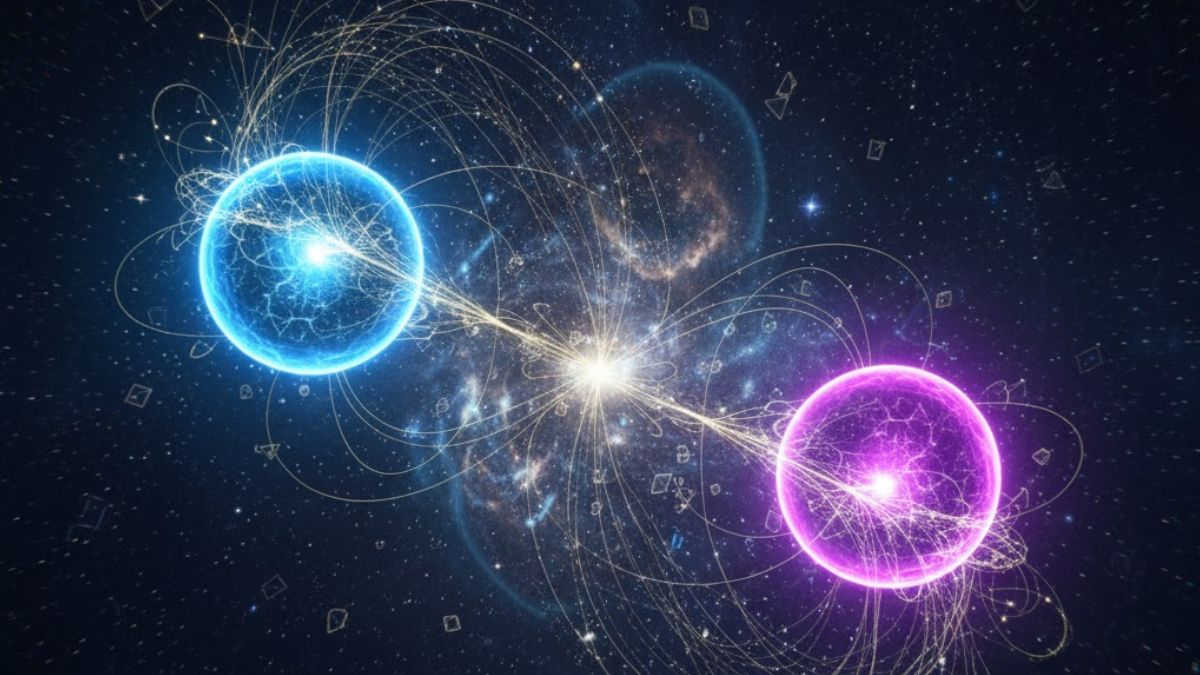
There’s a secret conversation happening all around us, a silent whisper between the tiniest pieces of the universe. It’s a conversation that doesn’t need words, doesn’t need signals, and doesn’t even seem to care about distance. Imagine if you had a magical pair of dice. Every time you rolled them, no matter how far apart they were, one would always show a three when the other showed a four. If you changed one, the other would instantly change in response. This isn’t a fantasy; it’s the real and bewildering world of quantum entanglement, a concept so strange that even Albert Einstein called it “spooky action at a distance.”
For a long time, we thought the universe operated on a set of simple, predictable rules. A thing is in one place. To affect something else, you have to touch it or send a signal to it, like a wave or a message, and nothing can travel faster than light. But quantum entanglement shatters that comfortable view. It suggests that two particles can become so deeply linked that they share a single existence, behaving as one unified system even when separated by the vast emptiness between galaxies.
This idea is at the very heart of how our universe might truly work, and it’s pushing the boundaries of everything from computing to our understanding of reality itself. So, how can two objects be instantly connected, seemingly breaking the cosmic speed limit set by light? Let’s unravel the mystery of this incredible cosmic connection.
Let’s try a simpler thought experiment. Picture two special coins. They aren’t normal coins; they are a linked pair. You give one to your friend, who then boards a spaceship and travels to a star system light-years away. You keep the other coin in your hand. Now, the rule with these coins is that they are always opposite. If your coin lands on heads, you know, at that very instant, that your friend’s coin has landed on tails. You didn’t have to call them up and ask. The moment you saw your result, you knew theirs.
This is the essence of quantum entanglement. It’s a special connection that can form between tiny particles, like electrons or photons (particles of light). When particles become entangled, they lose their individuality. Their properties, like their “spin” (a kind of intrinsic rotation) or polarization, are tied together. They are described by a single quantum state. It’s not that you are sending a message from one coin to the other; it’s that the two coins were never truly separate to begin with. They are two parts of a single system.
Before you measure them, the particles don’t have a definite state. They are in a blur of all possible states at once, a concept called superposition. It’s only when you measure one particle that it “picks” a state, and its entangled partner, no matter where it is, instantly picks the corresponding state. The connection is immediate. This is what makes it so “spooky.” It feels like information is traveling faster than light, but as we’ll see, the reality might be even stranger.
The story of entanglement starts not in a lab, but on paper, with a heated debate between some of the greatest minds in physics. In the 1920s and 1930s, scientists were developing quantum mechanics, the theory that describes the bizarre world of atoms and particles. This new theory was incredibly successful at predicting experimental results, but its implications were deeply unsettling.
Albert Einstein was particularly troubled. He believed in a “local” and “real” universe. “Local” means that things can only be influenced by their immediate surroundings, and no influence can travel faster than light. “Real” means that objects have definite properties even when we aren’t looking at them. A moon is there, with a certain mass and location, whether or not an astronaut is looking at it. Quantum mechanics, however, suggested the opposite. It implied that particles don’t have definite properties until measured, and that this act of measurement could instantly affect another, faraway particle.
In 1935, Einstein, along with his colleagues Boris Podolsky and Nathan Rosen, published a famous paper now called the EPR paradox. They used the idea of entanglement to argue that quantum mechanics must be incomplete. They thought there must be some “hidden variables”—unknown factors that predetermined how the particles would behave, making the universe local and real again. They used entanglement to point out what they saw as a flaw in the theory, calling it “spooky action at a distance” because they couldn’t imagine it being true.
For decades, this was a philosophical argument. Then, in the 1960s, physicist John Bell proposed a way to test it. He developed a mathematical theorem that could distinguish between Einstein’s “hidden variables” and the truly “spooky” quantum connection. If experiments violated “Bell’s inequality,” it would mean Einstein was wrong, and the universe was genuinely spooky. When technology finally caught up in the 1980s, a series of brilliant experiments by Alain Aspect and others did just that. They confirmed that quantum entanglement was real. The particles were connected in a way that defied our classical intuition about space and time.
Einstein’s famous phrase, “spooky action at a distance,” perfectly captures the weirdness of entanglement. But what exactly is so spooky about it? Let’s break it down. The spookiness comes from three things: instantaneity, distance, and the lack of any known force or signal.
First, the connection is instantaneous. As far as we can tell, the moment you measure one entangled particle, its partner takes on the correlated state. There is no travel time. If the particles were on opposite sides of the Milky Way galaxy, which is 100,000 light-years across, the connection would seem to happen in zero time. This appears to violate the universal speed limit set by Einstein’s theory of relativity: the speed of light.
Second, the distance doesn’t seem to matter. Experiments have successfully entangled particles over hundreds of kilometers. The connection doesn’t get weaker with distance. It’s as strong across a meter as it is across a solar system. This challenges our everyday experience where forces like gravity and magnetism get rapidly weaker the farther apart objects are.
Third, and most importantly, you can’t use it to send a message. This is the crucial point that saves us from breaking the laws of physics. Think back to the magical coins. You have no control over whether your coin lands on heads or tails. It’s random. You only know that your friend’s coin is the opposite. Your friend, looking at their coin, also just sees a random result. They only know what your coin showed if you call them up on a regular, slow-speed-of-light phone and tell them. Without that classic communication, all both of you have is random data. So, while the correlation is instantaneous, you can’t use it to send information like “hello” or “invade Mars” faster than light. The universe, it seems, allows for spooky connections, but it strictly enforces a “no-communication” rule to prevent paradoxes.
In the world we experience directly—the world of coffee cups, cars, and cats—we don’t see objects mysteriously influencing each other across space. Your car keys don’t change color just because you painted your car in a different garage. So why don’t we see quantum entanglement at our scale?
The main reason is that entanglement is incredibly fragile. For particles to remain entangled, they need to be perfectly isolated from their environment. The moment an entangled particle interacts with anything else—a stray air molecule, a photon of light, or even a random fluctuation in a field—it loses its special connection. This process is called decoherence. Our everyday world is noisy and warm, full of constant interactions. In this bustling environment, quantum effects like superposition and entanglement get washed away almost instantly, leaving behind the predictable, “classical” world we know.
Think of it like trying to hear a whisper in a quiet library versus at a rock concert. In the library (a highly controlled, cold, isolated lab), the whisper (entanglement) is clear. At the rock concert (your living room), the whisper is completely drowned out by the noise. This is why creating and maintaining entangled particles for experiments is so difficult. Scientists have to use sophisticated equipment to cool particles down to near absolute zero and trap them in vacuums to shield them from the outside world.
While we don’t see direct entanglement, some scientists believe it might play a role in biological processes like photosynthesis, where plants convert sunlight into energy with near-perfect efficiency. The idea is that entangled states in the plant’s molecules might help find the most efficient path for the energy to travel. This is still an active area of research, but it hints that the quantum world’s “spookiness” might be subtly woven into the fabric of life itself.
Even though it sounds like science fiction, scientists are already putting quantum entanglement to work in incredible technologies that were unimaginable just a few decades ago.
One of the most advanced applications is in quantum cryptography. Imagine you want to send a secret message. With normal encryption, a clever hacker might be able to intercept and break the code. But with quantum encryption, you can use entangled photons to create an unbreakable key. The act of a hacker trying to eavesdrop and measure the photons would disturb their entangled state, immediately alerting the sender and receiver that the line is no longer secure. This isn’t a theory; quantum key distribution is already being used by banks and governments to protect sensitive data.
Then there’s the race to build a quantum computer. Ordinary computers use bits, which are either 0 or 1. Quantum computers use quantum bits, or qubits, which can be 0, 1, or both at the same time (superposition). By entangling many qubits together, a quantum computer can perform a massive number of calculations simultaneously. This could allow them to solve problems that are impossible for today’s supercomputers, like designing complex new medicines, discovering new materials, or breaking current encryption codes. While still in its early stages, companies like Google and IBM are making rapid progress.
Another fascinating use is in quantum teleportation. Don’t picture Star Trek; this isn’t about beaming people around. Quantum teleportation is about transferring the exact quantum state of one particle to another distant particle. This is done by using a pair of entangled particles as a resource. The original particle’s state is destroyed in the process, but all its information is recreated in the distant particle. This could be a vital way to move quantum information around inside a future quantum internet.
The existence of entanglement forces us to ask profound questions about the nature of reality itself. What does it mean for two things to be “separate”? Our entire intuition is based on the idea that the universe is made of distinct objects located in specific points in space. Entanglement challenges this at the most fundamental level.
One interpretation is that space itself might not be the fundamental framework of the universe. Entangled particles suggest that what we perceive as empty space and vast distances might be an illusion emerging from a deeper, more connected reality. At some level, everything in the universe might be linked in a way we don’t yet understand.
Another mind-bending idea is that perhaps the particles aren’t communicating at all. Instead, our idea of cause and effect might be wrong. Maybe when we measure the two particles, we are just revealing a property that was always shared, not causing a change. Or, perhaps the future and the past are not as distinct as we think, and our measurement is just locking in a destiny that was always there.
These are not questions with easy answers. They are at the frontier of theoretical physics. The study of entanglement is not just about building better gadgets; it’s a journey to the very heart of what it means to exist in this universe. It suggests that reality is far more interconnected, mysterious, and wonderful than we ever dreamed.
Quantum entanglement reveals a universe that is far stranger and more wonderful than the one we experience day to day. It shows us that the tiny particles that build our reality are capable of a deep, instantaneous connection that defies our conventional understanding of space and time. From enabling unbreakable codes to powering the supercomputers of tomorrow, this “spooky action” is becoming a practical tool, all while forcing us to rethink the very fabric of existence.
The next time you look up at the stars, consider this: the light from those distant suns is made of photons. And for all we know, some of those photons, trillions of miles apart, might be entangled, performing their silent, coordinated dance across the cosmos. It makes you wonder, if the smallest things in the universe are so deeply linked, what other invisible connections are we a part of without even knowing?
1. Can quantum entanglement be used for communication?
No, it cannot be used for sending messages or information faster than light. While the correlation between entangled particles is instantaneous, the results of the measurements are random, so you cannot control them to encode a message like “hello.”
2. Does quantum entanglement prove that time travel is possible?
No, quantum entanglement itself does not provide a mechanism for time travel. While it challenges our classical ideas of space and time, it does not allow for sending information backwards in time or creating the kind of paradoxes often associated with time travel.
3. How long can quantum entanglement last?
In theory, entanglement can last indefinitely as long as the particles remain completely isolated from their environment. In practice, it is very fragile and can be broken in fractions of a second by the slightest interaction with the outside world.
4. Can large objects, like humans, become entangled?
In principle, yes, the laws of quantum mechanics apply to all objects. However, the larger and warmer an object is, the more difficult it is to maintain quantum coherence. For now, scientists have only managed to entangle microscopic objects like atoms and photons.
5. Is quantum entanglement a force?
No, it is not a force like gravity or magnetism. There is no energy being exchanged between the particles. It is better described as a fundamental correlation, a unique kind of connection that is built into the fabric of quantum mechanics.
6. Who is the father of quantum entanglement?
While the concept emerged from the work of many, Albert Einstein, Boris Podolsky, and Nathan Rosen are often credited with first highlighting its strange implications in 1935. Physicist John Bell later provided the framework to test it, and Alain Aspect conducted the first conclusive experiments.
7. Can we create entangled particles?
Yes, scientists can create entangled particles in laboratories using several methods. Common techniques involve using special crystals to split a single photon into two entangled photons or trapping and cooling ions so their properties become linked.
8. How fast is quantum entanglement?
Experiments have shown that if there is a speed to the connection, it is at least 10,000 times faster than the speed of light. Many physicists believe the effect is truly instantaneous, meaning it doesn’t involve speed at all in the traditional sense.
9. Does quantum entanglement happen naturally?
Yes, it is believed that entanglement is a natural and common process. It likely occurs in the high-energy environments of stars, in the early universe, and potentially even in some biological systems, though it is very difficult to observe in natural, noisy settings.
10. What is the future of quantum entanglement?
The future is focused on harnessing entanglement for revolutionary technologies. This includes building more powerful quantum computers, creating a super-secure global quantum internet, and developing ultra-precise quantum sensors for medical imaging and navigation.