
 By SAJID ali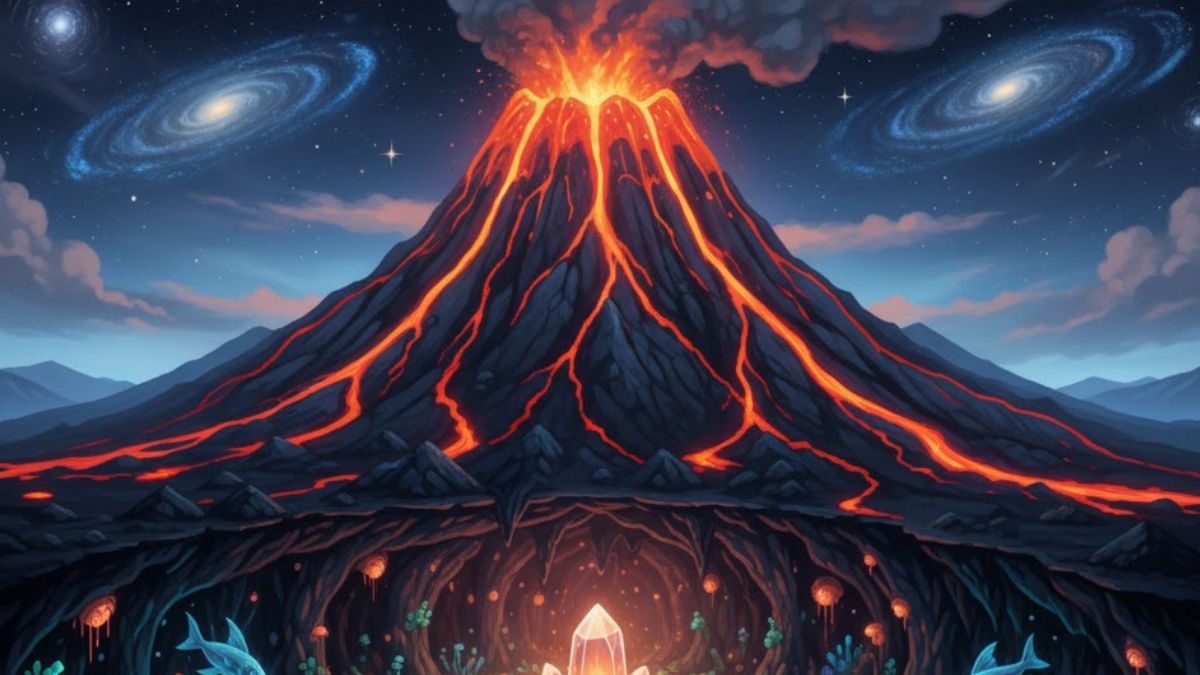
The ground beneath our feet feels so solid and permanent. But deep below the surface of our planet, there are forces at work that are anything but still. We often see volcanoes as these terrifying mountains of fire and destruction, capable of reshaping landscapes in an instant. Their eruptions are awesome displays of nature’s raw power, sending plumes of ash miles into the sky and painting the horizon with rivers of glowing lava.
But what if that power is only half the story? What if, instead of just being bringers of death and barren rock, volcanoes are also guardians of life in one of the most unexpected places imaginable? Scientists are starting to uncover a incredible secret. The same intense heat that fuels a volcano’s fury might also be creating hidden pockets, deep within the Earth, where entire ecosystems could be thriving completely cut off from the world above.
We’ve always looked for life in the sunlight, in the forests and oceans. But the discovery of life in the most extreme places on Earth—like the super-heated waters around deep-sea vents—has made us rethink everything. If life can flourish in the absolute darkness of the ocean floor, powered by chemicals and heat from the Earth itself, could the same thing be happening under a volcano? This idea takes us on a journey into a hidden world, a place where the rules of life are rewritten. So, what kind of strange and resilient creatures could possibly call the hot, dark heart of a volcano their home?
To understand how a volcano could hide a secret world, we first need to understand what a volcano really is. A volcano isn’t just a mountain. It’s more like a doorway, a vent that connects the surface of our planet to the hot, molten rock deep below the crust. The Earth’s crust, the part we live on, is broken into giant puzzle pieces called tectonic plates. These plates are always slowly moving, and where they push together or pull apart, they create weak spots. Magma, which is liquid rock from the Earth’s mantle, can squeeze up through these cracks.
When this magma collects in a large pool underground, we call it a magma chamber. It’s the volcano’s engine room. The pressure builds and builds until finally, the magma forces its way to the surface. Once it erupts and flows out, we call it lava. But the story doesn’t end with the lava flow. All that hot rock and gas moving around underground doesn’t just vanish after an eruption. It leaves behind a complex network of tunnels, caves, and porous rock, all heated by the slowly cooling magma deep below.
Imagine a giant, natural heating system running under a mountain. The hot rocks warm the groundwater that seeps down from the surface. This creates vast reservoirs of hot water and steam. In some places, this water bursts out as geysers and hot springs. But in others, it stays trapped, creating a warm, wet, and dark labyrinth. This isn’t a place of fiery lava rivers; it’s a subterranean world of rock, heat, and water—the three basic ingredients that some scientists believe could be a perfect recipe for life, even without a single ray of sunshine.
The idea of anything living inside a volcano sounds like science fiction. We think of it as a place of extreme heat, crushing pressure, and toxic gases. For most life as we know it, it would be instant death. But over the past few decades, explorers of the deep have made discoveries that have completely changed our definition of where life can exist.
At the bottom of the ocean, along cracks in the seafloor called hydrothermal vents, they found entire ecosystems thriving in total darkness. No sunlight ever reaches these depths. The water is superheated by magma and can be filled with chemicals like hydrogen sulfide, which is poisonous to us. Yet, around these vents, giant tube worms, strange clams, and unique types of bacteria flourish. These communities don’t run on solar energy. They run on chemical energy. The bacteria are the foundation, using a process called chemosynthesis. They take the chemicals spewing from the vent and convert them into food, just like plants use sunlight for photosynthesis. All the other animals depend on these bacteria.
Now, let’s take that idea and move it underneath a volcano. The conditions are surprisingly similar. You have heat from the magma. You have water circulating through the rocks. And that water is rich in minerals and chemicals dissolved from the volcanic rock. This creates a perfect soup for chemosynthetic microbes. If these tiny life forms can get a foothold, they can form the base of a whole food web. They wouldn’t need the sun. Their entire world would be powered by the Earth’s own inner heat. This means that deep under a volcano, there could be pockets of warm water teeming with microbial life, and perhaps even larger, more complex creatures that feed on them.
If we are going to imagine an ecosystem under a volcano, we can’t just picture the animals we see on the surface. Any life there would have to be incredibly specialized to handle the darkness, the heat, and the chemical-rich environment. They would be extremophiles—organisms that love extreme conditions.
The most important members of this hidden community would be the microbes. We’re talking about bacteria and archaea, tiny single-celled organisms that can eat rocks, breathe sulfur, and thrive in water that would be scalding to us. They would coat the walls of the underground caves and float in the water, forming slimy, colorful mats. These microbes would be the grass and trees of this sunless world, the primary producers that create energy for everyone else.
What would eat these microbes? We might find something like tiny worms or crustaceans, similar to what we see at ocean vents. They would graze on the microbial mats. Perhaps there would be small, colorless shrimp filtering the microbes out of the water. In the absolute darkness, there would be no need for eyes, so many of these creatures would likely be blind. They might rely on other senses, like touch or detecting vibrations in the water, to find their way around.
Larger predators could exist too. Think of a specialized snail or a crab that feeds on the smaller grazers. The entire ecosystem would be a slow, steady, and delicate dance in the warm dark. It wouldn’t be a bustling jungle, but a stable and ancient world, possibly existing for thousands of years completely isolated from the surface. Finding such creatures would be like discovering life on another planet, showing us that life is even more stubborn and adaptable than we ever dreamed.
You might be wondering, if these secret worlds are real, how do we find them? We can’t just walk into an active volcano. The search for these underground ecosystems is a difficult and dangerous puzzle that requires some very clever detective work. Scientists use a combination of indirect methods and, where possible, direct exploration.
First, they study the surface for clues. They map out areas where steam and hot gases are escaping from vents called fumaroles. They take the temperature of the ground and test the chemistry of the water in hot springs. The gases and minerals present can tell them a lot about what’s happening deep below. It’s like a doctor analyzing a patient’s symptoms to figure out what’s going on inside their body.
Next, they use tools to see underground without digging. They use instruments that measure tiny changes in gravity and magnetism, which can reveal hollow spaces or different rock types. They also use seismic surveys, which work like a sonar for the Earth. By creating small vibrations on the surface and measuring how the sound waves travel through the ground, they can create a 3D picture of the underground structure, spotting caves, tunnels, and water reservoirs.
The final, most exciting step is direct sampling. This is the hardest part. Scientists drill very deep boreholes to bring up rock and water samples from far below. In these samples, they search for the DNA of microbes. Finding microbial DNA in water that has been isolated for thousands of years would be the ultimate proof of a hidden ecosystem. Some ambitious projects are even trying to send small, tough robots into volcanic caves to explore and take pictures. It’s a slow and careful process, but every sample brings us closer to confirming that life has found a way, even here.
The search for life under volcanoes on Earth isn’t just about satisfying our curiosity about our own planet. It has much bigger implications. It directly influences our search for life elsewhere in our solar system. If life can survive and even thrive in the hot, dark, chemically-rich underworld of a volcano, then we have to expand our horizons when we look at other worlds.
The most exciting place to apply this knowledge is Mars. We see Mars today as a cold, dry, and dusty planet. Its surface is bombarded with radiation and seems very inhospitable. But Mars has a past. It has huge, dormant volcanoes, like Olympus Mons, the largest volcano in our solar system. Scientists believe that Mars was once volcanically active and had liquid water. If life ever got a start on Mars billions of years ago, could it have retreated underground when the surface became harsh? Could there still be microbial communities living in warm, wet pockets deep beneath the Martian surface, powered by volcanic heat? Our search on Mars is now focused on these exact kinds of environments.
Another prime candidate is a moon of Jupiter called Europa. Europa is an ice-covered world, but scientists are almost certain there is a vast, global ocean of liquid water beneath its icy crust. What is heating that ocean and keeping it from freezing solid? The likely answer is tidal forces from Jupiter’s gravity, which squeeze and stretch the moon, creating heat through friction—a process similar to volcanic heating. On the floor of Europa’s ocean, there could be volcanic vents just like the ones on Earth. If life can exist around vents in our ocean, why not in Europa’s? Finding life under our own volcanoes gives us the hope and the blueprint to go looking for it in these distant, icy oceans.
Volcanoes have always captured our imagination with their destructive power. But this new perspective shows us they might also be creators and protectors of life in one of the most hidden environments imaginable. They are not just mountains of fire; they are potential keepers of secret, sunless worlds where life has learned to dance to a different tune—the slow, steady beat of the Earth’s inner heat.
The search for these underground ecosystems is like a real-life treasure hunt, pushing the limits of our technology and our understanding of biology. Every new discovery in the deep, dark places of our world reminds us just how tenacious life is. It forces us to ask a profound question: if life can find a way in the most unexpected corners of our own planet, how common might it be throughout the vastness of the universe?
1. What is the hottest part of a volcano?
The hottest part of a volcano is the magma chamber, which is the large pool of molten rock deep underground. The temperature there can reach between 1,300 and 2,400 degrees Fahrenheit (700 to 1,300 degrees Celsius).
2. Can volcanoes create new land?
Yes, absolutely. When lava from a volcanic eruption flows into the ocean and cools down, it solidifies into new rock, creating new land. The Hawaiian Islands are a famous example of entire islands formed by repeated volcanic activity over millions of years.
3. How many volcanoes are active on Earth right now?
Scientists estimate there are about 1,350 volcanoes that have been potentially active in the last 10,000 years. On any given day, between 10 and 20 volcanoes are erupting somewhere in the world.
4. What gas comes out of volcanoes the most?
The most common gas released by volcanoes is water vapor, making up over 50% of volcanic gas. Other significant gases include carbon dioxide, sulfur dioxide, and hydrogen sulfide.
5. Why is the soil around volcanoes so good for farming?
Volcanic ash and rock break down over time to create a very fertile soil. This soil is rich in important nutrients like potassium, phosphorus, and other minerals that plants need to grow strong and healthy.
6. What is the difference between magma and lava?
Magma is the name for molten rock when it is still stored underground in the magma chamber. Once it erupts onto the Earth’s surface and starts flowing, it is then called lava.
7. Can we predict when a volcano will erupt?
While we cannot predict eruptions with perfect accuracy, volcanologists can often provide warnings. They look for signs like small earthquakes, ground swelling, and changes in the type and amount of gases being released, which indicate that magma is moving upwards.
8. What is the “Ring of Fire”?
The Ring of Fire is a major area in the basin of the Pacific Ocean where a large number of earthquakes and volcanic eruptions occur. It’s a horseshoe-shaped belt where several tectonic plates meet and interact, causing intense geologic activity.
9. Do volcanoes exist on other planets?
Yes, volcanoes are found on other planets and moons. Mars has the largest known volcano in the solar system, Olympus Mons. Jupiter’s moon Io is the most volcanically active body we know, with hundreds of volcanoes constantly erupting.
10. What is a supervolcano?
A supervolcano is a volcano that has had an eruption of magnitude 8 on the Volcano Explosivity Index, meaning it has erupted more than 240 cubic miles of material in a single event. These eruptions are incredibly rare but can have global effects on the climate. Yellowstone in the U.S. is a well-known example.