
 By SAJID ali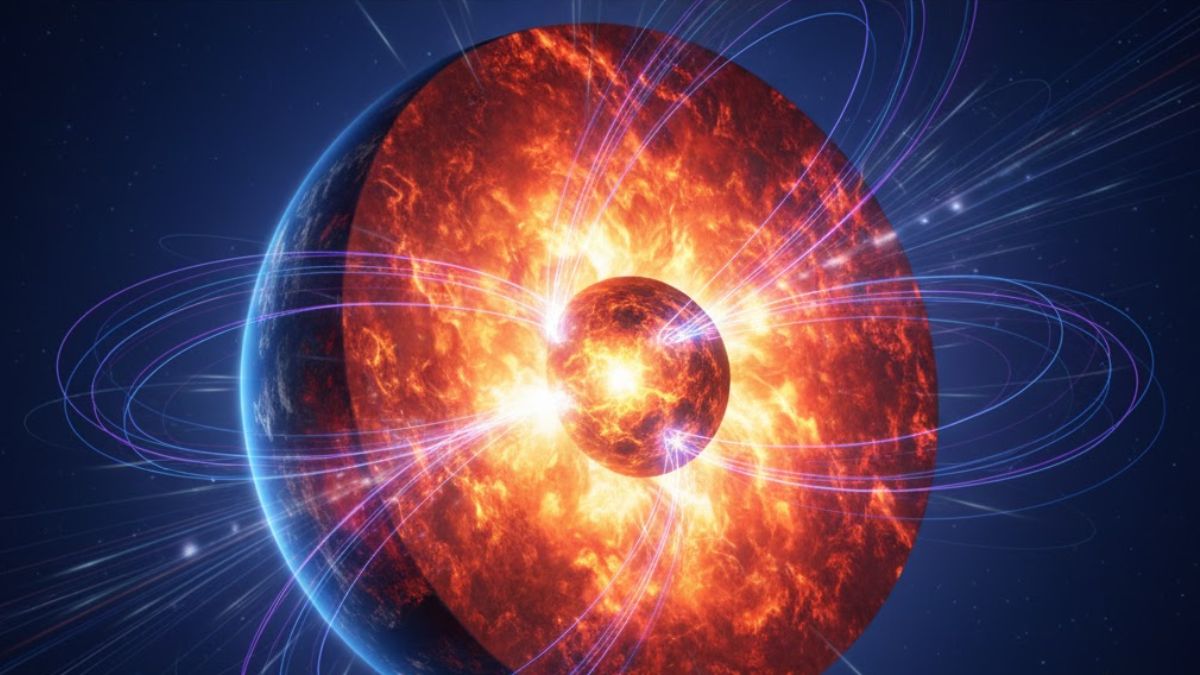
There’s an invisible shield around our planet, a silent guardian we rarely think about. It’s not made of steel or rock, but of an invisible force. This shield protects us every single day from a constant stream of radiation coming from the Sun. Without it, life as we know it would be very different, perhaps even impossible. This guardian is the Earth’s magnetic field.
We can’t see it, but we can see its effects. It’s the reason a simple compass needle always points north, guiding travelers for centuries. It’s also the creator of the beautiful, dancing curtains of light known as the Northern and Southern Lights. But this protective field is not a steady, unchanging rock. Deep within the Earth, it is alive and restless. Scientists who study it have discovered something astonishing: our magnetic field has a mind of its own, and every so often, it decides to turn everything upside down. North becomes south, and south becomes north. What could possibly cause such a dramatic and seemingly sudden reversal?
To understand why it flips, we first need to understand what it is. Think of the Earth as a giant magnet. But unlike the magnet you might stick to your fridge, this one is on a planetary scale. It creates a giant, invisible bubble around our world called the magnetosphere. This bubble acts like a force field, deflecting most of the dangerous charged particles that the Sun constantly shoots our way in the solar wind.
If you could see this magnetic field, it would look like giant loops surrounding the Earth, flowing out from near the South Pole, arching through space, and returning to the Earth near the North Pole. This is why your compass points north—the needle aligns itself with these invisible lines of force. The strength and direction of this field aren’t constant; they shift slightly from year to year. Sometimes it gets stronger in one place and weaker in another, like a living, breathing entity. This constant, subtle dance is a clue that something powerful and dynamic is happening at the very heart of our planet.
The source of this magic is not a giant bar of magnetized iron, as you might imagine. The truth is far more spectacular. The engine for our magnetic field lies deep beneath our feet, in the Earth’s core. The core is made up of two parts: a solid inner ball of iron, about as hot as the surface of the Sun, and a swirling, churning ocean of liquid metal that surrounds it, called the outer core.
This outer core is the key. The liquid there is mostly iron and nickel, and it’s so hot that it moves constantly, like water boiling in a pot. At the same time, the Earth is rotating. This combination of intense heat causing the liquid to rise and fall, combined with the planet’s spin, creates massive, swirling currents of molten metal. When an electrical conductor, like liquid iron, moves around like this, it generates an electrical current. And as any science class will tell you, an electrical current creates a magnetic field. This entire process is known as the geodynamo. It’s a self-powering generator, 3,000 kilometers below the surface, that has been running non-stop for billions of years.
Now we get to the truly fascinating part. That churning, swirling liquid metal in the outer core doesn’t move in a calm, predictable pattern. It’s chaotic and turbulent, like a raging whirlpool. Imagine a pot of water on a very hot stove. The water bubbles and churns in complex, unpredictable ways. The Earth’s outer core is like that, but with molten metal and on a planetary scale.
The magnetic field is created by this movement. So, if the flow of the metal changes, the magnetic field changes with it. Normally, the flow is somewhat organized, maintaining the north-south alignment we’re used to. But sometimes, the chaotic nature of the flow can create a sort of “rebellion.” Small, localized magnetic fields can spring up in the opposite direction within the liquid core. Most of the time, these rebellious patches fade away. But if they become strong enough and manage to organize, they can start to dominate, eventually causing the entire planet’s magnetic field to reverse its polarity. It’s not a sudden, overnight event, but a gradual takeover that, from a geological perspective, can seem surprisingly quick.
Scientists don’t have a crystal ball, but they do have clues. One of the biggest warning signs is that the Earth’s magnetic field is getting weaker. Over the last couple of centuries, measurements have shown that the overall strength of the field has decreased by about 9%. In one particular area, known as the South Atlantic Anomaly, the field is significantly weaker. This spot, over the South Atlantic Ocean, is so faint that satellites passing through it have to shut down their sensitive electronics to avoid damage from solar radiation.
A weakening field is often seen as a precursor to a reversal. Think of it like this: before the field can flip, the old, dominant field has to lose its strength to make way for the new, opposing one. This weakening isn’t uniform, which is why we get these strange weak spots. It’s as if the protective shield is developing holes before it reorganizes itself into a new configuration. This doesn’t mean a flip is guaranteed to happen tomorrow, but it does tell us that the forces that drive reversals are active right now.
Absolutely. The Earth’s magnetic field has flipped many, many times. It’s a normal part of our planet’s life. By studying rocks, especially volcanic rocks, scientists have been able to create a history of these reversals. When lava erupts and cools, tiny magnetic minerals inside the rock lock in the direction and strength of the Earth’s magnetic field at that very moment. It’s like a fossilized compass.
This rock record shows us that reversals are not rare. In the last 20 million years, the field has flipped about every 200,000 to 300,000 years. However, it’s very irregular. The last full reversal, called the Brunhes-Matuyama reversal, happened about 780,000 years ago. That’s much longer than the average, meaning our planet is long overdue for a flip, according to the geological clock. This doesn’t mean it’s imminent, but it does mean we are in a period where the possibility is very real.
This is the million-dollar question. The good news is that the fossil record shows no mass extinctions that line up neatly with past magnetic reversals. Life, in its resilient way, has weathered these flips before. The process of reversal is not a clean, instant switch. It’s a messy, drawn-out affair that can take anywhere from 1,000 to 10,000 years to complete.
During this long transition, the magnetic field doesn’t vanish; it just becomes much more complicated and weaker. It might form multiple north and south poles, or look like a patchwork quilt of magnetic zones. A weaker field means more solar and cosmic radiation can reach the Earth’s surface. This could pose an increased risk of radiation for life, and it could certainly cause havoc for our technology. Our power grids and satellite networks, which we rely on for communication, navigation, and weather forecasting, are vulnerable to intense solar storms. A weak magnetic field would leave them far more exposed. So, while it might not be an apocalypse for nature, it would be a significant challenge for human civilization, forcing us to adapt and protect our fragile electronic infrastructure.
The Earth’s magnetic field is a testament to the dynamic and living nature of our planet. It’s not a static rock but a pulsating, changing force born from a sea of molten iron deep in the core. Its occasional flips are not signs of a planet in trouble, but rather evidence of a robust and active planetary engine. While the process might seem sudden and alarming to us, it’s just a blink in the Earth’s long history. As we continue to monitor the slow weakening and shifting of our protective shield, we are reminded that we live on a world that is still full of mysteries, its heart beating with a powerful, magnetic rhythm. The next time you see a compass pointing north, remember the incredible, churning power that makes it possible, and consider the fact that one day, far in the future, that same compass might quietly, steadily, begin to point south.
Do you think our advanced technological society is prepared to handle the long-term challenges a magnetic reversal would bring?
1. How long does it take for the Earth’s magnetic field to flip?
The process is not quick from a human perspective. A full magnetic reversal can take anywhere from 1,000 to 10,000 years to complete. It’s a very slow, gradual weakening and reforming of the field rather than an instant switch.
2. What would happen to my compass during a magnetic flip?
Your compass would behave very strangely over thousands of years. The needle would become unstable, wobbling between directions before eventually settling on the new “north,” which would be located near what we currently call the South Pole.
3. Can a magnetic reversal cause earthquakes or volcanoes?
There is no direct evidence that magnetic reversals cause earthquakes or volcanic eruptions. Both are driven by the movement of tectonic plates in the Earth’s crust, while the magnetic field is generated much deeper, in the core.
4. How do scientists know the magnetic field has flipped in the past?
Scientists study the magnetic history locked in rocks. When volcanic lava cools or sediments settle on the ocean floor, tiny magnetic minerals align with the Earth’s field at that time, providing a permanent record that can be read millions of years later.
5. Is the Earth’s magnetic field weakening now?
Yes, overall, the Earth’s magnetic field has been weakening for the last several centuries. A large area over the South Atlantic Ocean, in particular, has shown a significant drop in strength, which scientists are closely monitoring.
6. Could a magnetic flip wipe out all technology?
It wouldn’t wipe it out completely, but it would pose a serious threat. A weak magnetic field during the transition would offer less protection from solar storms, which could damage satellites, disrupt power grids, and affect GPS and communication systems.
7. How often do these magnetic flips happen?
The frequency is irregular. On average, a flip has occurred every 200,000 to 300,000 years over the last 20 million years, but sometimes the field remains stable for much longer, as it has for the last 780,000 years.
8. Will the Northern Lights be affected by a reversal?
Yes, they would likely become much more common and visible from many more places around the world. The auroras are caused by solar particles interacting with the magnetic field, and a weaker, more complex field would allow these particles to reach the atmosphere over a wider area.
9. Are we overdue for a magnetic reversal?
Based on the average rate of past reversals, yes, we are statistically overdue. However, the process is so irregular that “overdue” doesn’t mean it will happen soon; it simply means we are in a window of time where it is a possibility.
10. Can humans survive a magnetic field reversal?
Yes, absolutely. Our ancestors lived through many reversals without any issue. The main challenge for modern humans would not be survival itself, but protecting our technology and infrastructure from increased radiation during the thousands of years the field is weak.