
 By SAJID ali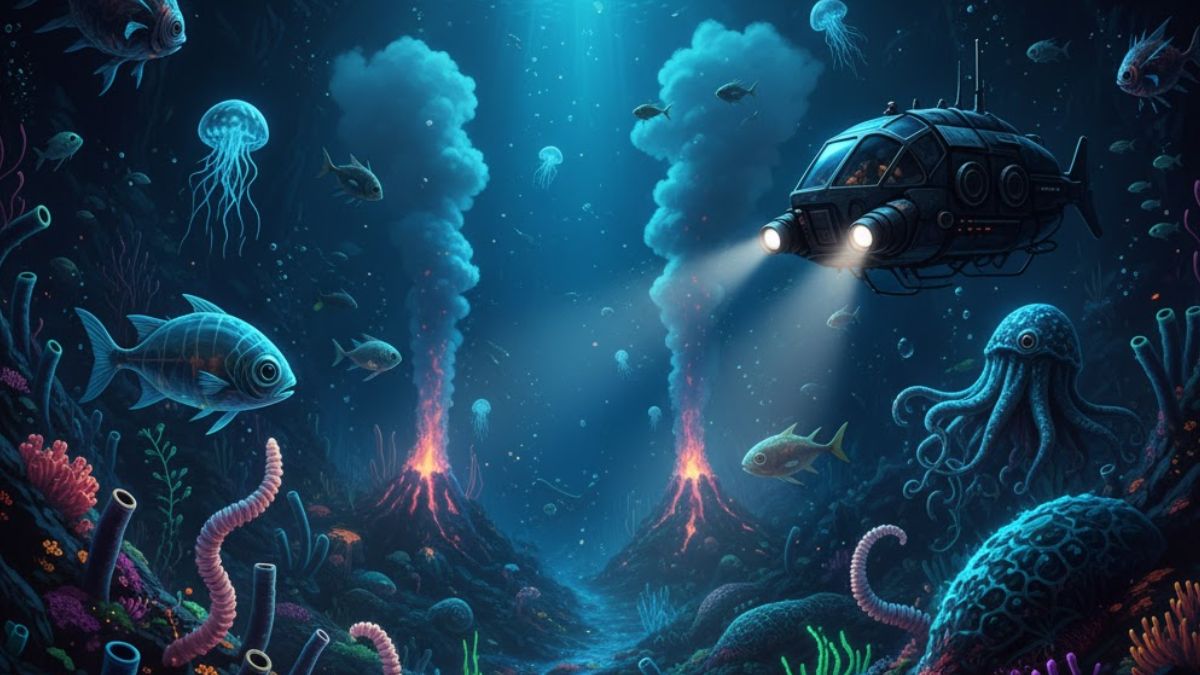
The surface of our planet is something we see every day. We walk on solid ground, drive on paved roads, and look out over fields, mountains, and cities. It feels permanent and known. But this familiar crust we live on is just a thin skin, like the shell of an egg. And beneath that shell lies a world that is more alien and mysterious than any landscape we imagine on distant planets.
If we were to take all the water from the oceans and pour it away, we would see a hidden landscape of incredible drama. There are towering underwater volcanoes, vast plains that stretch for thousands of miles, and colossal mountain ranges. But the most breathtaking features are the deep ocean trenches. These are not gentle valleys; they are deep, V-shaped gashes in the ocean floor, so profound that they defy easy understanding. They are the true final frontiers of our own world.
We are about to journey to the very bottom of the sea, to a place of eternal darkness, crushing pressure, and astonishing life. We will explore what these trenches are, how they formed, and what secrets they hold in their silent, dark embrace. So, if the highest mountain on Earth was placed inside the deepest trench, its peak would still be over a mile underwater. What kind of world exists in that deep, dark silence?
To find the deepest point in the ocean, we must travel to the western Pacific Ocean, to a location near the Mariana Islands. Here, nestled in the Mariana Trench, is a small, valley-like depression called the Challenger Deep. This is the champion of depth, the lowest point on Earth’s solid surface.
How deep is it? The Challenger Deep is approximately 36,000 feet deep. To put that into a picture we can grasp, imagine you are standing at the top of Mount Everest, the world’s tallest mountain. Now, imagine you could lift that entire mountain and drop it into the Challenger Deep. The shocking truth is that the summit of Everest would still be submerged under more than a mile of water. The pressure at the bottom is unimaginable, about a thousand times the standard atmospheric pressure we feel at sea level. It is a weight so immense that it would instantly crush most man-made objects, a place where the very nature of matter is tested.
This incredible depth was not discovered all at once. The first sounding, or depth measurement, was taken in 1875 by the HMS Challenger, the ship that gave the deep its name. For a long time, we knew very little about it. It was just a number on a chart, a remote and unreachable mystery. It was not until 1960 that humans first visited this alien landscape, and even today, more people have walked on the moon than have journeyed to the bottom of the Challenger Deep. It remains one of the most inaccessible places on our own planet.
The existence of these deep trenches is not a random accident. They are the most visible scars from an epic, slow-motion battle happening deep within the Earth. Our planet’s outer shell, called the lithosphere, is not one solid piece. It is broken into giant puzzle pieces called tectonic plates, and these plates are constantly, slowly moving.
Most ocean trenches form at a specific type of boundary where two of these plates collide. In a process called subduction, a denser oceanic plate slides underneath a lighter continental plate or another oceanic plate. Think of it like one great piece of the Earth’s crust being forced to dive down beneath another. The point where this happens creates a deep, narrow trench. It is a slow and powerful process, moving only a few inches per year, but over millions of years, it carves these incredible chasms into the seafloor.
This process is not just about creating holes. It is a fundamental part of how our planet works. As the oceanic plate is forced down into the Earth’s hot interior, or mantle, it begins to melt. This melted rock, now lighter than its surroundings, rises back up through the crust. This is what creates the chains of volcanoes that almost always line the edges of continents near these trenches. The entire “Ring of Fire,” a horseshoe-shaped zone around the Pacific Ocean known for its frequent earthquakes and volcanoes, is essentially outlined by these subduction zones and their deep-sea trenches. So, these trenches are not just passive holes; they are active, dynamic features that shape the very geography of our world.
The environment at the bottom of an ocean trench is one of the most extreme on Earth. It is a world utterly unlike our own, defined by three key factors: darkness, cold, and pressure. First, let’s talk about light. Sunlight can only penetrate so far into the ocean. Beyond about 3,300 feet, there is complete and total darkness. This zone is called the aphotic zone, and the trench floors lie far, far below it. The world down there is perpetually black, a midnight that has never seen the sun.
The temperature is just above freezing, typically around 34 to 39 degrees Fahrenheit. It is a constant, bitter cold. But the most defining and crushing characteristic is the pressure. We call it hydrostatic pressure—the weight of all the water above pushing down. At the bottom of the Mariana Trench, the pressure is about 15,750 pounds per square inch. To feel that kind of pressure on land, you would have to balance the weight of fifty jumbo jets on your body. This immense pressure compresses everything, and it is the main reason why exploring these depths is so incredibly difficult. It is a silent, heavy, and dark world that seems designed to keep visitors out.
For a long time, scientists thought the deep trenches were biological deserts. They assumed that no life could possibly survive the crushing pressure, the cold, and the lack of light. How could anything find food or energy in such a barren place? They were wonderfully wrong. The bottom of the trench is not a barren wasteland; it is teeming with life, but life that has adapted in the most incredible ways.
The foundation of this deep-sea ecosystem is not sunlight, but chemicals. At the hot vents on the seafloor, which can exist even in trenches, bacteria perform a miracle. They use a process called chemosynthesis, where they convert toxic chemicals like hydrogen sulfide from the Earth’s interior into energy. This is the deep-sea equivalent of plants using sunlight for photosynthesis. These bacteria form the base of a food web that includes bizarre and wonderful animals. We find ghostly white snailfish, fields of strange worms with red plumes, and armies of scavenging amphipods, which look like pale, oversized shrimp.
One of the most amazing discoveries is that these creatures have special adaptations to handle the pressure. Their bodies are flexible, and their cellular processes are built to function normally under such extreme conditions. If they were brought to the surface quickly, their bodies would expand and fall apart. They are perfectly evolved for a world we can barely visit. The discovery of this “extreme life” has even excited astronomers, as it suggests that life could potentially exist in similarly harsh environments on other worlds, like the icy, subsurface oceans of Jupiter’s moon Europa.
Visiting the deep trenches is one of the greatest engineering challenges humanity has ever undertaken. We cannot send a human down there in a normal submarine. The pressure would crumple it like a soda can. So, how do we explore this hidden world? Scientists use incredible machines called submersibles, which are specially built to withstand the immense pressure.
These submersibles are like underwater spaceships. They have thick, metal hulls, usually made from a special type of foam or synthetic glass that can resist being crushed. The most famous ones are HOVs, or Human-Occupied Vehicles, like the Deepsea Challenger, which carried filmmaker James Cameron to the bottom of the Challenger Deep in 2012. These crafts have powerful lights and cameras to pierce the darkness, and robotic arms to collect samples of rocks, sediment, and strange deep-sea creatures.
Perhaps even more common are ROVs, or Remotely Operated Vehicles. These are unmanned robots connected to a ship on the surface by a long, strong cable. Pilots on the ship control the ROV in real-time, seeing through its cameras and manipulating its arms. ROVs can stay down for much longer than a human-occupied submersible, sometimes for days at a time, sending back a constant stream of video and data. They are our eyes and hands in the deep, revealing the secrets of the trenches one dive at a time.
The trenches are full of surprises, constantly challenging what we think we know. One of the most shocking discoveries is that even in the most remote place on Earth, we have found human pollution. When the deep-diving submersibles reached the bottom of the Mariana Trench, they found plastic bags and sweet wrappers. This showed us that there is no place on Earth left untouched by our waste, a sobering reminder of our impact on the planet.
But the discoveries are not all gloomy. Scientists have also found vast fields of strange, bubbling mud volcanoes on the trench floor. They have discovered lakes of liquid carbon dioxide trapped under the sediment. And perhaps the most surprising find of all is that the rocks at the bottom of the trenches are not dry and solid. They are saturated with water, and this water is being pulled down into the Earth’s mantle through the subduction process. This changes our understanding of the Earth’s water cycle, suggesting that the planet may be recycling its water deep within itself over geological time.
Every single expedition that goes down comes back with something new—a new species, a new geological formation, or a new piece of the puzzle about how our planet functions. The trenches are not empty; they are a treasure trove of scientific wonders, each one helping us to better understand the complex and dynamic world we live on.
The strange life forms of the deep ocean are not just curiosities; they could be incredibly valuable to all of us on the surface. The extreme environment of the trenches forces animals and microbes to evolve unique biochemical compounds to survive. They produce special proteins and enzymes that allow their cells to function under high pressure and cold temperatures.
Scientists are now studying these “extremophile” organisms, believing they could be a goldmine for new medicines. For example, the enzymes from bacteria that live around deep-sea hot vents are already being used in laboratory tests and industrial processes because they are stable under conditions that would destroy normal enzymes. The search is on for new antibiotics, cancer-fighting drugs, and other compounds that might be derived from the unique chemistry of trench life.
This field of research, called bioprospecting, is like searching for biological treasure. The deep sea is the largest ecosystem on Earth, and we have only explored a tiny fraction of it. The potential for discovering a molecule that could cure a disease or solve an industrial problem is enormous. The incredible life in the darkness below may one day help to save lives in the sunlit world above.
The deepest parts of our ocean are more than just dark, cold holes. They are active, dynamic places that play a crucial role in shaping our planet’s geology and climate. They are home to a web of mysterious life that thrives against all odds, life that may hold secrets to our own future. They are a testament to the fact that the greatest mysteries are not always far away in space, but sometimes right here, hidden beneath the waves on our own blue planet.
We have mapped the surface of Mars in greater detail than our own ocean floor. Every time we send a probe into the deep, we see a part of our world that no human has ever seen before. It makes you wonder, if we have only explored a small percentage of these deep trenches, what other incredible secrets are waiting to be discovered in the darkness below?
1. What is the deepest part of the ocean called?
The deepest part of the ocean is called the Challenger Deep. It is located at the southern end of the Mariana Trench in the western Pacific Ocean.
2. How deep is the Mariana Trench?
The Mariana Trench is about 36,000 feet deep at its lowest point, the Challenger Deep. This is deep enough to submerge Mount Everest and still have over a mile of water above it.
3. Is there any light at the bottom of the ocean trench?
No, there is absolutely no sunlight at the bottom of an ocean trench. It is in perpetual and total darkness, as sunlight cannot penetrate beyond the first few thousand feet of the ocean.
4. What kind of animals live in the Mariana Trench?
Animals that live in the Mariana Trench include the Mariana snailfish, which is the deepest-living fish known, giant amphipods (large shrimp-like crustaceans), and various types of microbes and sea cucumbers adapted to the extreme pressure.
5. How can fish survive the immense pressure down there?
Deep-sea fish have adapted with flexible skeletons and bodies that lack air-filled spaces like swim bladders. Their cellular processes are specially designed to function normally under thousands of pounds of pressure.
6. How long does it take to reach the bottom of the Mariana Trench?
In a specialized deep-diving submersible, it takes about four hours to descend to the bottom of the Challenger Deep. The ascent back to the surface takes a similar amount of time.
7. Why is the water in the deep ocean so cold?
The deep ocean is cold because the sun’s warmth cannot reach it. The water temperature remains just above freezing because it is filled by dense, cold water that sinks from the polar regions and flows slowly across the ocean floor.
8. Has a human ever been to the bottom of the Mariana Trench?
Yes, but only a handful of times. The first was in 1960 by Don Walsh and Jacques Piccard. The most recent solo dive was by filmmaker James Cameron in 2012. A few other manned and unmanned missions have also visited since.
9. What would happen to a human at the bottom of the trench without a submersible?
Without the protection of a submersible, the immense pressure would instantly crush the body. The lungs and any air-filled cavities would collapse, and it would be immediately fatal.
10. Are there volcanoes in the deep ocean trenches?
Yes, there are volcanoes and hydrothermal vents near trenches. These are formed by the geological activity of tectonic plates grinding against each other, which melts rock and creates undersea volcanic eruptions and vents that spew superheated, mineral-rich water.