
 By SAJID ali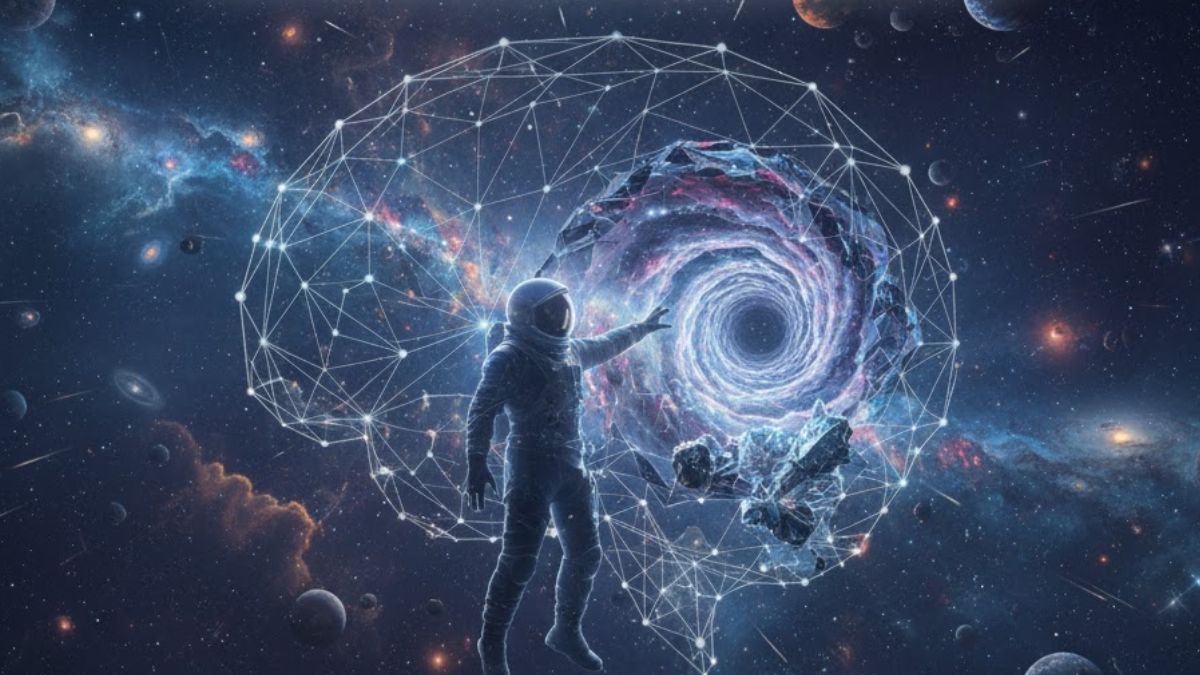
There’s a map of the cosmos in your mind, probably one you’ve seen since childhood. It shows our blue Earth, the yellow Sun, the other planets on their tracks, and a spray of stars in the background. It feels complete, like a finished painting. But the truth is, that map is just a tiny, glowing speck on a canvas of unimaginable size. The real painting extends so far beyond what we can see that it challenges everything we think we know about reality. We are, in a very real sense, living inside a small, illuminated bubble adrift in an infinite, dark ocean.
This bubble is what scientists call the “observable universe.” It contains every star, every galaxy, and every bit of light that has had enough time to travel across space to reach our telescopes since the universe began. It is our cosmic horizon, the ultimate limit of our vision. But just like a ship on the ocean can only see to the horizon, we know there’s more out there. The universe doesn’t just stop at the edge of what we can see. So, what lies beyond that final frontier of light? What kind of reality exists past the edge of our own?
This is one of the most profound questions we can ask. The answer isn’t simple, and it takes us on a journey from the birth of the cosmos to the very nature of existence itself. We have to piece together clues from physics and a good dose of imagination to even begin to guess. So, if the observable universe is just our neighborhood, what does the rest of the city look like?
Think of the universe as a vast, dark forest, and we are sitting by a small campfire. The light from our fire only illuminates the trees and rocks within a certain distance. Everything outside that circle of light is hidden in absolute darkness. We know the forest continues, but we cannot see what’s there. The observable universe is that circle of light. It’s not a physical wall or a barrier you could bump into. It’s a limit created by the speed of light and the age of the universe.
The universe is about 13.8 billion years old. Light, as fast as it is, takes time to travel. This means that when we look at a galaxy that is 10 billion light-years away, we are seeing it as it was 10 billion years ago. Now, consider a galaxy so far away that the light it emitted at the very beginning of the universe is only just reaching us now. That galaxy is at the very edge of our observable universe. Beyond that point, light hasn’t had enough time to reach us yet. It’s not that there’s nothing there; it’s that information from those regions hasn’t arrived at our cosmic doorstep.
So, the “edge” is really a time limit, a horizon of events. It’s the maximum distance we can see back in time, all the way to the initial burst of light from the Big Bang. This also means our observable universe is constantly growing. Every second, light from previously unseen regions finally reaches us, expanding our bubble of knowledge by another light-second. But is this expansion revealing more of the same, or something entirely different?
Trying to grasp the size of the observable universe is enough to make your head spin. Let’s try to scale it down to something we can understand. Imagine you shrunk our entire solar system—the Sun and all the planets out to Neptune—down to the size of a single coin. On that scale, our home galaxy, the Milky Way, would be about the size of North America. That’s already immense.
Now, hold that thought. The observable universe contains not just one galaxy, but an estimated two trillion galaxies. Each of these galaxies is an island of billions or even trillions of stars. If you packed all those galaxies into our scaled-down model, the diameter of the observable universe would be roughly the distance from the Earth to the Moon. That’s a sphere over 384,000 kilometers across, filled with the equivalent of two trillion “North America”-sized galaxies. And remember, this is just the part we can see. The total universe, beyond our view, is almost certainly much, much larger. Many scientists believe it is infinite. Our entire, mind-crushingly vast observable universe might be just one grain of sand on an endless beach.
Let’s play a science fiction game. Imagine you have a spaceship that can travel at any speed, and you decide to fly straight toward the observable edge. What would happen as you approached this famous horizon? The journey itself would be a trip back in time. The farther you travel, the older the light you’re seeing from galaxies. As you get closer to the theoretical edge, you’d be witnessing the universe in its infancy, seeing the first galaxies slowly forming from clouds of gas.
But here’s the twist: you would never actually find a wall or a “You Are Here” sign at the edge. If you could keep going, you’d simply find more universe. You’d fly past galaxies that were once beyond our view and enter a new region of space that was previously invisible from Earth. From your new vantage point, your own observable universe would have shifted. You’d have a new cosmic bubble centered on you. The edge isn’t a place; it’s a perspective. It’s unique to every single point in the universe. So, the act of traveling towards it just moves the goalposts. The true wonder isn’t reaching the edge, but realizing that every spot in the cosmos has its own.
This is where things get truly strange. Based on our best theories, the universe beyond our horizon is probably very similar to the universe inside it. The laws of physics, the types of galaxies, the elements that make up stars—they are likely the same. This idea, called the Cosmological Principle, suggests that on a large scale, the universe is smooth and uniform. No matter where you go, it looks roughly the same.
However, some of the most exciting theories in cosmology suggest otherwise. The theory of cosmic inflation proposes that in the first fraction of a second after the Big Bang, space itself expanded faster than the speed of light. This process could have stretched tiny quantum fluctuations into vast, cosmic-sized variations. If this is true, then far, far beyond our observable bubble, the fundamental nature of reality could be different. Some regions might have different physical constants; the strength of gravity or the mass of an electron could be different. In an infinite universe, every possible configuration of matter and physics might exist somewhere. There could be realms where time behaves differently, or where the very concept of a galaxy doesn’t exist. It’s a dizzying thought: our entire cosmic history, with its specific rules that allowed for stars, planets, and life, might just be one possible outcome in a multiverse of infinite possibilities.
The idea of a multiverse is perhaps the most speculative but fascinating answer to what lies beyond. If our entire universe, including the unobservable part, is just one bubble in a grander cosmic foam, then what we call “beyond” might not be more of our universe, but an entirely different one. Think of it like this: our universe is one soap bubble in a froth of countless other soap bubbles. Each bubble is its own universe, possibly with its own unique laws of physics, its own Big Bang, and its own story.
These bubble universes wouldn’t be made of the same “stuff” as ours. They might have more dimensions of space, or fewer. They could be expanding or collapsing. Some might be sterile and empty, while others could be teeming with forms of life we can’t even imagine. The scary part is that we likely can never interact with or detect these other universes. They exist in a reality separate from our own. So, the answer to “what’s beyond the edge?” could be a landscape of other, disconnected cosmic realms, forever out of reach.
You might be wondering how we can talk about things beyond our vision. It sounds like guesswork, but it’s actually based on rigorous scientific detective work. Scientists use the part of the universe we can see as a laboratory. By studying the cosmic microwave background—the faint afterglow of the Big Bang that fills all of space—we can see the “baby picture” of the universe. The patterns in this light tell us about the conditions of the entire cosmos in its first moments.
From this, we can make predictions. The way our universe is structured, the way it’s expanding, and the distribution of galaxies all point towards a reality that is much larger than what we observe. It’s like looking at a single square foot of a vast tapestry. By carefully examining the threads, the colors, and the pattern in that one square, we can be fairly confident that the rest of the tapestry continues in a similar, though not necessarily identical, way. Our models of the universe are incredibly successful at explaining what we see inside our bubble, which gives us confidence that they are also roughly correct about what lies outside of it.
The journey to the edge of the observable universe is ultimately a journey into the limits of our own knowledge. We have pushed our vision to a horizon 46 billion light-years away, only to find that the true universe extends into a darkness that is both terrifying and exhilarating. It might be an endless sea of more galaxies, or it might be a gateway to an infinite multiverse of alien realities. The edge is not a end point, but a beginning—a reminder of how much is left to discover.
This mystery is what makes astronomy so compelling. We are bound to our tiny planet, yet through science and imagination, we can ponder the entirety of existence. We may never know for sure what lies beyond our cosmic horizon, but the act of asking the question connects us to every human who has ever looked up at the night sky and felt a sense of wonder. If the entire cosmos is a story, we’ve only read the first page. What do you think the next chapter might reveal?
1. Does the universe have an end?
The universe as a whole likely does not have an end. The “end” we talk about is the observable edge, which is the limit of how far we can see. The actual universe probably continues forever, or it might be curved back on itself in a way that has no boundary, like the surface of a sphere.
2. What is outside the universe?
This question is tricky because “outside” might not have any meaning. The universe is, by definition, all of space, time, matter, and energy. If the universe is infinite, there is no “outside.” If it is a bubble in a multiverse, then the “outside” would be a broader meta-realm containing other universes, but it wouldn’t be space or time as we understand it.
3. How can the universe be 93 billion light-years wide if it’s only 13.8 billion years old?
This is because space itself is expanding. While light from the most distant objects has been traveling for 13.8 billion years, the space between us and that light source has been stretching. The object that emitted that light is now much, much farther away than 13.8 billion light-years—about 46 billion light-years away in each direction, adding up to a diameter of about 93 billion light-years.
4. Will we ever be able to see beyond the observable universe?
As time passes, more light will reach us, so our observable universe will slowly get bigger. However, due to the accelerating expansion of the universe, distant galaxies are flying away from us so fast that their light will never reach us. This means there is a fundamental limit to how much we will ever see, and a vast part of the cosmos will remain forever hidden.
5. Is the observable universe the same for everyone?
Yes, in principle. Every point in the universe has its own observable universe. For an alien on a planet in a distant galaxy, their observable bubble is centered on them, and it includes different regions of space. They would see a different “edge,” and we would be inside it.
6. What is at the center of the observable universe?
We are. The observable universe is a sphere centered on the observer. So, for us on Earth, we are at the center of our observable universe. This isn’t because we are special, but because we can only see the light that has reached us.
7. Can anything travel beyond the observable universe?
In theory, if you could travel faster than light, you could reach regions currently outside our observable bubble. However, according to our current understanding of physics, nothing can travel faster than light. Furthermore, the expansion of space makes many of these regions unreachable, even at light speed.
8. How many galaxies are in the observable universe?
The most recent estimates suggest there are around two trillion galaxies in the observable universe. This number is constantly refined as our telescopes become more powerful.
9. What is the cosmic microwave background?
It is the leftover heat radiation from the Big Bang. It is the oldest light we can see, filling every part of the sky. It acts as a snapshot of the universe when it was just 380,000 years old, and it provides crucial evidence for the Big Bang theory.
10. Could there be another Earth outside the observable universe?
In an infinite universe, it is statistically almost certain that there are planets identical to Earth, and even copies of you, existing in the unobservable vastness. However, they are so unimaginably far away that we could never have any contact or evidence of them.