
 By SAJID ali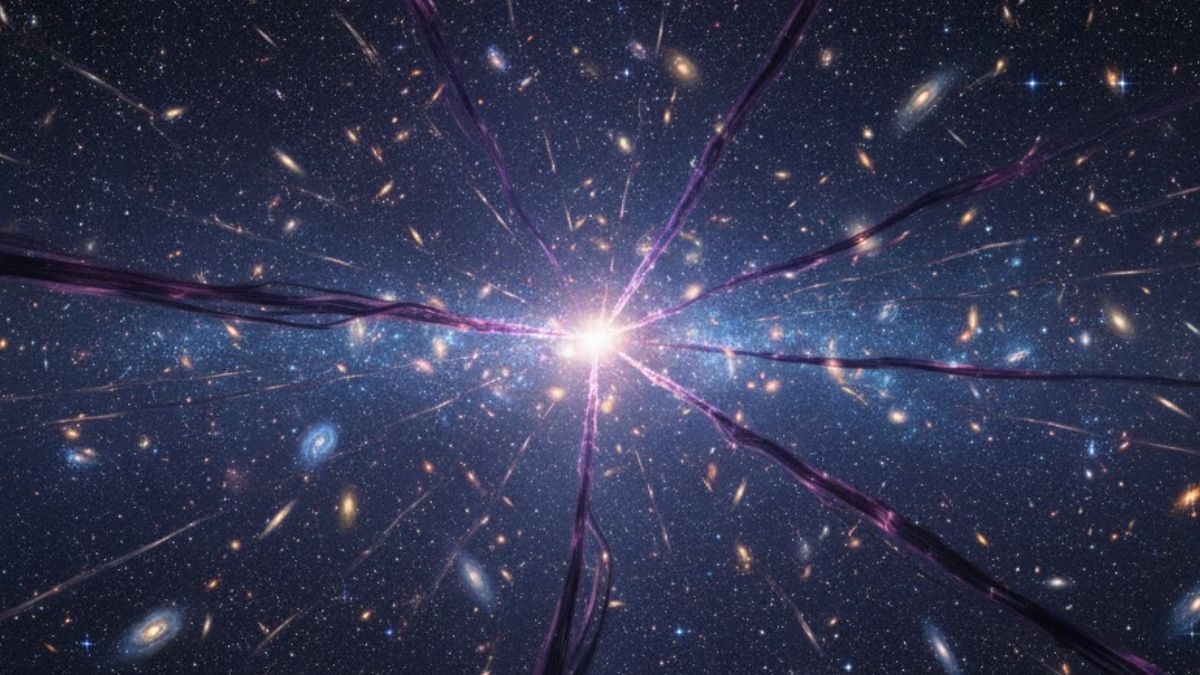
There’s a quiet revolution happening in the cosmos, one that we on Earth are almost entirely unaware of. It doesn’t make a sound or give off a flash. If you could somehow step outside our galaxy and watch the universe on fast-forward, you would witness something deeply strange. Every single galaxy, every cluster of stars, is rushing away from every other. And this isn’t just a gentle drift; it’s a runaway expansion that’s getting faster every single moment. It’s as if an unseen hand has given the entire universe a mighty push, and that push never stops.
For a long time, scientists thought the universe’s expansion was like a ball thrown into the air. They expected that the gravity of all the matter—the planets, stars, and galaxies—would eventually pull everything back together, slowing the expansion down. It was a logical, comforting idea. But in the late 1990s, two teams of astronomers made a discovery that turned this idea completely on its head. By looking at distant exploding stars, they found that the universe’s expansion isn’t slowing down at all. It’s speeding up. This was as shocking as throwing that ball into the air and watching it blast off into space faster and faster.
This discovery pointed to the existence of something mysterious and powerful, a force that works against gravity. Scientists called it “Dark Energy.” It’s the name we give to whatever it is that is causing the universe to fly apart at an ever-increasing rate. But what exactly is this mysterious energy? And how can something we can’t see or touch be the dominant force shaping the fate of everything we know?
If you were to ask a room full of cosmologists that question, the answer would almost certainly be Dark Energy. It makes up a staggering 68% of the universe, yet we know almost nothing about it. It’s the most profound puzzle in modern physics, a ghost in the cosmic machine that is driving the destiny of every galaxy, star, and planet. Understanding it means understanding the ultimate fate of the cosmos itself.
The story of dark energy begins not with its discovery, but with the groundbreaking realization that the universe is expanding at all. Back in the 1920s, an astronomer named Edwin Hubble was meticulously studying distant galaxies. He noticed something peculiar. The light coming from these galaxies was shifted toward the red end of the color spectrum.
You can think of this like the sound of a passing ambulance. As it moves away from you, the siren’s sound waves stretch out, making the pitch sound lower. This is called the Doppler Effect. The same thing happens with light. When a galaxy is moving away from us, its light waves stretch, making them appear redder. This is “redshift.” What Hubble found was astonishing: almost every galaxy he looked at showed this redshift. And the farther away a galaxy was, the greater its redshift. This could only mean one thing—the galaxies were all rushing away from us, and the most distant ones were moving the fastest.
This led to a monumental conclusion: the universe itself is expanding. It’s not that galaxies are flying through space away from a central point, like fragments from an explosion. Instead, the very fabric of space between the galaxies is stretching. Imagine drawing dots on a deflated balloon. As you blow up the balloon, every dot moves away from every other dot. There is no center; the entire surface just grows. This is exactly what is happening to our universe in three dimensions. This discovery set the stage for the Big Bang theory and completely changed our view of the cosmos. But everyone assumed that this expansion must be slowing down over time, thanks to the relentless pull of gravity.
For decades, the big question for astronomers was not if the expansion was slowing, but by how much. Would gravity eventually halt the expansion and pull everything back in a “Big Crunch,” or would the universe just keep expanding forever at a slower and slower pace? To find out, two independent teams set out in the 1990s to measure the slowing down. They used a special kind of exploding star, called a Type Ia supernova, as a “standard candle.”
A standard candle is an object whose true brightness we know. By comparing how bright it appears from Earth to how bright it actually is, we can calculate its distance very accurately. It’s like knowing the true wattage of a lightbulb. If you see a 100-watt bulb looking very dim, you know it must be far away. Type Ia supernovae are incredibly bright, so they can be seen from billions of light-years away. By looking at these supernovae in extremely distant galaxies, the astronomers were looking back in time, seeing the universe as it was billions of years ago.
The results, announced in 1998, were shocking. The distant, ancient supernovae were fainter than they should have been if the universe’s expansion had been slowing down. This meant they were farther away than expected. The only explanation was that the expansion of the universe was not slowing down; it was speeding up. Something was overpowering the force of gravity, pushing galaxies apart faster and faster. This was the moment the concept of dark energy was born. It was a complete surprise that earned the researchers the Nobel Prize in Physics and forced us to rewrite our understanding of the cosmos.
This is the million-dollar question, and the honest answer is we don’t know for sure. Dark energy is the name we’ve given to the “something” that is causing the accelerated expansion. It’s a placeholder for a profound mystery. We can see its effects clearly, but we have no idea what it is made of. It’s like knowing there’s a wind because you see the trees bending, but you can’t feel the wind yourself and have no idea where it’s coming from.
Scientists have a few leading ideas, but they are all deeply strange. The frontrunner idea involves a concept from the early days of Einstein’s theory of relativity. Einstein had introduced a “cosmological constant,” a sort of inherent energy woven into the very fabric of empty space itself. This energy of the vacuum would have a repulsive gravity, pushing space apart. He later called it his “biggest blunder,” but after the discovery of the accelerating universe, it made a huge comeback. If this is true, dark energy is a property of space itself. As more space comes into existence, more of this repulsive energy is created, leading to a never-ending, accelerating expansion.
Another idea is that dark energy is a new, dynamic kind of energy field that fills space, which scientists sometimes call “quintessence.” Unlike the cosmological constant, this field could change over time and vary in strength. Think of it like a new, unseen force that suddenly became dominant in the universe’s history. There are even more exotic theories that suggest our understanding of gravity itself is wrong on the largest scales. Maybe Einstein’s theory of General Relativity needs to be modified when dealing with the vast emptiness of intergalactic space. Each of these ideas is being actively investigated, but for now, dark energy remains one of the greatest unsolved problems in science.
To understand how dark energy works, we first need to think about how gravity works. Gravity is an attractive force. It pulls things together. The Earth’s gravity pulls you down, and the Sun’s gravity holds the planets in orbit. On a cosmic scale, gravity tries to pull all the galaxies together, acting like a brake on the expansion of the universe.
Dark energy does the opposite. It creates a kind of repulsive gravity, or a negative pressure. Imagine you are in a swimming pool. The water around you pushes in on you from all sides—that’s like normal gravity. Now, imagine if the water suddenly started pushing outward, forcing the pool to get bigger and bigger. That’s similar to what dark energy seems to be doing to the fabric of space.
The key to its power is its consistency. The amount of dark energy in a given volume of space is very, very small. But space is mostly empty. And as the universe expands, more space is created. With more space comes more dark energy. So, while the gravitational pull from matter gets weaker as things move farther apart, the push from dark energy actually gets stronger because there’s more of it. About five billion years ago, the universe had expanded enough that the cumulative push of dark energy overcame the pull of gravity, and the expansion started to accelerate. It has been speeding up ever since.
This is a very common point of confusion, and for good reason—they both have “dark” in their name, and we can’t see either of them! But they are two completely different things, playing entirely opposite roles in the cosmos.
Let’s break it down. Dark Matter is mysterious because we can’t see it, but we can feel its gravitational pull. We know it’s there because galaxies are spinning so fast that they should fly apart unless there is a huge amount of invisible matter holding them together with its gravity. Dark matter acts like a cosmic glue. It is attractive. It clumps together and helps form the structure of the universe, acting as a scaffolding for galaxies.
Dark Energy, on the other hand, is repulsive. It works on the vast, empty stretches of space between galaxies. It doesn’t clump or help form structure; it actually fights against the structure-building work of gravity by pushing everything apart. Think of it this way: Dark Matter is the invisible anchor that holds galaxies together, while Dark Energy is the invisible force that pushes the galaxies away from each other. One builds the cosmic cities, the other pushes the cities apart, making the distances between them unimaginably vast.
The existence of dark energy has completely reshaped our predictions for how the story of the universe will end. Before its discovery, the future was a race between expansion and gravity. Now, with dark energy in the driver’s seat, the most likely future is a cold, lonely, and ever-accelerating one.
This leading theory is called the “Heat Death” or the “Big Freeze.” In this scenario, the expansion of the universe continues to accelerate forever. Over trillions of years, all the stars will burn out. Galaxies will be pulled so far apart that the night sky from any surviving planet would be utterly black. Eventually, even the galaxies themselves will be torn apart, and then solar systems, and finally, the very atoms that make up all matter might be ripped apart in a “Big Rip” if the dark energy is strong enough. The universe would become a cold, dark, and incredibly vast emptiness, with every particle isolated from every other, unable to ever interact again.
It’s a bleak picture, but it’s not necessarily the only one. If dark energy is the “quintessence” field and it changes over time, the future could be different. Perhaps the acceleration could stop, or even reverse. The mystery of what dark energy is is directly tied to the mystery of our ultimate fate.
Dark energy is the ultimate cosmic riddle. It is the dominant component of our universe, yet it is completely invisible and undetectable by any direct means. We only know it exists because of the profound effect it has on everything we can see—it is stretching the very fabric of reality, deciding the final destiny of every galaxy and star. From the shocking discovery of the accelerating universe to the frantic search for an explanation, the story of dark energy reminds us that the cosmos is far stranger and more wonderful than we ever imagined. We are living in the early chapters of this discovery, a time of great mystery and great potential for a revolution in our understanding.
So the next time you look up at a clear, starry night, remember that what you see—the pinpricks of light, the vast darkness—is only a tiny fraction of the story. The real action is happening in the empty space between them, where an unseen force is silently, steadily, guiding the universe toward an unknown future.
What do you think—will we ever solve the mystery of what dark energy truly is?
1. Can we see or detect dark energy directly?
No, we cannot see or detect dark energy directly with any of our current instruments. We only know it exists because we can observe its dramatic effect on the expansion of the entire universe over vast distances.
2. Does dark energy affect our solar system?
No, dark energy does not have any noticeable effect on our solar system or even our galaxy. Its repulsive force is incredibly weak on small scales and is only noticeable over the immense, cosmic distances between galaxies.
3. How much of the universe is made of dark energy?
Astronomers calculate that dark energy makes up about 68% of the total mass-energy content of the universe. Normal matter—the stuff that makes up planets, stars, and us—makes up less than 5%.
4. What is the cosmological constant?
The cosmological constant was a term Albert Einstein added to his equations to describe a repulsive energy inherent to empty space. It’s the leading explanation for dark energy, suggesting it is a fundamental property of the vacuum of space itself.
5. Could dark energy be a fifth fundamental force?
It’s a possibility that scientists are exploring. Dark energy could represent a new, fifth fundamental force in nature that only becomes significant over the largest possible scales, acting in opposition to gravity.
6. Will dark energy eventually destroy the universe?
It likely won’t “destroy” the universe in an explosive sense, but it could lead to a “Heat Death” or “Big Freeze,” where the universe becomes cold, dark, and empty. A more extreme version called the “Big Rip” could tear apart all structures, including atoms, if dark energy’s strength increases.
7. How do we know dark energy is real if we can’t see it?
We know it is real through its observable effects, primarily the measured acceleration of the universe’s expansion using distant supernovae and other probes like the cosmic microwave background radiation.
8. When was dark energy discovered?
The term was coined after 1998, when two independent teams of astronomers announced their findings that the universe’s expansion was accelerating, based on observations of Type Ia supernovae.
9. Does dark energy have anything to do with black holes?
While both are mysterious cosmic phenomena, there is no confirmed direct connection between dark energy and black holes. Black holes are regions of extremely strong gravity, while dark energy is a repulsive force that dominates the empty stretches of space.
10. Could our understanding of dark energy be wrong?
Absolutely. The nature of dark energy is the biggest open question in cosmology. Our current models fit the data, but it’s possible that a completely new theory of gravity or physics is needed to truly explain what we are observing.