
 By SAJID ali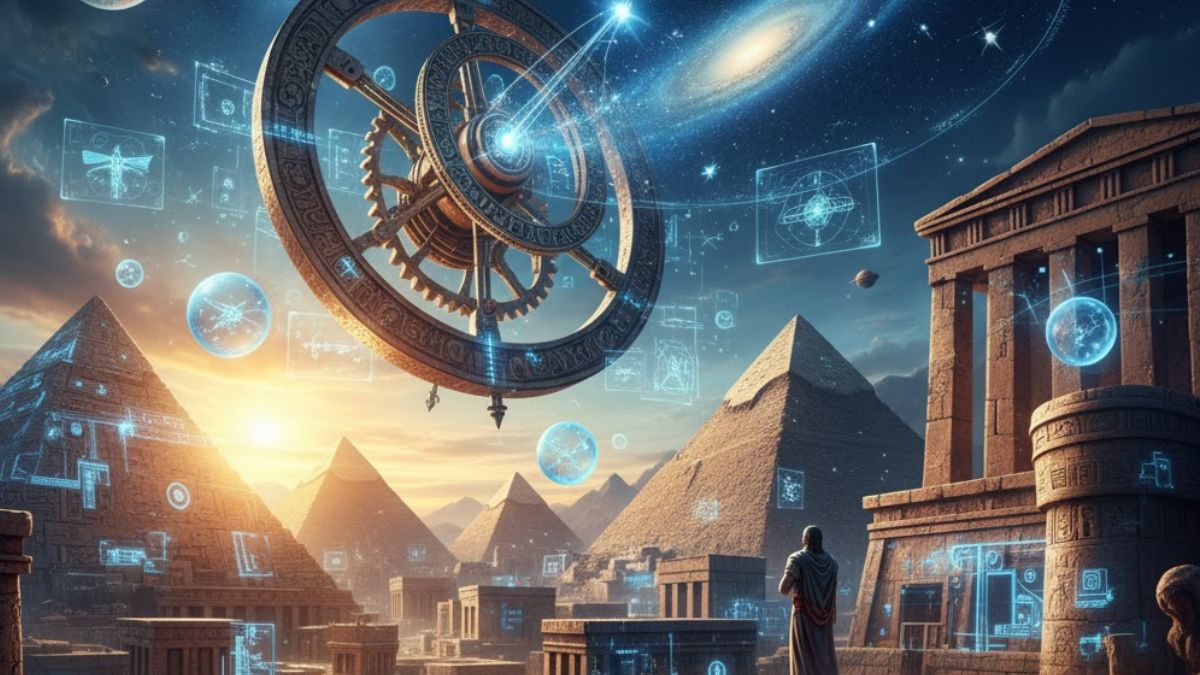
There’s a quiet mystery that hangs in the air when you stand before the Great Pyramid of Giza. It’s so massive, so perfectly aligned, that it’s hard to believe human hands built it thousands of years ago with only simple tools. Or consider an ancient map from the 1500s that shows the coast of Antarctica… a continent that wouldn’t be officially discovered for another 300 years. How is that possible?
We often picture our ancestors as people who were just starting to figure things out. We imagine them with basic technology, struggling to survive. But then we find artifacts, buildings, and texts that simply don’t fit that story. They point to a level of understanding that seems to appear out of nowhere, leaving us with a puzzling question that tickles the back of our minds.
This article isn’t about proving aliens or lost super-civilizations. It’s about exploring the genuine, head-scratching achievements of ancient people. From astronomy to engineering, there are things they knew that we would only rediscover centuries later. So, what exactly did these ancient civilizations know, and how did that knowledge get lost for so long?
Look at the pyramids of Egypt. They are not just piles of stone. The Great Pyramid was originally covered in highly polished white limestone, acting as a giant mirror that could be seen for miles. Its four sides are aligned almost perfectly with the four cardinal directions—north, south, east, and west. The accuracy is astonishing. With no modern compasses or satellites, how did they achieve such precision?
It’s not just Egypt. In South America, the Inca built walls from giant, irregularly shaped stones. These stones were cut so precisely that you cannot fit a single piece of paper between them. They fit together like a complex jigsaw puzzle, without any mortar, and have withstood countless earthquakes. Modern engineers struggle to understand the technique. The common explanation is that it was done with endless patience, stone hammers, and sand. But the scale and perfection make you wonder if there was more to it. Did they possess a forgotten method for softening or shaping stone? We may never know the full answer, but the evidence of their advanced skill is right there in front of us.
Long before the telescope was invented, ancient people were mapping the stars with incredible accuracy. The Babylonians, over 3,000 years ago, could predict the movements of planets and even forecast eclipses. They kept detailed records on clay tablets, tracking the sky night after night, generation after generation.
Then there are the Maya in Central America. They developed a calendar so complex and precise that it puts our modern calendar to shame in some ways. They calculated the length of a year to be 365.2420 days. Our current, technology-assisted calculation is 365.2422 days. The difference is tiny. They also tracked the orbit of Venus with remarkable precision. How did they do this without optical instruments? It seems their knowledge came from pure, dedicated observation. They built their entire society and religion around the cycles of the cosmos, and in doing so, they unlocked secrets of time that we assume only modern science could reveal.
The story of the Baghdad Battery is a fascinating one. Found in Iraq and dating back 2,000 years, it is a simple clay jar with a copper cylinder and an iron rod inside. If you filled it with an acidic liquid like vinegar, it would produce an electric charge. Was this an ancient battery? Many experiments have shown that it could have been used for electroplating, like putting a thin layer of gold onto silver. If so, it means the concept of electricity was being played with long before Benjamin Franklin and his kite.
Another puzzle comes from ancient India. Texts called the Vedas describe flying machines called Vimanas in great detail. They talk about their construction, how they took off, and how they flew. Mainstream history tells us the first powered flight was in 1903. But these ancient descriptions make you stop and think. Were these just imaginative stories, or were they recording a technology that was real for them but was later lost? It’s a compelling mystery that suggests our timeline of technological progress might not be as straightforward as we think.
When we think of ancient surgery, we often picture crude and painful procedures. But evidence tells a different story. Archaeologists have found skulls from ancient Peru that show clear signs of successful trepanation—a procedure where a hole is drilled into the human skull. What’s amazing is that the bone shows signs of healing, meaning the person lived for a long time after this incredibly delicate operation. They had to have knowledge of anatomy, hygiene, and surgical technique to pull this off.
Similarly, ancient texts from India describe complex procedures like cataract surgery and even plastic surgery. The Sushruta Samhita, written thousands of years ago, details over 1,000 illnesses and 700 medicinal plants. It describes how to perform surgery on the human eye, how to stitch wounds, and how to reconstruct damaged noses. This was knowledge born from centuries of practice and observation, a medical science that was, in many ways, far ahead of its time.
One of the most intriguing theories is that of a shared, global knowledge. How is it that cultures across the world, who supposedly never made contact, built using the same complex mathematical principles? The Pythagorean theorem, for instance, is named after the Greek philosopher Pythagoras. But there is evidence that the ancient Babylonians used the same principle over a thousand years before he was born.
The idea of the “Golden Ratio,” a special number approximately equal to 1.618, appears in the design of the Parthenon in Greece, the Great Pyramid in Egypt, and in the art of the Renaissance. It’s a pattern that is also found throughout nature, in the spiral of a seashell or the arrangement of seeds in a sunflower. Did these different cultures all independently discover this “perfect” proportion? Or does it point to a much older, shared source of knowledge that traveled across the world in the distant past? It’s a question that challenges our understanding of how ideas spread.
So, if these civilizations were so advanced, what happened? Why did we have to “rediscover” things like concrete, astronomy, and medicine centuries later? The answer often lies in the fragility of civilization itself. Great libraries, like the Library of Alexandria, were burned, destroying countless scrolls and books of ancient wisdom. Empires fell to war and invasion, and with them, their specialized knowledge died.
Languages were forgotten, and scribes who could read ancient texts passed away without teaching others. Knowledge was often kept secret, shared only among priests or elite scholars, making it vulnerable to being lost. It’s a humbling thought that our own modern world, with all its digital storage, is not immune to this. A major catastrophe could easily wipe out our collective knowledge, leaving future generations to puzzle over the ruins of our skyscrapers, just as we puzzle over the pyramids.
The achievements of ancient civilizations are a powerful reminder that human intelligence and curiosity are not new. They had a deep understanding of their world, achieved through patient observation and brilliant innovation that we are still trying to fully comprehend. They may not have had our technology, but they possessed a wisdom that was, in many ways, beyond their time.
Perhaps the real mystery is not how they did it, but why we are so quick to underestimate the power of the human mind, no matter what era it exists in. What other secrets from our past are still waiting to be understood?
1. What is the most mysterious ancient civilization?
Many find the Maya or the ancient Egyptians to be the most mysterious due to their advanced knowledge of astronomy and their massive, precise monuments. However, the Indus Valley Civilization is also a great mystery because we still cannot translate their written language.
2. Did ancient civilizations have electricity?
The discovery of artifacts like the Baghdad Battery suggests that some ancient cultures may have understood the basic principles of generating an electric current, though it was likely used for small-scale purposes like electroplating and not for powering cities.
3. How did the Egyptians build the pyramids?
The most accepted theory is that they used massive ramps, sleds, and thousands of skilled workers to move the stones. However, the incredible precision and alignment of the pyramids continue to spark debates about whether they had more advanced, lost techniques.
4. What is the oldest known civilization?
Mesopotamia, located in modern-day Iraq, is often called the “cradle of civilization.” The Sumerians who lived there are credited with inventing one of the first writing systems (cuneiform) and establishing some of the first cities around 4000 BCE.
5. How did ancient people know about planets?
They knew about planets through careful, long-term observation of the night sky. They tracked the “wandering stars” (planets) and recorded their movements, noticing their unique paths and cycles over many years.
6. Is there any evidence of lost ancient technology?
While there is no definitive proof of futuristic technology, there are “out-of-place artifacts” (OOPArts) like the Antikythera mechanism, a complex ancient Greek analog computer, that show a level of technological sophistication we didn’t attribute to that era.
7. What is the Antikythera mechanism?
It is an ancient Greek hand-powered device, often called the world’s first analog computer. It was used to predict astronomical positions and eclipses decades in advance, demonstrating a highly advanced knowledge of gears and astronomy.
8. Why is the alignment of ancient monuments so important?
Many ancient temples and pyramids are aligned with stars, solstices, or cardinal points. This shows that astronomy was a central part of their culture and religion, and it proves they had a sophisticated understanding of the Earth’s place in the cosmos.
9. Did ancient civilizations have advanced mathematics?
Yes, civilizations like the Babylonians, Egyptians, and Maya had advanced mathematical systems. They used geometry to build their structures and complex arithmetic to track time and celestial events, often developing these concepts independently.
10. How was so much ancient knowledge lost?
Knowledge was lost through the destruction of libraries (like the Library of Alexandria), the fall of empires, the death of scholars without passing on their knowledge, and the simple fact that many records were written on perishable materials like papyrus or bark.