
 By SAJID ali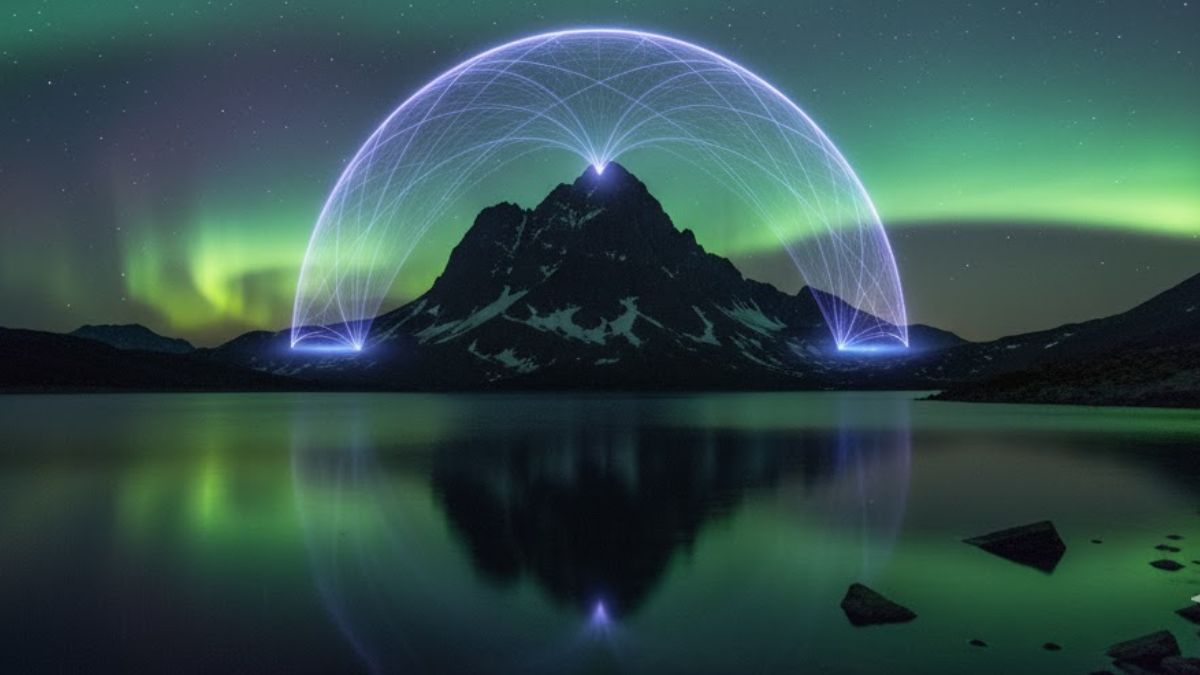
There’s a quiet hill in Poland that has puzzled visitors for generations. On this hill, parked cars seem to roll uphill as if pulled by an invisible force. Bicyclists feel a strange tug, and water appears to flow against gravity. It’s not a magic trick or an optical illusion—it’s a real, measurable phenomenon linked to something we can’t see: a strange magnetic field.
We often think of Earth’s magnetic field as a steady, invisible blanket that protects us and guides compass needles north. But in certain special spots around the world, that blanket gets twisted and warped. Mountains stand tall and silent, lakes lie deep and still, yet beneath their surface, something unusual is happening to the forces that normally hold steady. These places don’t follow the rules, and because of that, they’ve become centers of mystery, scientific study, and even local legend.
What could possibly cause a mountain or a lake to bend the very magnetic fabric of our planet? Is it something hidden deep below, or is it a trick of the landscape itself? The answers take us on a journey deep into the Earth’s past and into the surprising secrets of the rocks beneath our feet.
To understand why some places are strange, we first need to understand what “normal” is. Let’s try a simple experiment. If you have a simple compass, you’ll see the needle always points north. It’s not magic; it’s responding to the Earth’s magnetic field. Think of this field as a giant, invisible set of lines that loop from the North Pole to the South Pole, like the pattern you see when you sprinkle iron filings around a bar magnet.
Our entire planet acts like that big bar magnet. Deep down in the Earth’s core, there’s a spinning ball of molten iron. This movement creates a powerful magnetic field that surrounds the globe. This field is why compasses work for navigation and why we are shielded from harmful radiation from the sun. It’s a constant, reliable force—except in those special places where it isn’t.
In these unique locations, the magnetic field becomes stronger, weaker, or points in the wrong direction. A compass might spin in circles instead of pointing north. Scientists measure these fields with sensitive devices called magnetometers, which can detect these tiny, local changes. So, when we talk about a “strange” magnetic field, we mean a small, localized area where the planet’s predictable magnetic influence gets disrupted.
The most common culprit for these strange magnetic fields is, quite simply, the rock itself. Not all rock is the same. Some types of rock are rich in magnetic minerals like magnetite. Magnetite is a natural magnetic material—it’s sometimes called lodestone. If you’ve ever held a magnet that picked up a piece of black sand, you were probably looking at magnetite.
Now, imagine an entire mountain made from, or containing vast deposits of, this magnetic rock. A great example is the Mystery Spot in Santa Cruz, California. The area is known for its confusing gravitational and magnetic effects, largely due to the high concentration of magnetite in the local rock formations. This magnetic mountain acts like a local magnet, pulling the Earth’s magnetic field lines towards it and creating a disturbance that we can measure and even feel.
But it’s not just about what’s on the surface. Sometimes, the history of the rock is what matters. Millions of years ago, when volcanic lava was cooling, the iron-rich minerals within it aligned themselves with the Earth’s magnetic field at that time, like tiny frozen compass needles. If the rock has since shifted or rotated, those frozen magnets are now pointing in a different direction than the current global field. This creates a conflict, a small pocket of magnetic force that is out of sync with the rest of the planet, leading to compass errors and strange readings.
Mountains made of magnetic rock seem somewhat logical, but what about lakes? Water is not magnetic, so how can a body of water have a strange magnetic field? The secret isn’t in the water, but in what lies far beneath the lakebed.
There are places, like the East African Rift Valley, where the Earth’s crust is being pulled apart. This thinning of the crust allows magma from deep within the Earth to rise much closer to the surface. This magma is rich in iron and other magnetic materials. A lake sitting on top of such a geologically active area is like a blanket covering a powerful magnet. The magnetic field from the hot, magnetic rock below distorts the local field, making the lake itself a source of magnetic mystery.
In other cases, lakes form in areas that were once sites of massive meteorite impacts. The immense heat and pressure of such an impact can create new, magnetic minerals from the shattered rock, or concentrate existing ones. The lake is just the peaceful surface hiding a violent, magnetic past deep below its muddy floor.
Sometimes, the strangeness isn’t from a mountain or a lake, but from an empty space underground. Lava tunnels are long, cave-like tubes formed when the outer surface of a lava flow cools and hardens, while the hot lava inside continues to flow, eventually draining away. These tunnels can be massive, big enough to walk through.
These hollow spaces are often lined with volcanic rock that contains magnetic minerals. Because the tunnel is a void, the magnetic field can behave in unusual ways around its shape. It can create a magnetic signature that is different from the solid ground around it. Explorers using compasses might find their needles behaving erratically when they walk over these hidden caverns, not knowing there’s a empty, magnetic tube beneath their feet.
Similarly, large deposits of metal ores buried deep underground, like an iron ore deposit that was never mined, can act as a huge, hidden magnet. They pull the Earth’s magnetic field toward them, creating a local bulge or dip in the field that scientists can map from the surface, often leading to the discovery of these hidden resources.
You might wonder how we know about these invisible anomalies. Scientists don’t just stumble upon them by chance anymore; they go looking. They use a tool called a magnetometer, which is a very sensitive electronic compass that can detect tiny changes in the strength of the magnetic field.
These devices can be carried by hand for small surveys, towed behind boats to map magnetic fields under the ocean, or even flown in airplanes to scan large areas of land quickly. The airplane method, called an aeromagnetic survey, is like giving the land an MRI scan. The plane flies back and forth in a grid pattern, and the magnetometer records the magnetic strength below. When the data is mapped, scientists can see bright spots and patches where the magnetic field is stronger or weaker, revealing the hidden magnetic geology of the landscape.
This is how we find underwater mountains (seamounts) in the ocean and locate mineral deposits. It’s a powerful reminder that even the things we cannot see directly leave a fingerprint that we can learn to read.
This is a very common and sensible question. The simple answer is no, these natural magnetic fields are not dangerous to human health. The changes in the magnetic field, while measurable with sensitive instruments, are still incredibly weak compared to the magnets we use in everyday life, like the one on your refrigerator door.
The field from a magnetic mountain is far, far weaker than the magnetic field you are exposed to during an MRI scan at a hospital. The “danger” is not to your body, but to your navigation! The main effect you might experience is a compass that doesn’t work properly, which could be a problem for a hiker relying on one in a remote area. Other than that, these places are perfectly safe to visit and explore. The feeling of weirdness is often more about visual illusions and the power of suggestion than any physical effect on your body.
You might think that studying a small magnetic hill is just a fun scientific curiosity, but it actually has very serious and practical applications. The magnetic map of a region is a crucial piece of information. Pilots use detailed magnetic maps for navigation. Before we had GPS, this was even more critical, as an uncharted magnetic anomaly could send an aircraft off course.
Furthermore, these magnetic signatures are a direct window into what lies beneath the ground. Geologists use these maps to find valuable resources like groundwater, oil, and minerals. By understanding the magnetic fingerprint of different rocks, they can pinpoint the best places to drill or mine without having to dig up the entire landscape. So, the strange pull of a magnetic hill is not just a mystery; it’s a clue that helps us understand and responsibly use the planet we live on.
Our planet is far from a uniform ball of rock. It’s a dynamic, layered, and sometimes messy place with a long and complex history. The strange magnetic fields around certain mountains and lakes are like whispers from that history. They tell stories of ancient volcanoes, colossal meteorite impacts, and vast deposits of magnetic rock hidden from view. They remind us that there is still much to discover about the world beneath our feet, and that even the forces we think of as constant can have local surprises.
The next time you hear about a place where water flows uphill or a compass spins wildly, you’ll know that it’s not magic—it’s geology. It’s the Earth showing one of its many hidden and fascinating dimensions. Isn’t it amazing how a simple compass can point not just north, but also downward, toward the secrets buried deep below?
1. What is the most famous place with a strange magnetic field?
One of the most famous is the Oregon Vortes in the United States, where balls roll uphill and people appear to change height depending on where they stand. Another is the Magnetic Hill in Ladakh, India, where cars seem to roll uphill due to a powerful magnetic anomaly.
2. Can a strong magnetic field affect the human body?
The natural magnetic fields found at these locations are far too weak to have any known effect on the human body. They are much weaker than the fields generated by common household appliances like hairdryers or microwaves.
3. How does the Earth’s main magnetic field protect us?
The Earth’s magnetic field acts like a shield, deflecting most of the charged particles constantly streaming from the sun, known as the solar wind. Without this shield, this radiation would strip away our atmosphere and make life on Earth very difficult.
4. Are there magnetic fields on other planets?
Yes, other planets have magnetic fields too. Jupiter has a tremendously powerful magnetic field, while Mars has a very weak and patchy one. The strength of a planet’s magnetic field depends on whether it has a molten, spinning metal core.
5. Can animals detect magnetic fields?
Yes, many animals use the Earth’s magnetic field for navigation. Birds, sea turtles, bats, and even some bacteria have a built-in “magnetic sense” that helps them migrate across vast distances with incredible accuracy.
6. What is the difference between gravity and magnetism?
Gravity is a force that pulls objects with mass toward each other, like the Earth pulling you down. Magnetism is a force that acts on certain materials, like iron, and can either pull them (attract) or push them (repel) without needing physical contact.
7. Can a magnetic field be created by water?
No, water itself is not magnetic and does not create a magnetic field. However, a lake can be located above geological features, like magnetic rock formations or lava flows, that are the true source of the strange magnetic field.
8. Why does my compass point north?
Your compass needle is a small magnet. It aligns itself with the Earth’s magnetic field, which has a north and south magnetic pole. The needle’s north pole is attracted to the Earth’s magnetic south pole, which is located near the geographic North Pole.
9. Has the Earth’s magnetic field always been the same?
No, the Earth’s magnetic field has flipped many times in history, meaning the North and South magnetic poles have swapped places. These reversals are recorded in magnetic rocks on the ocean floor.
10. Can I detect a magnetic anomaly myself?
Yes, with a simple compass! If you are in a known area for magnetic anomalies, you can watch your compass needle. If it doesn’t point steadily north or if it wobbles and points in a different direction when you move a few steps, you might be standing on a local magnetic disturbance.