
 By SAJID ali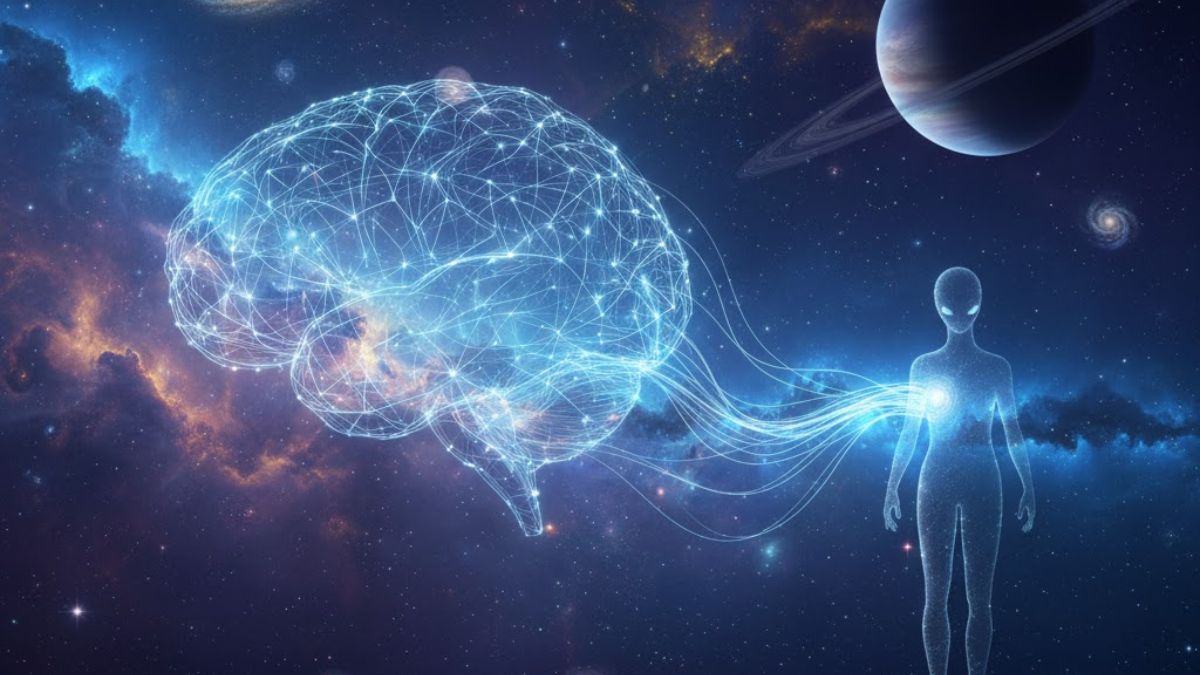
You’re reading these words right now. But have you stopped to think about the you that is doing the reading? There’s a silent, invisible experience happening inside your head. You are aware of the screen’s glow, the weight of your device in your hands, and the meaning you’re pulling from these squiggles of text. This simple, everyday miracle of being aware—of having an inner world—is what we call consciousness. It’s the most familiar thing in the world to each of us, and yet, for scientists and philosophers, it remains the deepest and most stubborn mystery.
Think about a computer. It can process information, solve complex math problems, and even beat a grandmaster at chess. But as far as we know, that computer doesn’t feel anything. It doesn’t get frustrated when it loses or feel a spark of joy when it wins. It just runs its program. Your brain, a three-pound lump of tissue inside your skull, is also running a biological program of incredible complexity. But unlike the computer, there is a “light on” inside. There is an experience. How does a lump of matter give rise to this rich, private movie of thoughts, feelings, and sensations that is your life?
This article is a journey into that profound puzzle. We won’t be using complicated scientific jargon. Instead, we’ll explore the simple, mind-bending questions that everyone from neuroscientists to philosophers is still trying to answer. How can something as non-physical as a feeling arise from physical stuff? Why are you you? If we can map the human brain, why can’t we find the seat of consciousness? The mystery is so deep that it might just be the final frontier of science, not in outer space, but within our own minds.
So, what is it about this inner feeling of “being” that makes it so impossible for science to explain?
When we talk about consciousness, we’re not really talking about being smart or being awake. A person in a deep, dreamless sleep is unconscious. A person who is awake and alert is conscious. But the real magic is in the content of that consciousness. It’s the taste of chocolate, the sting of a paper cut, the deep blue of a summer sky, the memory of your first day at school, and the feeling of love for someone.
A good way to think about it is to imagine the difference between a robot and a human. A advanced robot with a camera for eyes could scan a red rose and identify it. It could say, “This is a rose. It is red.” It could even water it if its programming instructed it to. But does the robot experience the redness of the rose? Does it feel any sense of beauty or smell its fragrance? Almost certainly not. It processes data. You, on the other hand, have a direct, personal experience of that rose. That experience is consciousness.
It’s the difference between having information and having a feeling. Your brain receives signals from your eyes about light wavelengths, but you see the color red. Your skin sends nerve signals about damage, but you feel pain. Consciousness is the mysterious translator that turns cold, physical data into the warm, vivid reality of our lives. It’s the “something it is like” to be you. There is something it is like to be a bat, using echolocation to navigate the world, even if we can’t imagine it. But there is arguably nothing “it is like” to be a toaster. This quality of inner experience is the heart of the mystery.
It seems like a simple question with an obvious answer. Of course consciousness is in the brain! When you get hit on the head, you might see stars or lose consciousness. When you drink alcohol, it changes your brain chemistry and alters your thoughts and feelings. We can see specific parts of the brain light up on a scanner when a person looks at a picture or listens to music. The connection between the brain and the mind seems undeniable.
But here’s where it gets tricky. Just because two things are connected doesn’t mean one is the other. Think about your television. The picture on the screen is completely dependent on the electronics inside the TV. If you remove a specific wire, the picture might turn green or disappear entirely. You could even map which part of the circuitry controls the color red. But you would never say the picture of a news anchor is inside the wires and transistors. The picture is what the TV produces.
Some scientists and philosophers argue that the brain is like that television. It’s the machinery that produces consciousness, but consciousness itself might be something more, a kind of emergent property. The real puzzle is how and why this happens. How do tiny electrical signals jumping between neurons—which are just cells, like the cells in your liver—create the entire universe of your subjective reality? We can describe the brain’s hardware perfectly, but we still can’t explain the software of feeling and awareness. This gap between the physical brain and the mental experience is often called the “explanatory gap,” and it’s a gap that no one has yet managed to bridge.
We live in an age of artificial intelligence. Computers can now write poems, create art, and hold conversations that feel eerily human. It’s natural to wonder if, with enough complexity, a computer could become conscious. Could it have its own inner life? This question forces us to think about what consciousness really requires.
A computer, at its core, is a machine that manipulates symbols based on rules. It takes in ones and zeros, follows its programming, and puts out different ones and zeros. It’s a system of incredible complexity, but it’s all about information processing. The human brain also processes information, but it seems to do something extra. It doesn’t just process information about the color red; it generates the sensation of redness. It doesn’t just calculate that a situation is dangerous; it creates the feeling of fear.
This is known as the “hard problem” of consciousness, a term made famous by philosopher David Chalmers. The “easy problems” are about how the brain functions—how we focus our attention, how we integrate information, how we report our mental states. These are challenging, but scientists are making progress on them. The “hard problem” is the question of why and how any of this physical processing is accompanied by a subjective experience. A super-advanced computer might solve all the easy problems. It could act exactly like a conscious being. But would there be anyone home inside? Would it feel like anything to be that computer? We have no idea how to even begin answering that, and simply making a computer more complex doesn’t seem to solve the fundamental issue.
Our consciousness is built from our senses. It’s a stream of sights, sounds, smells, tastes, and touches. It feels like our consciousness is a direct window to the outside world, but it’s not. It’s a carefully constructed simulation.
Your brain is locked in a dark, silent box—your skull. It has no direct access to the world. All it gets are electrical signals sent along your nerves. Your eyes don’t send pictures to your brain; they send coded messages about edges, contrasts, and colors. Your brain then uses this information to build its own version of the world. The rich, three-dimensional, colorful world you perceive is a masterpiece of construction happening entirely inside your head.
This means that the “red” you see when you look at an apple is not a property of the apple itself. The apple simply reflects certain wavelengths of light. The experience of “redness” is a quality that your brain generates to represent that wavelength. The same goes for sound. Air vibrations hit your eardrum, are turned into signals, and your brain creates the experience of a melody or a voice.
So, consciousness is not a passive reception of the world. It’s an active creation. Your brain is taking ambiguous data and making a best guess, a simulation so good that you never even notice it’s there. This raises a strange thought: we are all living inside a virtual reality model created by our brains, and consciousness is the engine that makes that model feel real.
Look into the eyes of a dog. When it wags its tail with joy or whimpers in fear, it’s very hard to believe that it doesn’t have some kind of inner life. Most of us feel sure that mammals like dogs, dolphins, and chimpanzees are conscious. They seem to feel pain, pleasure, and emotions. But what about a fish? A bee? A worm?
This is a fiercely debated question. Scientists often use behavior as a clue. If an animal shows complex behaviors, learns from experience, and seems to have emotions, we are more likely to grant that it is conscious. But we can never truly know. This is called the “problem of other minds.” You can only be certain of your own consciousness. You assume other people are conscious because they are like you, but for animals, the further they are from us biologically, the harder it is to be sure.
Some researchers believe consciousness is widespread in the animal kingdom. They point to octopuses, which can solve complex puzzles and have distinct personalities, or bees, which can communicate through a “waggle dance.” Others are more cautious, suggesting that much of this behavior could be complex pre-programming, like a biological robot. The question of animal consciousness forces us to think about what the minimum requirements for consciousness are. Does it require a large brain like ours? Or could a much simpler nervous system still have a faint glimmer of an inner world? We simply don’t know.
Every night, you lose consciousness. When you fall into a deep, dreamless sleep, the inner movie of your mind stops playing. Then, during REM sleep, it starts up again, but in a bizarre, illogical, and often emotional way—we call this dreaming. The states of sleep and dreaming give us fascinating clues about consciousness.
When you are in a deep sleep, your brain is still active. It’s doing housekeeping—sorting memories, repairing the body—but it’s not generating a conscious model of the world that you can interact with. The “theater” of your mind is dark. During dreaming, the theater is open, but the show is strange. The part of your brain that handles logic and self-awareness is dialed down, while the emotional and visual centers are lit up. Your brain is still trying to create a world, but it’s using internal memories and signals instead of fresh data from your senses.
This shows that consciousness isn’t an all-or-nothing state. It’s a spectrum. There’s the bright, focused consciousness of solving a math problem, the drifting consciousness of daydreaming, the bizarre consciousness of a dream, and the total absence of consciousness in deep sleep. Studying these different states helps scientists see which parts of the brain need to be active and connected for our normal waking consciousness to exist. Yet, even when we map these networks, the core question remains: why does this specific pattern of brain activity come with a show playing on the inside?
This might sound like a question from science fiction, but some serious scientists and philosophers are considering it. The idea is called panpsychism. “Pan” means all, and “psyche” means mind. So, panpsychism is the view that consciousness is a fundamental property of the universe, like mass or electrical charge.
According to this view, consciousness didn’t suddenly emerge when brains became complex enough. Instead, it was always there, in some very simple form, in everything. Maybe an electron has a tiny, simple spark of experience. Of course, it wouldn’t be thinking thoughts. It would be the most basic form of feeling imaginable. When these simple particles come together in incredibly complex systems like a human brain, these tiny sparks combine to create the rich, flowing stream of consciousness we enjoy.
Why would anyone think this? Because the emergence of consciousness from entirely non-conscious matter seems so difficult to explain. If consciousness is fundamental, then the mystery is not how it was created, but how it combines and complexifies. It’s a radical idea, and most scientists are skeptical because it’s very hard to test. But it shows just how deep the mystery of consciousness is—it’s so baffling that some are willing to consider that the very fabric of reality might be tinged with a form of awareness.
The mystery of human consciousness is a humbling reminder that the most familiar part of our existence is also the most unknown. We have sent probes to the edge of the solar system and peered back to the dawn of time, but we still cannot explain how a three-pound organ inside our heads creates the experience of being us. It is the silent, invisible center of our lives, the one thing we cannot doubt, and the one thing that science cannot fully grasp.
We’ve explored how it’s more than just intelligence, how it might be a product of the brain but not the same as the brain, and why the simplest feeling poses a “hard problem” that no computer seems able to solve. We live inside a reality constructed by our minds, and we share this planet with other creatures whose inner worlds we can only guess at. From the depths of dreamless sleep to the wild visions of our dreams, consciousness flickers and changes, yet its essential nature stays hidden.
Perhaps one day, a brilliant scientist will have a breakthrough and the puzzle will be solved. Or perhaps consciousness, by its very nature, can never be fully explained by the physical tools of science. Maybe the viewer can never fully see itself. What do you think—is consciousness the final frontier that science will conquer, or is it a mystery that will forever remain just beyond our grasp?
1. What is consciousness in simple terms?
Consciousness is your individual experience of being aware. It’s the “inner movie” of your life, including everything you see, hear, feel, think, and remember. It’s not just being awake; it’s the personal sensation of what it’s like to be you.
2. Can science explain consciousness?
Science can explain many functions related to consciousness, like which brain areas are active when we see or feel something. However, science has not yet explained the “hard problem”—why and how these physical processes in the brain create subjective, personal feelings and experiences.
3. Are animals conscious like humans?
While we can’t be certain, most scientists believe that many animals, especially mammals and birds, have some level of consciousness. They show behaviors that suggest they feel pain, pleasure, and emotions, even if their inner world is different from our own.
4. Can a robot ever become conscious?
Based on our current understanding, it’s unclear. A robot could be programmed to act exactly like a conscious being, but we have no idea how to create or even detect a genuine inner experience in a machine made of silicon and code.
5. What is the difference between the brain and the mind?
The brain is the physical, three-pound organ in your head, made of cells and neurons. The mind refers to the thoughts, feelings, consciousness, and memories that are produced by the brain’s activity. The brain is the hardware; the mind is the software and the experience.
6. Do babies have consciousness?
Yes, but it develops over time. A newborn has very basic sensations, but as their brain grows and connects, their conscious experience becomes richer and more complex, including a sense of self and memory.
7. What happens to consciousness when we die?
This is one of the biggest unanswered questions. From a scientific perspective, when brain activity ceases, consciousness appears to end, as it is intimately tied to the brain’s function. This is a topic that also intersects with spiritual and philosophical beliefs.
8. Why is consciousness considered a mystery?
It’s a mystery because it is a subjective experience that arises from objective, physical matter. We can study the brain completely, but we still can’t explain how that study translates into the feeling of love, the color blue, or the taste of sugar.
9. What are dreams, and are we conscious when we dream?
Dreams are a unique form of consciousness. During dreaming, your brain is active and creating a world of experience, but it’s disconnected from most sensory input and has reduced logical reasoning. So, you are conscious, but in a different, often distorted, way.
10. Is our consciousness unique in the universe?
We don’t know. Given the vast number of planets in the universe, it’s possible that other conscious beings exist. However, since we don’t fully understand how consciousness arises on Earth, we can only speculate about its existence elsewhere.